NOTE: The Grooming Journal does not recommend products simply for the sake of recommending them. We create buying guides to help you understand your options and make a more informed decision based on your specific grooming concern, needs, and preferences.The products we feature are not sponsored placements.
We select and assess products based on relevant product information, such as ingredients, formulation, materials, specifications, stated purpose, and how well they fit the specific concern or need discussed in the guide.We do not physically purchase or test the products featured in our guides. Our assessments are based on publicly available product information, manufacturer details, ingredients or materials, specifications, and other relevant evidence.
Some links in our articles may be affiliate links, which means TGJ may earn a commission if you make a purchase through them. This does not influence which products we include or how we assess them.
If we ever feature a sponsored product or sponsored placement, it will be clearly identified as sponsored. Sponsored content will not be presented as an independent, non-sponsored recommendation.Our goal is simple: we don’t tell you what to buy. We help you understand what you’re buying.
Quick Summary
The best shampoo for hair fall depends on what is actually causing the problem. A shampoo can help keep the scalp clean, reduce buildup and improve the condition of fragile hair, but it cannot replace treatment for male-pattern hair loss. Choose based on your scalp and hair condition rather than the words “anti-hair-fall” on the bottle. If shedding is persistent, rapidly increasing or accompanied by visible thinning, the cause should be assessed by a dermatologist.
There is no single shampoo that is best for every man experiencing hair fall.
Hair shedding can happen for different reasons, including male-pattern hair loss, temporary shedding after illness or major stress, scalp conditions, hair breakage and damage. The right shampoo therefore depends on what you are actually trying to fix.
This distinction matters because shampoo works mainly at the scalp and hair-fibre level. It can cleanse oil and buildup, improve hair feel and reduce some forms of breakage. It cannot reverse follicle miniaturization simply because it contains an ingredient marketed for hair growth.
If you are unsure why your hair is falling, start with our guide to How To Stop Hair Fall before choosing a product.
Table of Contents
What Is the Best Shampoos for Hair Fall in Men?
There is no universally best shampoo for hair fall in men.
If your main problem is an oily scalp and buildup, cleansing ability becomes more important. If your hair is dry, fragile or breaking easily, a formula with conditioning ingredients can be more useful. If you have progressive recession, crown thinning or a widening pattern of thinning, changing shampoos should not be your main strategy.
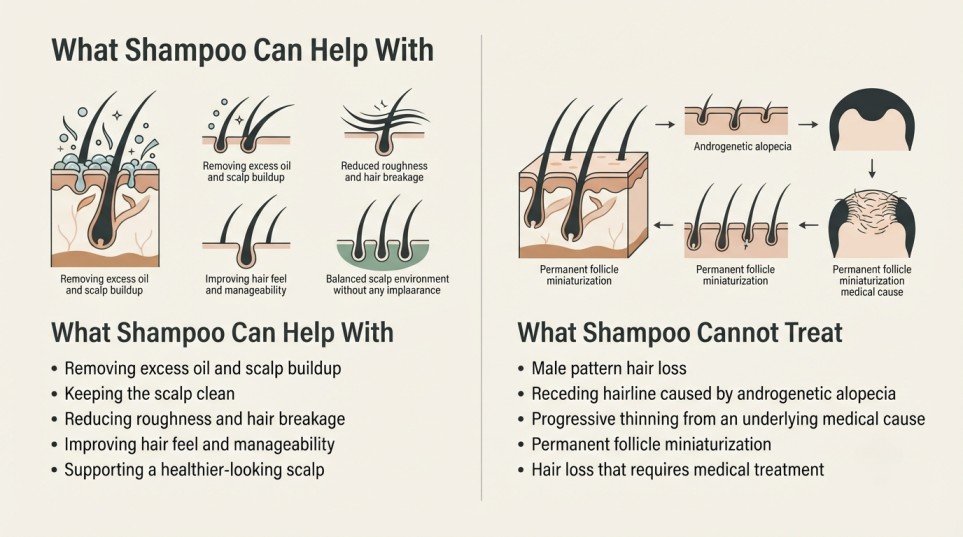
Male-pattern hair loss is caused by progressive changes in susceptible hair follicles. The American Academy of Dermatology lists topical minoxidil and prescription finasteride among established treatments for male-pattern hair loss. Shampoo has a supporting role rather than replacing these treatments.
Choose Based on Your Hair-Fall Concern
| Concern | Look For | Avoid / Be Careful With |
|---|---|---|
| Hair breakage and fragile strands | Gentle cleansing and conditioning ingredients | Aggressive scrubbing, excessive heat and harsh handling |
| Oily scalp and buildup | Effective cleansing; scalp-friendly exfoliating ingredients can be useful | Heavy formulas that leave excessive residue |
| Fine, thinning-looking hair | Lightweight cleansing and ingredients that improve hair feel and volume | Heavy conditioning that makes fine hair look flatter |
| Dry or rough hair | Mild cleansing, humectants and conditioning ingredients | Over-washing and very hot water |
| Progressive hairline or crown thinning | Gentle hair care alongside evidence-based hair-loss treatment | Depending on shampoo alone |
| Persistent scalp irritation or scaling | A suitable gentle cleanser and proper diagnosis | Repeatedly adding stronger actives without identifying the cause |
How to use a hair-fall shampoo
Apply shampoo primarily to the scalp and massage gently with your fingertips. There is no benefit to aggressively scrubbing the hair shaft.
How often you wash should depend on your scalp. An oily scalp may need more frequent washing, while a dry or easily irritated scalp may need less frequent cleansing.
Thinning hair is also more fragile. Gentle washing and conditioning can reduce unnecessary mechanical damage.
Products You Can Consider
The products below are selected for different hair and scalp concerns rather than ranked from best to worst. Each formula has a different strength, so use the ingredient profile and “Best For” section to decide which one fits your hair and scalp needs.
1. Sebamed Anti-Hairloss Shampoo
| Key Ingredients | Caffeine, Ginkgo biloba leaf extract, Creatine, Piroctone Olamine, Zinc PCA |
| Best For | Men who want a scalp-focused shampoo with caffeine and conditioning/supportive ingredients |
| Avoid If | You are expecting a rinse-off shampoo to reverse established male-pattern hair loss |
| Full Ingredient List → | Official ingredient list |
Sebamed’s current formula contains caffeine and Ginkgo biloba, along with creatine, Zinc PCA and piroctone olamine. The brand positions the formula around supporting the hair root and reducing hair loss.
The practical advantage is that the formula does more than simply cleanse. However, the presence of caffeine or Ginkgo biloba in a shampoo should not be interpreted as equivalent to the clinical evidence supporting established medical treatments for male-pattern hair loss.
Check Price & Latest Deal →
2. Bare Anatomy Anti-Hair Fall Shampoo
| Key Ingredients | Adenosine, Biotinoyl Tripeptide-1, Apigenin, Oleanolic Acid, Isoniacinamide |
| Best For | Men concerned about weak, thin-feeling hair and breakage who prefer a conditioning shampoo formula |
| Avoid If | You want a shampoo to replace medically established treatment for progressive hair loss |
| Full Ingredient List → | Official ingredient list |
Bare Anatomy’s current formula combines a relatively mild cleansing system with glycerin, dimethiconol and conditioning agents. It also contains adenosine, Biotinoyl Tripeptide-1, apigenin and oleanolic acid, which the brand uses as its hair-fall-focused ingredient system.
That combination makes more sense for someone who wants to address hair feel, breakage and the appearance of weaker strands while cleansing the scalp. The important limitation is contact time: this is a rinse-off product, so its ingredient profile should not be treated as proof that it can reproduce the effects of a leave-on hair-loss treatment.
Check Price & Latest Deal →
3. Kérastase Genesis Homme Anti-Hair Fall Purifying Shampoo
| Key Ingredients | Salicylic Acid, Creatine, Ginger Root Extract |
| Best For | Oily scalps, sweat, styling-product buildup and men who want a stronger cleansing shampoo |
| Avoid If | Your scalp is very dry, easily irritated or sensitive to stronger cleansing and fragrance |
| Full Ingredient List → | Official ingredient list |
This is the most clearly cleansing-oriented formula in this group. Its current ingredient list includes Sodium Laureth Sulfate, Sodium Lauryl Sulfate and salicylic acid, together with creatine and ginger root extract. Kérastase specifically positions it for removing scalp buildup, sweat and excess oil.
That makes it a better match for an oily or buildup-prone scalp than for someone whose main problem is dryness. Salicylic acid can help with surface buildup, while creatine is positioned by the brand around hair-fibre strength and resilience. Those benefits should not be confused with treatment of male-pattern hair loss.
Check Price & Latest Deal →
4. L’Oréal Professionnel Density Advanced Shampoo
| Key Ingredients | Omega 6 complex, Niacinamide, Pyridoxine HCl, Salicylic Acid, Wheat Polypeptides |
| Best For | Fine, low-density or thinning-looking hair where volume and hair-fibre feel are priorities |
| Avoid If | You are specifically looking for a proven treatment for progressive male-pattern hair loss |
| Full Ingredient List → | Official ingredient list |
L’Oréal Professionnel positions Density Advanced as a shampoo for thinning hair and highlights its Omega 6 complex. The current India-market ingredient information also lists niacinamide, pyridoxine HCl, salicylic acid and wheat polypeptides.
The strongest reason to consider this formula is its focus on the appearance and feel of fine hair. A densifying shampoo can make existing hair look fuller or improve manageability without increasing the number of functioning follicles, so keep that distinction clear if your thinning is progressing.
Check Price & Latest Deal →
5. Forest Essentials Ayurvedic Hair Cleanser Bhringraj & Shikakai
| Key Ingredients | Bhringraj, Shikakai, Reetha, Licorice, Fenugreek, Amla, Pro-vitamin B5 |
| Best For | Men who prefer a botanical/Ayurvedic cleansing approach and want a cleanser that is less focused on conventional sulfate cleansing |
| Avoid If | You are relying on Ayurvedic hair cleansing as the sole treatment for persistent or progressive hair loss |
| Full Ingredient List → | Official ingredient list |
Forest Essentials uses Bhringraj, Shikakai and Reetha as major components of this cleanser, with additional botanical extracts including licorice, fenugreek and amla. The formula also contains hydrolyzed wheat protein and conditioning ingredients.
The formula is more appropriate for someone who prioritizes a botanical cleansing approach and wants to avoid a conventional sulfate-based shampoo. However, the traditional use of Bhringraj and Shikakai should not be presented as equivalent to the evidence behind established treatments for male-pattern hair loss.
Check Price & Latest Deal →
NOTE: Product formulas can change or be updated by the manufacturer over time. Our product assessments are based on the formulation and product information available to us at the time of writing or updating this guide.
Always check the current ingredient list and product details on the product packaging or the manufacturer’s official website before purchasing. Do not assume that an older formula is identical to the current one.
If a product’s formula changes and the change comes to our attention, we will make reasonable efforts to review and update our assessment and product list where appropriate.
However, we cannot guarantee that every formulation change will come to our attention immediately—or at all.
Our assessment therefore reflects the information available to us at the time of the latest update.
How to Use Hair-Loss Shampoo With Other Treatments
Do not assume that adding several anti-hair-fall products will produce better results.
A shampoo is rinsed off, while products such as minoxidil are designed to remain on the scalp. They therefore serve different roles. If you already use a dermatologist-recommended hair-loss treatment, choose your shampoo mainly around scalp tolerance, cleansing needs and hair condition rather than trying to duplicate every active ingredient in your treatment routine.
For male-pattern hair loss, the American Academy of Dermatology lists topical minoxidil and finasteride among established treatment options. Minoxidil needs consistent use, and results take time.
If your scalp becomes persistently itchy, red, painful or irritated after adding products, simplify the routine rather than adding another active.
If hair loss is rapidly progressing, appears in patches, affects the eyebrows or body hair, or occurs with significant scalp inflammation, see a dermatologist instead of continuing to switch shampoos.
Conclusion
The best shampoo for hair fall in men is the one that fits the actual problem you are trying to manage.
For an oily, sweaty or buildup-prone scalp, a stronger cleansing formula such as Kérastase Genesis Homme makes more sense. For weak, fragile or thinning-looking hair, Bare Anatomy or L’Oréal Professionnel Density Advanced may be more relevant depending on whether your priority is hair condition or cosmetic density. Sebamed takes a scalp-focused approach with caffeine and Ginkgo, while Forest Essentials is the most botanical option in this group.
None of these choices changes the basic rule: shampoo is supportive hair care, not a substitute for diagnosing the cause of persistent hair loss. If you are experiencing progressive recession or crown thinning, treat that as a hair-loss problem rather than a shampoo problem.
For the next step, read Hair Fall Solutions for Men and Best Hair Growth Serum for Men. You can also use Best Hair Care Routine for Men to build the rest of your routine.
Frequently Asked Questions
Can shampoo actually stop hair fall in men?
A shampoo can help with scalp cleansing, hair condition and some types of breakage, but it should not be considered a stand-alone treatment for progressive hair loss. Male-pattern hair loss requires a different approach.
Which shampoo is best for male-pattern hair loss?
No shampoo should be considered the primary treatment for male-pattern hair loss. Evidence-based options include topical minoxidil and prescription finasteride. Shampoo can support scalp and hair condition alongside appropriate treatment.
Does anti-hair-fall shampoo regrow hair?
You should be cautious with that claim. Some shampoos contain ingredients associated with hair-growth research, but a rinse-off formula should not automatically be treated as a proven hair-regrowth treatment.
Is caffeine shampoo effective for hair loss?
Caffeine is used in several hair-loss shampoos, including Sebamed Anti-Hairloss Shampoo. However, the presence of caffeine in a shampoo does not establish that the finished product can treat male-pattern hair loss. Established treatments have substantially stronger clinical evidence.
How often should men use an anti-hair-fall shampoo?
There is no universal schedule. Wash according to your scalp’s oiliness, sweat and buildup. An oily scalp may require more frequent washing, while a dry or irritated scalp may need less frequent cleansing.
Can washing your hair cause hair fall?
Washing can make loose hairs more noticeable because hairs that were already shed are removed during washing. Aggressive scrubbing and rough handling can also increase breakage, particularly when hair is already fragile.
Should I use a stronger shampoo if I have an oily scalp?
Not necessarily every time, but effective cleansing is important when oil and product buildup are significant. A shampoo such as Kérastase Genesis Homme, which contains salicylic acid and stronger cleansing surfactants, is more logically suited to buildup-prone scalps than a very rich conditioning formula.
Can I use a hair-fall shampoo with minoxidil?
A shampoo and minoxidil generally have different roles because shampoo is rinsed off while minoxidil is a leave-on treatment. Follow the instructions for your specific minoxidil product and speak with a dermatologist if you develop persistent scalp irritation. Minoxidil is an established treatment for male-pattern hair loss.
When should I see a dermatologist for hair fall?
See a dermatologist if shedding persists, becomes noticeably worse, produces a receding hairline or crown thinning, creates bald patches, or occurs alongside scalp pain, redness, scaling or inflammation. Finding the cause is more useful than repeatedly changing shampoos.
Authoritative Sources
- American Academy of Dermatology — Male Pattern Hair Loss
- American Academy of Dermatology — Hair Loss: Diagnosis and Treatment
- American Academy of Dermatology — Hair Shedding
- Mayo Clinic — Hair Loss: Symptoms and Causes
- Mayo Clinic — Hair Loss: Diagnosis and Treatment