Quick Summary
A patchy beard is usually driven by genetics, follicle sensitivity, or skin health — not low testosterone. This guide breaks down why patches form and walks through 10 evidence-informed ways to encourage fuller growth, from skincare basics to microneedling and topical minoxidil. You’ll also learn realistic timelines, common mistakes to avoid, and when patchiness might need a dermatologist’s input rather than a home routine.
If your beard grows thick along the jaw but barely shows up on your cheeks, you’re not doing anything wrong — and you’re definitely not alone. Learning how to fix a patchy beard starts with understanding that it’s one of the most common facial hair complaints, and it has more to do with genetics and follicle biology than effort or masculinity.
This guide walks through methods that actually have some evidence behind them, not shaving myths or overnight miracle claims. You’ll learn why patches form in the first place, ten practical ways to encourage fuller growth, and what results are realistic — plus when patchiness might be worth mentioning to a dermatologist instead of just waiting it out.
Table Of Contents
What Is a Patchy Beard?
A patchy beard is facial hair that grows unevenly, with some areas — often the cheeks — thinner or bare compared to fuller regions like the jawline, chin, and mustache. It happens because individual hair follicles respond differently to hormones and genetics, not because of a single deficiency or lack of effort.
Why Beards Grow Patchily
Most patchy beards come down to a combination of the factors below. Figuring out which one applies to you helps you choose the right fix instead of guessing.
1. Genetics and Follicle Sensitivity
Facial hair follicles carry androgen receptors that respond to dihydrotestosterone (DHT). How dense and how sensitive those receptors are varies by region of the face, and that pattern is largely inherited.
This is why two men with similar testosterone levels can have completely different beard patterns. Patchiness is often just how your particular follicles are wired, not a sign that anything is wrong.
2. Age and Beard Maturity
Beard follicles keep maturing well into a person’s twenties, and sometimes into their thirties. Areas that look sparse now can activate and fill in later as dormant follicles switch on.
If you’re in your late teens or early twenties, some of what looks like a “permanent” patch may simply be a beard that hasn’t finished maturing yet.
3. Alopecia Barbae and Other Skin Conditions
Not all patchiness is the lifelong, genetic kind. If a smooth, coin-shaped bald patch appears suddenly in an area that used to grow hair normally, that can be a sign of alopecia barbae — an autoimmune condition that causes localized hair loss in the beard.
Fungal infections (tinea barbae) and folliculitis can also cause patchy hair loss, usually alongside redness, itching, or small bumps. Sudden, inflamed, or rapidly spreading patches are worth having a dermatologist look at rather than treating at home.
4. Nutrient Status and Overall Health
Hair follicles need adequate protein and specific micronutrients — including iron, zinc, and vitamin D — to complete a normal growth cycle. When intake of these is significantly low, hair growth can be affected across the whole body, not just the beard.
That said, if you’re already eating a varied, balanced diet, a nutrient gap is rarely the main reason for patchiness. If you suspect a deficiency, bloodwork from a doctor is the right next step before adding any supplement, since taking more of a nutrient you’re not actually short on won’t speed up growth.
5. Stress and Sleep
Chronic stress can push hair follicles into their resting phase earlier than normal, which thins hair growth broadly, including in the beard. This tends to show up as general thinning rather than true patchiness, but it can make existing patches look more noticeable.
What Results Can You Realistically Expect?
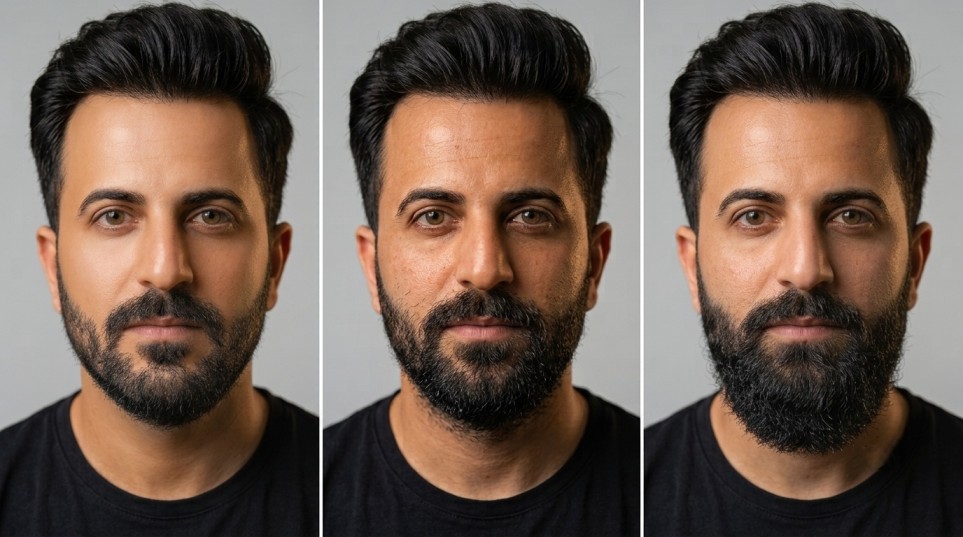
Some beard fullness may improve over 2–3 months as slower-growing follicles mature and you maintain consistent grooming and skin care. Treatments such as topical minoxidil or microneedling may produce modest changes over 3–6 months for some people, but beard-specific evidence is limited and results vary.
Genetically sparse or scarred areas may not fill in with home care alone. Sudden or clearly defined bald patches should be evaluated by a dermatologist rather than treated as ordinary beard patchiness.
How to Fix a Patchy Beard: 10 Proven Tips
The tips below are intended for common genetic or age-related patchy beards. If your beard develops sudden bald patches, redness, pain, swelling, or scarring, see a dermatologist before trying home treatments.
Here’s a quick comparison of all 10 tips and the strength of evidence behind each one.
1. Give Your Beard Enough Time Before Judging It
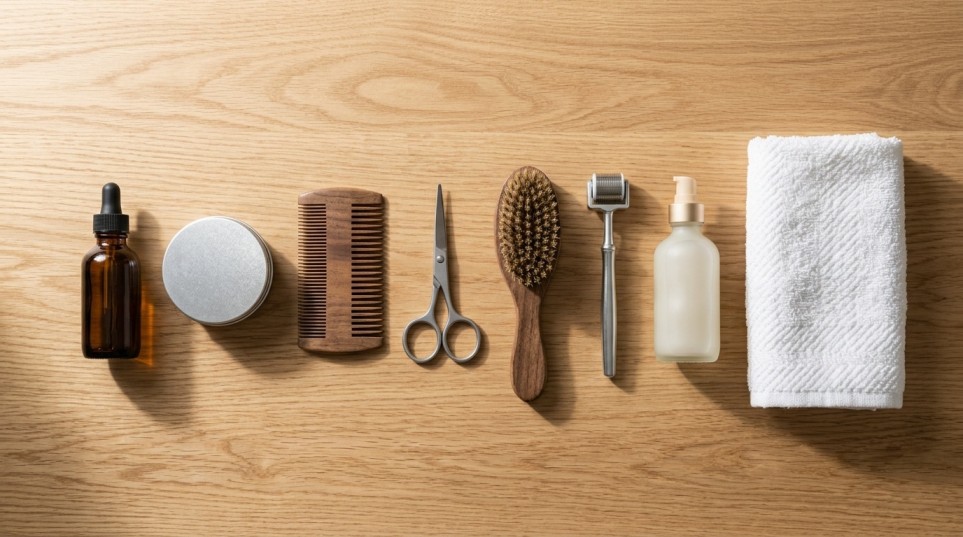
Evidence level: Proven biology — this is how the hair growth cycle works, not a treatment claim.
Beard hair grows at roughly a centimeter a month, but not every follicle is on the same schedule. Some patches that look empty at week two are simply behind, not absent.
Commit to at least 4–6 weeks of uninterrupted growth before deciding a patch is permanent, and ideally 8–12 weeks for a fair assessment. For a full breakdown of what actually speeds this process up, see how to grow a beard faster naturally.
2. Exfoliate and Care for the Skin Underneath
Evidence level: Personal-care tip — supports skin health; not proven to reverse patchiness on its own.
Dead skin buildup and clogged pores can make hair growth look sparser than it is and contribute to ingrown hairs. Gently exfoliating the skin under your beard once or twice a week, with a mild scrub or soft brush, keeps follicles clear without irritating the skin.
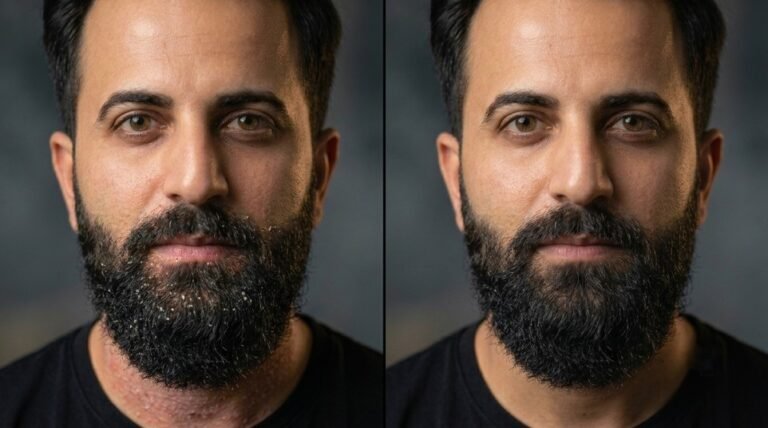
Overdoing it backfires — irritated skin can slow healthy growth rather than help it. If you’re dealing with flaking or itching along with patchiness, that’s often a separate issue worth reading up on in our guide to beard dandruff.
3. Use Beard Oil or Balm to Support Healthy Skin
Evidence level: Personal-care tip — comfort and skin conditioning, not follicle stimulation.
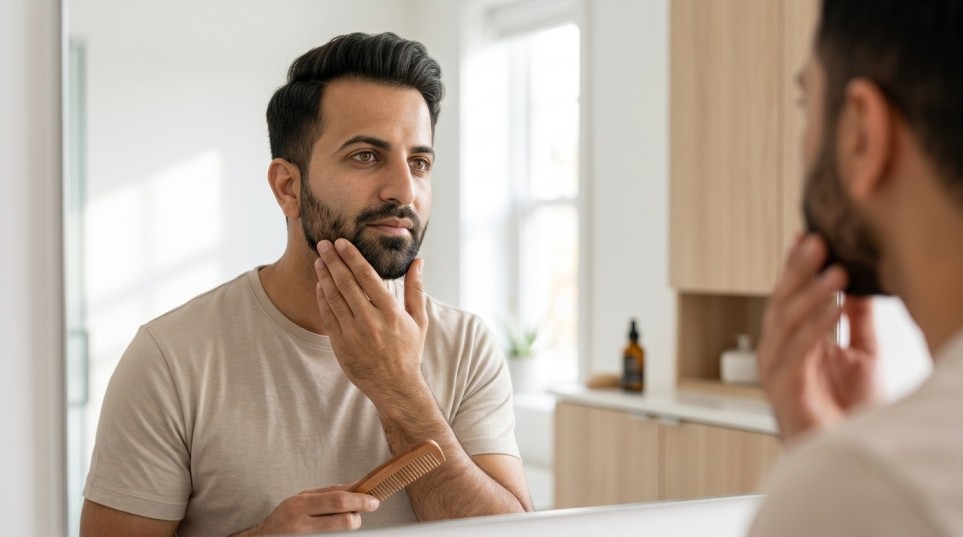
Beard oil moisturizes the skin and softens the hair shaft, which reduces the itching and dryness that often leads to picking or scratching at thin areas — a habit that can make patches worse. It creates a better environment for hair to grow in.
What it doesn’t do is create new follicles or reverse genetically thin patches. If you want the full picture on what beard oil can and can’t realistically deliver, we cover that in does beard growth oil actually work or is it just hype.
4. Try Derma Rolling (Microneedling)
Evidence level: Evidence-based, limited beard-specific data — most research is on scalp hair.
Microneedling uses a roller of tiny needles to create controlled micro-injuries in the skin, which triggers localized blood flow and growth-factor activity. Most of the supporting research is on scalp hair, often combined with minoxidil, so evidence specific to beards is more limited but the underlying mechanism is plausible.
If you try it, once every 1-2 weeks with an appropriate needle length is a common starting approach for home use, although protocols vary and beard-specific research remains limited. Hygiene matters -a dirty or overused roller can cause irritation or infection instead of helping. Skip it on the same day you use retinoids or other active skincare ingredients, since combining them increases irritation risk.
5. Consider Topical Minoxidil
Evidence level: Evidence-based, limited beard-specific data — approved for scalp use; beard use is off-label.
Minoxidil is approved for scalp hair loss, and it’s used off-label by some people for beard growth. It’s thought to work by extending the active growth phase of the hair cycle and improving blood flow to the follicle.
Small clinical studies and observational research suggest some users develop modestly denser facial hair over 3–6 months, although beard-specific evidence remains limited compared with scalp hair. It doesn’t work for everyone, and it won’t grow hair where a follicle isn’t present. Side effects can include dryness, irritation, and hair growth spreading slightly beyond the applied area. Talk to a doctor or dermatologist before starting, and know that results fade if you stop using it.
6. Support the Nutrients Your Hair Needs
Evidence level: Evidence-based, but only if you’re actually deficient — supplementing without a deficiency won’t speed growth.
Hair is mostly protein, so adequate protein intake matters for keratin production. Certain micronutrients — including biotin, zinc, iron, and vitamin D — also play a role in keeping the follicle’s growth cycle running normally.
The most useful step isn’t guessing and supplementing everything at once; it’s getting bloodwork if you suspect a specific deficiency, then addressing that specific gap. Taking large amounts of a nutrient you aren’t actually deficient in doesn’t accelerate beard growth and can carry its own risks.
7. Prioritize Sleep and Manage Stress
Evidence level: Limited evidence for a beard-specific effect — the mechanism is plausible, direct proof for beard density is thin.
Sleep supports the hormonal regulation and cellular repair that hair follicles rely on to stay in their growth phase. Chronic stress does the opposite, nudging follicles into their resting phase earlier than they should.
A consistent sleep schedule and some form of regular stress management, whatever works for you, won’t fix genetic patchiness, but they remove a factor that can quietly work against the growth you already have.
8. Keep Up Regular Movement and Exercise
Evidence level: Limited evidence — good for general health; not shown to meaningfully change beard density.
Regular exercise supports overall health, cardiovascular function, and metabolic health. While these factors contribute to normal hair biology, there’s no strong evidence that exercise directly increases beard density or overrides genetics.
Treat this as general health maintenance that supports growth conditions, not a targeted fix for patchiness.
9. Style Around the Patches While You Grow It Out
Evidence level: Personal-care tip — cosmetic technique, not a physiological fix.
While you wait for slower areas to fill in, smart trimming can make coverage look fuller than it is. Leaving a bit more length over thin patches, rather than trimming them short like the rest of the beard, often creates better visual density.
The right technique depends on where your patches are and how thick the surrounding hair is, which is why we’ve put together a dedicated guide on how to style a patchy beard without looking thin or messy.
10. Avoid Habits That Damage Follicles
Evidence level: Evidence-based — dermatology guidance broadly supports avoiding these.
A few common habits actively work against beard growth:
- Shaving out of frustration — this resets your progress and tells you nothing new about how the patch will eventually look.
- Picking or plucking thin spots — this raises the risk of ingrown hairs, folliculitis, and scarring, which can genuinely worsen patchiness.
- Harsh, alcohol-heavy grooming products — these dry out and irritate the skin, undermining the environment follicles need.
- Frequent heat styling — repeated heat exposure can weaken hair shafts over time.
- Smoking — it’s linked to reduced circulation, which general dermatology guidance associates with poorer hair health.
For the full daily and weekly routine that supports growth without falling into these habits, see our complete beard care routine guide.
How to Keep Your Beard Fuller Long-Term
Once your beard reaches its natural growth potential, focus on maintenance rather than chasing new growth.
- Keep the skin clean and moisturized.
- Trim regularly instead of reacting to daily changes in patchiness.
- Judge your beard over weeks or months, not day to day.
- If using minoxidil or microneedling, follow a consistent approach rather than repeatedly starting and stopping.
Myth vs Fact
| Myth | Fact |
|---|---|
| Shaving makes your beard grow back thicker. | Shaving does not change beard thickness, density, or growth rate. It can only make new growth look thicker because the hair has a blunt tip. |
| A patchy beard means you have low testosterone. | Beard density is strongly influenced by genetics and how facial hair follicles respond to androgens. Patchiness does not automatically indicate low testosterone. |
| Beard oil can fill in bald patches. | Beard oil moisturizes the skin and conditions existing hair, but it cannot create new follicles or reverse genetic patchiness. |
| Growing your beard longer will always fill in every patch. | Extra length can make some patches look less noticeable, but genetically sparse areas may remain thin. |
| You need to shave regularly to make a beard grow faster. | Shaving has no effect on the rate at which beard follicles produce hair. |
| Beard growth depends only on genetics. | Genetics play a major role, but age, skin health, nutrition, and certain medical conditions can also affect beard growth. |
| Beard growth oils can increase the number of hair follicles. | Oils can improve the condition and appearance of existing hair, but they do not increase follicle count. |
| Microneedling will definitely fill in a patchy beard. | Evidence for microneedling specifically for beard growth is limited. It may help some people, but results are not guaranteed. |
| Minoxidil is proven to work for everyone with a patchy beard. | Minoxidil is approved for scalp hair loss, not beard growth. Beard use is off-label, and available evidence is limited. |
| More aggressive derma rolling gives faster results. | More frequent or aggressive microneedling mainly increases irritation and injury risk. More is not necessarily better. |
| Beard supplements can make any beard grow faster. | Supplements are most useful when a genuine nutrient deficiency exists. Taking extra nutrients without a deficiency has not been shown to reliably increase beard growth. |
| Patchy facial hair in your early twenties is necessarily permanent. | Beard density can continue developing through the twenties and sometimes later, so early patchiness does not always represent the final pattern. |
| A sudden bald patch is just normal beard patchiness. | A sudden, smooth, or clearly defined bald patch can have a medical cause, such as alopecia areata, and should be evaluated if it appears unexpectedly. |
| Scrubbing the skin harder will make beard hair grow better. | Gentle skin care can support a healthy environment, but aggressive scrubbing can irritate the skin and potentially make problems worse. |
Quick Action Checklist
- Give new beard growth at least 6–8 weeks before judging its fullness.
- Keep the skin under your beard clean and moisturized.
- Exfoliate gently once or twice a week if your skin tolerates it.
- Use beard oil or balm for conditioning, but don’t expect it to regrow hair.
- If you’re considering microneedling or topical minoxidil, discuss the risks and suitability with a doctor first.
- Address suspected nutrient deficiencies with proper testing rather than taking supplements blindly.
- Trim strategically to make thinner areas look more balanced while your beard grows.
- See a dermatologist if patchiness appears suddenly or comes with redness, itching, pain, or inflammation.
Conclusion
Fixing a patchy beard is less about finding one miracle product and more about understanding what is causing the patchiness, giving your beard enough time to mature, and maintaining healthy skin and hair. Genetics set much of your beard pattern, but consistent grooming can help you make the most of the growth you have.
Start by giving your beard a full 8-week growth window and avoid habits that can damage the skin or hair. If patches appear suddenly, look unusually smooth, or come with redness, itching, or inflammation, see a dermatologist rather than assuming they are genetic.
Frequently Asked Questions
How long does it take to fix a patchy beard?
Most people notice some improvement within 2–3 months of consistent skin care and simply letting slower follicles catch up. Additional tools like minoxidil may take 3–6 months to show a modest difference, if they work for you at all.
Can a patchy beard be fixed permanently?
It depends on the cause. Age-related or slower-maturing beard growth often improves naturally over time, while genetically patchy beards may improve only modestly. If patchiness is caused by a treatable skin condition or nutrient deficiency, treating the underlying cause may restore growth. Scarred follicles generally do not regrow hair.
Does minoxidil actually work for beards?
Some studies and user reports show modest density improvements over several months, but it doesn’t work for everyone and stopping use reverses any gains. Talk to a doctor before starting.
Is a patchy beard genetic?
Largely, yes. How densely your facial follicles respond to hormones is inherited, which is why patchiness often runs in families.
Should I just shave off the patchy areas?
Shaving won’t change how the hair grows back, so it doesn’t “fix” anything — it just resets your timeline. Styling around patches while you wait is usually more effective than shaving in frustration.
Authoritative Sources
- American Academy of Dermatology (AAD).
Hair Loss: Diagnosis and Treatment. - Mayo Clinic.
Alopecia Areata – Symptoms and Causes. - MedlinePlus (U.S. National Library of Medicine).
Hair Loss. - British Association of Dermatologists (BAD).
Alopecia Areata – Patient Hub.