
Quick Summary:
Hair grows about half an inch a month — genetics sets that ceiling, but scalp care, nutrient balance, sleep, and reduced breakage decide how much of it you keep. This guide covers 15 practical habits for healthier follicles and stronger strands, the mistakes that undo them, and a realistic timeline for when change shows up.
If your hair feels stuck at the same length no matter what you try, the problem usually isn’t growth. It’s retention. Hair breaks off nearly as fast as it grows, and that’s what hides the progress you’re making. This guide breaks down how to grow hair faster naturally: the habits that work with your growth cycle instead of against it.
Fifteen tips, grouped by what each one targets, the mistakes that undo them without you noticing, and a realistic timeline for when change shows up.
Table Of Contents
What Does It Mean to Grow Hair Faster Naturally?
- Growing hair faster naturally means supporting your existing growth cycle, not overriding it. Hair grows about 0.5 inch (1.25 cm) a month no matter what a product label claims. Natural methods work by protecting scalp health, correcting nutrient gaps, and cutting breakage, so more of what you grow stays on your head instead of snapping off before it counts.
How Your Hair Growth Cycle Works
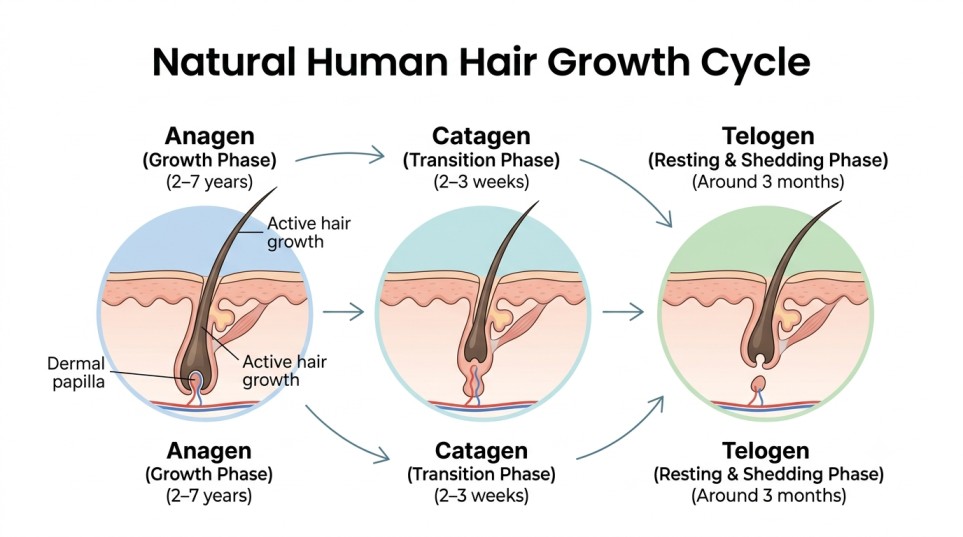
Every strand cycles through three phases, which is why “growth” and “visible length” aren’t the same thing:
- Anagen (growth phase): Lasts 2–7 years. This is where your length potential gets set.
- Catagen (transition): A short 2–3 week pause while the follicle shrinks.
- Telogen (resting/shedding): About 3 months, ending when the strand sheds and a new one starts.
At any given moment, 85–90% of your hair sits in anagen. The rest is resting or shedding, and that’s completely normal. Most people just never see that breakdown, which is why ordinary shedding can feel alarming. Nothing applied topically changes how long anagen runs. What natural methods change is the environment around the follicle, and how likely a strand is to survive once it starts growing.
What Controls Your Hair Growth Speed
If you’ve searched how to make hair grow faster and gotten nothing but vague answers, here’s the honest version: you can’t change the underlying rate much. What you can change is everything working against it.
- Genetics sets your ceiling: follicle density, anagen length, strand thickness. This one you don’t get to negotiate with.
- Age. Growth rate and anagen duration both taper off gradually, usually starting sometime in your 30s.
- Hormones. Thyroid function, pregnancy, and androgen sensitivity can all shift your growth cycle in either direction.
- Overall health. Illness, certain medications, and nutrient gaps can push follicles into resting phase earlier than they should.
Genetics you’re stuck with. Everything else on that list is fair game, and that’s what the rest of this guide deals with.
15 Natural Tips to Grow Hair Faster Naturally
Skim the table for the quick list. The reasoning underneath is what makes these stick, so it’s worth the extra thirty seconds.
Scalp Care (1–4)
Start underneath. Your follicle doesn’t care much what you put on your hair — it cares about the environment it’s actually sitting in.
1. Massage your scalp for 4–5 minutes a day. It sounds too simple to matter, but consistent massage increases blood flow to the follicles, which means more oxygen and nutrients reach them. A handful of small studies following people over several months found modestly thicker hair as a result. Not dramatic, but real.
2. Clarify your scalp every so often. Product, oil, and dead skin build up faster than most people notice, and clogged follicles don’t function as well. A gentle clarifying wash every 1–2 weeks, tuned to your own scalp, clears it out.
3. Wash with lukewarm water, not hot. Hot water feels good, but it strips natural oils and leaves the scalp barrier irritated and dry. Lukewarm gets your hair just as clean without the trade-off.
4. Deal with scalp conditions at the source. Dandruff, seborrheic dermatitis, and psoriasis all involve inflammation, and inflamed follicles don’t grow the way healthy ones do. Treating the condition itself does more than any anti-flake shampoo covering up the symptom.
Do Hair Growth Oils Really Work?
Hair growth oils can support a healthier scalp, but they won’t dramatically speed up your natural hair growth rate. Among natural options, rosemary oil has some of the more promising research, although the evidence is still limited compared with established hair-loss treatments. Other popular oils, such as castor, coconut, and argan oil, are better at reducing dryness and breakage than stimulating new growth.
If you choose to use a hair oil, think of it as part of a healthy hair care routine rather than a shortcut to faster growth. Healthy habits like good nutrition, scalp care, and minimizing breakage still have the biggest impact on long-term hair growth.
Nutrient & Internal Health (5–8)
This isn’t a diet section. It’s about whether your body has the raw materials to build hair in the first place.
5. Get enough protein. Hair is close to 100% keratin, a protein. When intake runs low for a while, your body treats hair as expendable and shifts follicles into resting phase early. There are more urgent places for that protein to go.
6. Rule out iron deficiency. Iron carries oxygen to your follicles, and low iron is one of the most common, most fixable causes of excess shedding, especially for anyone with heavy periods. A simple blood test settles it in one visit.
7. Don’t reach for biotin by default. True biotin deficiency is uncommon in healthy adults, and without one, extra biotin has thin evidence behind it for extra growth. It’s unlikely to hurt you, but it’s also probably not doing what the label implies.
8. Don’t overlook zinc, vitamin D, and omega-3s. All three play a role in cell turnover and follicle cycling, and low levels of any are tied to more shedding than usual. The same nutrients matter for facial hair too. If beard growth is also something you’re working on, our complete beard care routine for healthy growth covers the same ground in more depth.
Daily Habits (9–12)
None of the next four are about hair, technically. They’re about the systems hair growth depends on.
9. Get a handle on chronic stress. A major stressful stretch can push a larger-than-usual share of your hair into resting phase at once, a pattern called telogen effluvium. It typically shows up 2–3 months after the stress itself, which is exactly why people rarely connect the two.
10. Protect your sleep. Most cellular repair, follicles included, happens disproportionately during deep sleep. Cutting sleep short doesn’t just cost you energy. It’s one more stressor piled on top of everything else your body is managing.
11. Ease up on heat and chemical processing. Both weaken the protein bonds holding your hair shaft together, and the breakage that follows cancels out whatever you’re growing. Honestly, this is probably the single biggest reason hair seems to stop at a certain length.
12. Get trims on a schedule, not as an emergency measure. Cutting your hair doesn’t speed anything up. Growth happens at the root, completely unaffected by scissors. But removing split ends before they travel up the shaft is what protects the length you’ve already earned.
Hair Care & Damage Prevention (13–15)
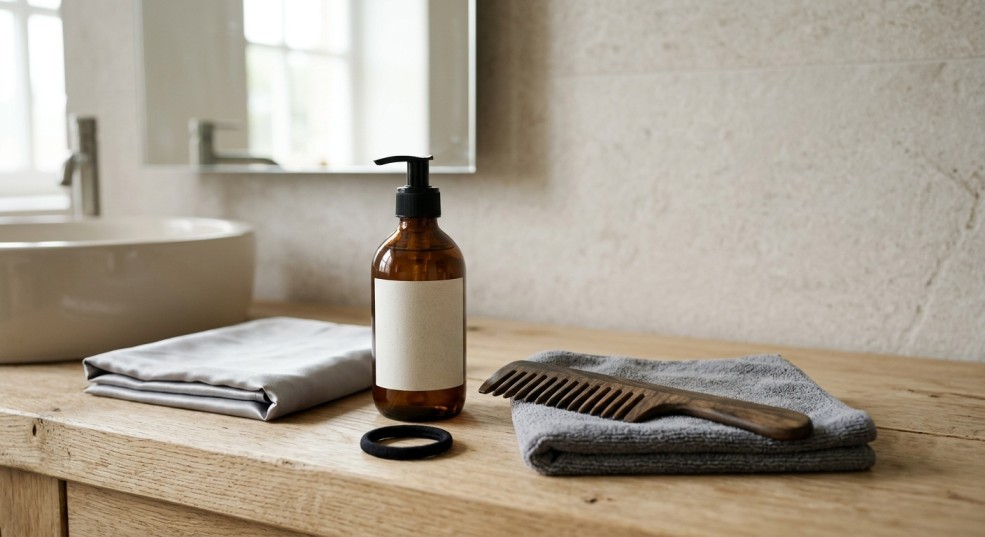
The last three are pure damage control: holding onto length you’ve already got instead of chasing more of it.
13. Match your wash frequency to your scalp type. Over-washing and under-washing both backfire, just in different directions: one clogs follicles, the other leaves them irritated and dry. There’s no universal “right” number of washes a week — it depends entirely on how your particular scalp behaves.
14. Detangle from the ends up, especially when wet. Wet hair stretches more and snaps more easily under tension than dry hair does. Starting at the tips and working upward, instead of dragging a comb from root to end, keeps that tension from turning into breakage.
15. Ease up on tight hairstyles. Constant pulling from tight ties, buns, or slicked-back edges can cause traction alopecia, a slow, tension-driven hair loss that usually shows up first along the hairline. Alternating your style and giving your scalp a break from pull protects follicles long term.
Best Practices for Seeing Real Results
Consistency beats intensity here, and it’s not just a platitude: the shedding you see today reflects what your follicles were doing about three months ago. Change something now, and you won’t see the payoff for months, not days.
- Track progress with monthly photos taken in the same light. Checking daily just shows you normal day-to-day noise.
- Change one or two things at a time, otherwise you’ll have no idea what helped.
- Give any new habit a full three months before deciding it isn’t working.
- Treat this as ongoing maintenance, not something you stop once your hair “catches up.”
Common Mistakes That Quietly Slow Down Hair Growth
The biggest one: chasing growth products while shedding is still active. If you’re losing more than usual, growth tips won’t help until you deal with the specific cause of your hair fall. A close second: stacking five fixes at once, so you never find out which one worked. Our breakdown of everyday hair care mistakes covers the usual offenders.
People also tend to blame their shampoo brand for slow growth, when the culprit is usually frequency, not the formula. Adjusting how often you wash your hair fixes more than switching bottles ever will.
Expecting visible change within weeks is another trap. Based on the growth-cycle timeline above, anything faster than 2–3 months is either temporary or unrelated to whatever you just started doing. Skipping trims and blaming “slow growth” is common too: usually it’s not slow growth, it’s breakage winning the race.
If what you’re dealing with is heavier shedding rather than just slow growth, our complete guide to hair fall solutions is the better next read.
Hair Growth Myths vs. Facts
| Myth | Fact |
|---|---|
| Cutting your hair makes it grow faster. | Hair grows from the follicles beneath your scalp, not from the ends. Trimming prevents split ends and breakage but doesn’t increase growth speed. |
| Brushing your hair 100 strokes a day makes it grow faster. | Excessive brushing can cause breakage. Gentle brushing is enough to detangle hair and distribute natural oils. |
| Hair needs to “breathe” to grow. | Hair strands are dead tissue and don’t need to breathe. Keeping the scalp clean and healthy matters more than avoiding hair products. |
| Supplements can make hair grow faster even if you’re not deficient. | Supplements mainly help when a nutrient deficiency is contributing to hair loss or poor hair health. Taking extra nutrients doesn’t override your natural growth rate. |
| Biotin automatically makes hair grow faster. | Biotin supports normal hair growth when you’re deficient, but deficiency is uncommon in healthy adults. Extra biotin has limited evidence for speeding up growth. |
| Scalp massage dramatically speeds up hair growth. | Small studies suggest scalp massage may modestly improve hair thickness over time, but it cannot dramatically increase your natural growth rate. |
| Hair oils can make hair grow much faster. | Some oils may support scalp or hair health, but they don’t dramatically speed up the natural growth cycle. Rosemary oil has some promising evidence, but research remains limited. |
| Washing your hair less makes it grow faster. | There is no fixed washing schedule that speeds up hair growth. Wash according to your scalp type and needs while keeping the scalp clean and comfortable. |
| Expensive hair products make hair grow faster. | Price doesn’t determine growth. Products can help manage dryness, buildup, or breakage, but they cannot override genetics or dramatically change the growth rate. |
| Shaving your hair makes it grow back thicker. | Shaving does not change hair thickness, density, or growth rate. Regrowth may feel coarser because the hair has a blunt tip. |
Realistic Timeline: When You’ll See Real Results
Set expectations before you start, or you’ll quit right before results show up.
- 0–4 weeks: Nothing visible yet. You’re correcting internal factors that take time to show up on the outside.
- 6–12 weeks: Less shedding, if stress or a deficiency was driving it. Scalp starts feeling healthier.
- 3–6 months: Noticeably less breakage, stronger-feeling hair, better length retention.
- 6–12 months: A measurable length difference, assuming you’ve stayed consistent.
If nothing’s changed by month six, or shedding suddenly gets heavy, that’s your cue to see a doctor, not to overhaul your routine again.
Quick Action Checklist
- Massage your scalp for a few minutes daily
- Talk to a doctor if shedding becomes unusually heavy or persistent, who can decide whether blood tests are needed
- Cut back on heat styling and tight hairstyles
- Match your wash frequency to your scalp type, not a generic schedule
- Get trims on a set schedule so breakage doesn’t outrun your growth
- Give any new habit a full three months before judging it
- Track progress monthly with photos, not daily inspection
Conclusion
Growing hair faster naturally has less to do with speeding up growth than most headlines suggest. Your follicles are already working at their genetic pace. This is about protecting that growth from breakage, deficiency, and stress long enough for it to show.
Start by cutting back on heat styling and other sources of breakage, while keeping your scalp care and overall routine consistent. Give these habits a full three months before judging the results. If shedding feels unusually heavy at any point, see a doctor before working through the rest of this list.
If you’re dealing with excessive shedding rather than slow growth, read our complete guide to hair fall solutions to identify the underlying cause before focusing on growth.
Frequently Asked Questions
How fast does hair grow, exactly?
About 0.5 inch (1.25 cm) on average, or roughly 6 inches a year. Genetics, age, and health shift this slightly in either direction, but no natural method changes the rate in any meaningful way.
Can biotin supplements make hair grow faster?
Only if you have a diagnosed deficiency, which is uncommon in healthy adults. Without one, extra biotin has thin evidence behind it for extra growth.
Is scalp massage worth doing for hair growth?
There’s modest evidence for it: a few small studies found thicker hair after months of consistent daily massage, likely from improved circulation. Low-risk and easy to keep up, just don’t expect a dramatic transformation from it alone.
Does trimming hair make it grow faster?
No. Growth happens at the root. Trimming only ever affects hair that already exists.
Are hair growth serums and products worth using?
Only to the extent they solve one specific problem: dryness, buildup, friction. They can’t override genetics, and they can’t fix a nutrient deficiency on their own. That needs to be addressed directly, sometimes with a doctor’s help.
How long until natural hair growth tips show results?
Most changes take several months. If a nutrient deficiency or stress is contributing to shedding, improvement may become noticeable within 2-3 months after the underlying issue is addressed. Visible length gains usually take 6-12 months because hair grows slowly.
Why does my hair stop growing at a certain length?
In most cases, your hair hasn’t stopped growing—it’s breaking off as quickly as new hair grows. Heat styling, split ends, chemical treatments, and friction can all prevent you from seeing length gains. Improving hair care habits and reducing breakage usually makes steady growth more noticeable over time.
Authoritative Sources
American Academy of Dermatology (AAD)
Hair loss: Diagnosis and treatment
https://www.aad.org/public/diseases/hair-loss/treatment
Mayo Clinic
Hair loss – Symptoms and causes
https://www.mayoclinic.org/diseases-conditions/hair-loss/symptoms-causes/syc-20372926
Cleveland Clinic
Telogen Effluvium
https://my.clevelandclinic.org/health/diseases/24486-telogen-effluvium
MedlinePlus
Hair Loss
https://medlineplus.gov/hairloss.html
PubMed
Standardized Scalp Massage Results in Increased Hair Thickness by Inducing Stretching Forces to Dermal Papilla Cells in the Subcutaneous Tissue
https://pubmed.ncbi.nlm.nih.gov/26904154/

Great content! Keep up the good work!