
NOTE: The Grooming Journal does not recommend products simply for the sake of recommending them. We create buying guides to help you understand your options and make a more informed decision based on your specific grooming concern, needs, and preferences.
The products we feature are not sponsored placements. We select and assess products based on relevant product information, such as ingredients, formulation, materials, specifications, stated purpose, and how well they fit the specific concern or need discussed in the guide.
We do not physically purchase or test the products featured in our guides. Our assessments are based on publicly available product information, manufacturer details, ingredients or materials, specifications, and other relevant evidence.
Some links in our articles may be affiliate links, which means TGJ may earn a commission if you make a purchase through them. This does not influence which products we include or how we assess them.
If we ever feature a sponsored product or sponsored placement, it will be clearly identified as sponsored. Sponsored content will not be presented as an independent, non-sponsored recommendation.
Our goal is simple: we don’t tell you what to buy. We help you understand what you’re buying.
Quick Summary
If you have oily skin, a moisturizer does not need to feel rich to be effective. A lightweight gel or gel-cream can provide hydration without adding a heavy or greasy finish.
When comparing a moisturizer for oily skin, start with:
- A lightweight texture that feels comfortable on your skin
- Oil-free or non-comedogenic positioning when clogged pores are a concern
- Hydrating ingredients such as glycerin, hyaluronic acid, or panthenol
- Barrier-supporting ingredients such as ceramides when your skin feels dry or irritated
- A finish that matches how oily your skin becomes during the day
- A formula your skin actually tolerates, rather than one chosen only because the label says “for oily skin”
There is no single moisturizer that fits every oily skin type. The useful question is whether the formulation makes sense for your skin.
Finding a moisturizer for oily skin can be surprisingly difficult.
A product feels too heavy, and your face looks shinier within a few hours. A very lightweight gel feels comfortable at first but does not provide enough hydration when your skin is dry or irritated. Then there are products covered in phrases such as “oil control,” “matte,” “pore minimizing,” and “for oily skin,” all of which can make the choice seem simpler than it actually is.
Oily skin still needs hydration. The challenge is finding a formulation that provides it without leaving a finish you dislike or aggravating concerns such as clogged pores or sensitivity. If cleansing is also part of the problem, see our guide to choosing a face wash for oily skin.
That is what this buying guide focuses on.
Instead of treating every man with oily skin as having the same needs, we look at texture, ingredients, finish, skin concerns, and marketing claims that matter when comparing a moisturizer for oily skin.
Table Of Contents
What Is The Best Moisturizer for Oily Skin ?
The best moisturizer for oily skin for men is usually a lightweight, non-greasy formula that hydrates the skin without leaving a heavy or overly oily finish. Look for oil-free or non-comedogenic moisturizers with ingredients such as glycerin, hyaluronic acid, panthenol, or ceramides, and choose the texture and finish based on how your skin behaves throughout the day.
| Look For | Avoid / Approach With Caution |
|---|---|
| Lightweight gel or gel-cream texture | Heavy, greasy textures if they feel uncomfortable |
| Oil-free or non-comedogenic formula | Products that repeatedly trigger clogged pores or breakouts for you |
| Glycerin, hyaluronic acid or panthenol | Fragrance if your skin is sensitive to it |
| Ceramides or other barrier-supporting ingredients | Aggressive oil-stripping positioning |
| Matte or natural finish, depending on preference | Strong marketing claims without checking the formulation |
Oily Skin Can Behave Differently
“Oily skin” is not one uniform condition. Not sure whether your skin is actually oily or combination? Our guide to finding your skin type explains how to identify the difference before choosing a moisturizer.
Two people can both describe their skin as oily while needing very different moisturizers. One may become extremely shiny by midday, another may have an oily T-zone but dry cheeks, while someone else may have oily skin that feels tight after cleansing.
For buying purposes, it is more useful to identify how your oily skin behaves than to search for a product labelled simply “for oily skin.”
| Oily Skin Concern | What to Consider |
|---|---|
| Oily + Very Shiny | Lightweight gel or gel-cream with a matte or shine-controlled finish |
| Oily + Dehydrated | Lightweight hydration from glycerin, hyaluronic acid, panthenol or similar humectants |
| Oily + Acne-Prone | Lightweight, non-comedogenic or oil-free formulas can be a useful starting point |
| Oily + Sensitive | Simpler, fragrance-free formulas with ingredients your skin already tolerates |
| Oily + Dry or Irritated | Hydration combined with barrier-supporting ingredients such as ceramides or panthenol |
| Oily + Combination | Lightweight hydration without making already-oily areas feel heavier |
| Oily + Low Concern | Prioritize comfortable texture, adequate hydration and a finish you can live with every day |
The point is not to find a moisturizer labelled for your exact concern. It is to identify what your skin actually needs from the formula.
If you are building a complete routine rather than choosing a moisturizer alone, see our guide to an oily skin care routine for men.
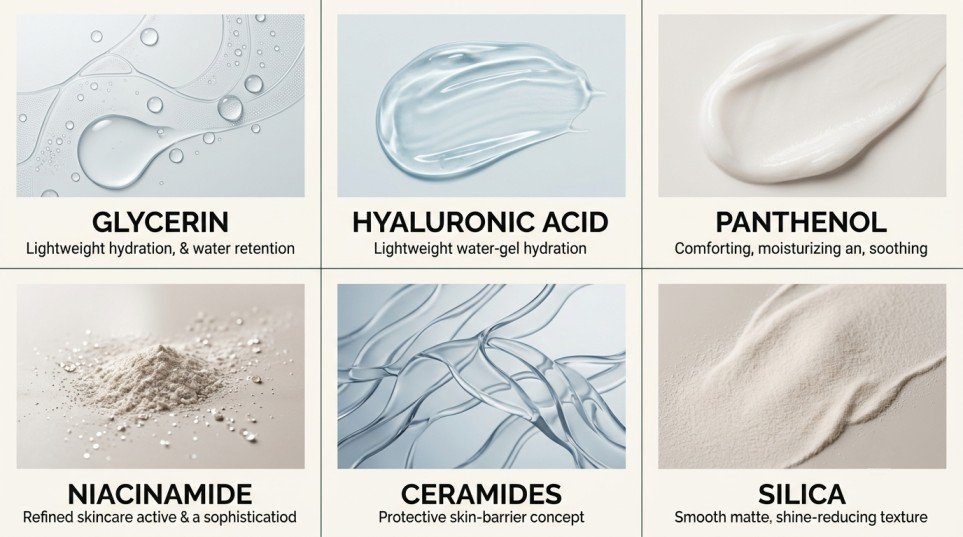
Ingredients to Look For
You do not need a long ingredient list to find a useful moisturizer. A few familiar ingredients can tell you what a formula is designed to do.
Glycerin
Glycerin is a humectant that helps attract and retain water in the outer layers of the skin. It is common in lightweight moisturizers because hydration does not require a rich, oily texture.
Hyaluronic Acid
Hyaluronic acid and forms such as sodium hyaluronate are primarily used for hydration and can appear in lightweight gels and water-gel formulations.
Panthenol
Panthenol, or provitamin B5, is used for its moisturizing and soothing properties. It can be particularly relevant when oily skin also feels dry or uncomfortable.
Niacinamide
Niacinamide is a multifunctional skincare ingredient that has also been studied for effects related to sebum production. Its presence alone does not mean a moisturizer will control oil to the same degree.
Ceramides
Ceramides are lipids naturally found in the skin barrier and are commonly used in moisturizers designed to support barrier function. They can be useful when oily skin is also dry or irritated.
Silica
Silica can be used in some formulations to help create a more matte or less shiny finish. Its presence alone, however, does not determine how a moisturizer will feel on your skin.
What to Avoid or Approach With Caution
There is no universal list of “bad” moisturizer ingredients for everyone with oily skin.
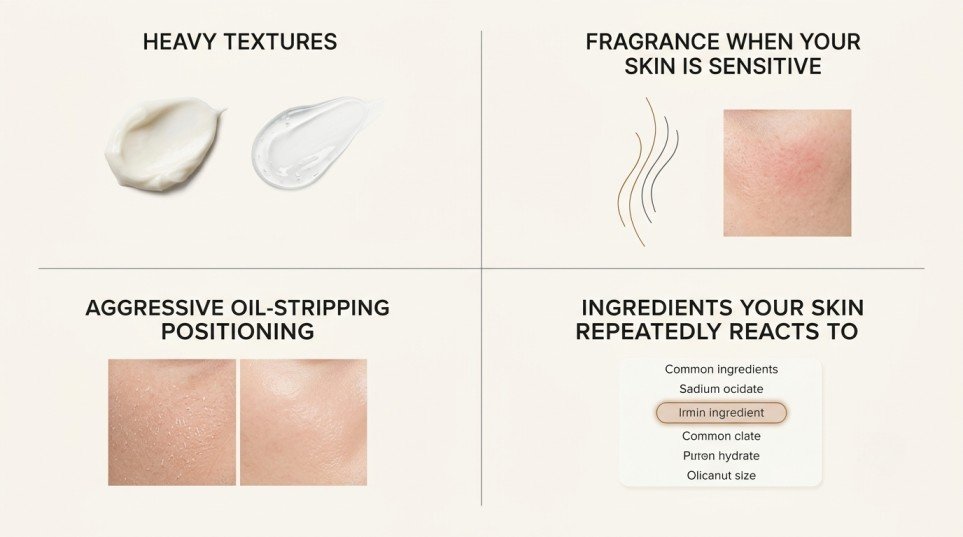
A better approach is to identify formulations that conflict with your particular concern.
Heavy Textures
A rich cream is not automatically wrong for oily skin. But if it consistently feels greasy or leaves an uncomfortable film, a lighter gel or gel-cream may be a better fit.
Fragrance When Your Skin Is Sensitive
Fragrance is not automatically a problem for everyone. If your skin is sensitive or repeatedly reacts to fragranced products, a fragrance-free formula removes one potential source of irritation.
Aggressive Oil-Stripping Positioning
Oily skin can make you want to remove every trace of oil. That does not necessarily make a moisturizer more suitable.
The aim is comfortable hydration, not making the skin feel completely dry.
Ingredients Your Skin Repeatedly Reacts To
Your own established reactions are more useful than a generic internet “avoid list.” If a particular ingredient or formula repeatedly causes problems, take that into account when comparing products.
Don’t Buy It Just Because It Says “For Oily Skin”
This is one of the easiest traps in the moisturizer aisle.
A front label might say:
- For oily skin
- Oil control
- Matte
- Pore minimizing
- Non-sticky
- Acne-friendly
- Sebum control
These phrases are not interchangeable.
A moisturizer marketed for oily skin can still feel too heavy for one person and comfortable for another. A matte moisturizer may suit someone who dislikes shine but feel unnecessarily drying to someone whose oily skin is also dehydrated. An “oil-free” formula can also differ substantially from another oil-free moisturizer in texture, finish and ingredient profile.
Instead of stopping at the front label, check five things:
1. Texture
Does it feel like a gel, gel-cream, lotion or richer cream?
2. Formula
What are the main moisturizing, soothing and texture-forming ingredients?
3. Finish
Does the product aim for matte, natural or dewy-looking skin?
4. Your actual concern
Are you mainly dealing with shine, dehydration, acne-prone skin, sensitivity or a combination?
5. Your skin’s response
Does the formula consistently feel comfortable, or does it leave you greasy, tight, irritated or congested?
The better question is not:
“Is this moisturizer made for oily skin?”
It is:
“Does this formulation make sense for my oily skin?”
Some Moisturizer Options You Can Consider
The following five options represent different formulation approaches rather than a ranked list. They are included so you can compare how different moisturizers address oily skin, hydration, shine and sensitivity.
1. CeraVe Oil Control Moisturizing Gel-Cream
| Key Ingredients ➞ | Niacinamide, glycerin, ceramides, sodium hyaluronate, silica |
| Good For ➞ | Oily and combination skin; people who prefer a more controlled, matte finish |
| Avoid / Consider Carefully ➞ | Less relevant if you specifically prefer a richer or dewy finish |
| Full Ingredient List ➞ | Official Product Page → |
CeraVe combines hydration and barrier-supporting ingredients with oil-absorbing technology designed for a less shiny finish. The formula includes ceramides, hyaluronic acid and niacinamide and is positioned for combination-to-oily skin.
Its main point of difference is the oil-control and matte-finish approach.
Check Price and latest deals ➞
2. Minimalist Vitamin B5 10% Moisturiser
| Key Ingredients ➞ | 10% Panthenol, glycerin, betaine, sodium hyaluronate, allantoin |
| Good For ➞ | Oily or combination skin that also feels dehydrated or needs hydration-focused care |
| Avoid / Consider Carefully ➞ | May not suit you if a strongly mattifying finish is the main priority |
| Full Ingredient List ➞ | Official Product Page → |
Minimalist takes a hydration-focused approach, using panthenol alongside humectants such as hyaluronic acid and betaine. The manufacturer positions the formula as lightweight, oil-free, fragrance-free and non-comedogenic.
It is therefore more relevant to an oily-skin routine where hydration matters alongside oiliness.
Check Price and latest deals ➞
3. Re’equil Oil Free Mattifying Gel Moisturiser
| Key Ingredients ➞ | Silica silylate, sodium hyaluronate, biosaccharide gum-1, Cydonia oblonga leaf extract, dimethicone |
| Good For ➞ | Oily or acne-prone skin where a more matte, shine-controlled finish is important |
| Avoid / Consider Carefully ➞ | Contains fragrance; consider this carefully if your skin is fragrance-sensitive |
| Full Ingredient List ➞ | Official Product Page → |
This formula takes a more clearly mattifying approach, with silica silylate alongside hydrating ingredients such as sodium hyaluronate.
The current manufacturer ingredient list also includes fragrance, which is worth noting if you are sensitive to fragranced skincare.
Check Price and latest deals ➞
4. Neutrogena Hydro Boost Hyaluronic Acid Water Gel
| Key Ingredients ➞ | Hyaluronic acid, glycerin, betaine, sodium PCA, amino acids |
| Good For ➞ | Oily or combination skin that prefers a lightweight water-gel texture and hydration-focused formula |
| Avoid / Consider Carefully ➞ | Contains fragrance; consider carefully if your skin is fragrance-sensitive |
| Full Ingredient List ➞ | Official Product Page → |
Hydro Boost uses a water-gel approach rather than positioning itself primarily around a matte finish. Its formulation includes hyaluronic acid, glycerin, amino acids and other humectants.
That makes its role different from a dedicated mattifying moisturizer: lightweight hydration and texture are the main considerations.
Check Price and latest deals ➞
5. Deconstruct Oil-Free Moisturizer
| Key Ingredients ➞ | 3% NMF Complex, 0.2% panthenol, glycerin, betaine, sodium PCA, amino acids |
| Good For ➞ | Oily, acne-prone, combination or sensitive skin looking for lightweight, fragrance-free hydration |
| Avoid / Consider Carefully ➞ | Less relevant if a strongly matte finish is the main priority |
| Full Ingredient List ➞ | Official Product Page → |
Deconstruct builds this formula around a 3% NMF Complex and panthenol, with additional humectants including glycerin, betaine and sodium PCA.
The manufacturer describes it as lightweight, oil-free, non-sticky, non-comedogenic and fragrance-free, making its main distinction hydration without a strongly mattifying positioning.
Check Price and latest deals ➞
Disclaimer: formulas can change or be updated by the manufacturer over time. Our product assessments are based on the formulation and product information available to us at the time of writing or updating this guide.
Always check the current ingredient list and product details on the product packaging or the manufacturer’s official website before purchasing.
Do not assume that an older formula is identical to the current one.
If a product’s formula changes and the change comes to our attention, we will make reasonable efforts to review and update our assessment and product list where appropriate.
However, we cannot guarantee that every formulation change will come to our attention immediately—or at all.
Our assessment therefore reflects the information available to us at the time of the latest update.
Conclusion
Choosing a moisturizer for oily skin is less about finding the product with the strongest “oil control” claim and more about finding a formulation that fits the way your skin actually behaves.
A lightweight gel or gel-cream can be a sensible starting point, but texture alone is not enough. Consider hydration, finish, ingredients, fragrance, non-comedogenic positioning and your own skin tolerance.
Most importantly, do not let the words “for oily skin” make the decision for you.
Read the formula. Match it to your concern. Then decide whether the product makes sense for your skin.
Frequently Asked Questions
Do men with oily skin need moisturizer?
Yes. Oily skin still needs hydration. A lightweight gel can be a practical option if richer textures feel uncomfortable.
What type of moisturizer is best for oily skin?
A lightweight gel or gel-cream is often a practical starting point, particularly if you dislike heavy textures. Your specific concern—such as shine, dehydration, acne-prone skin or sensitivity—should guide the final choice.
Is an oil-free moisturizer better for oily skin?
Not automatically. Oil-free can be a useful screening criterion, but it does not tell you everything about a formula’s texture, finish or hydration.
Is hyaluronic acid good for oily skin?
Hyaluronic acid can provide hydration and is commonly used in lightweight gel and water-gel formulations. Its presence alone does not determine whether the complete moisturizer will suit your skin.
Is a non-comedogenic moisturizer necessary for oily skin?
It can be a useful starting point if you are prone to clogged pores or acne. However, non-comedogenic is not a guarantee that a product will suit every person.
Can oily skin also be dehydrated?
Yes. Oil and water are not the same thing. Skin can produce excess sebum while still feeling tight or dehydrated, which is why lightweight hydration can still be useful for oily skin.
Authoritative Sources
- American Academy of Dermatology — How to Control Oily Skin
- American Academy of Dermatology — Moisturizer: Why You May Need It If You Have Acne
- American Academy of Dermatology — How to Pick the Right Moisturizer for Your Skin
- Peer-reviewed research on niacinamide and facial sebum production
- Manufacturer ingredient lists and product information for the products discussed in this guide