

Quick Summary
- Dry skin needs a cleanser that removes sweat, dirt, sunscreen and excess oil without stripping more than it has to.
- A mild cleansing system (the surfactants) matters more than any “hero” ingredient on the front of the bottle.
- Humectants such as glycerin and panthenol, plus conditioning ingredients such as fatty alcohols, can improve how skin feels after washing. Their effect in a rinse-off product is modest.
- “Sulfate-free,” “hydrating” and “gentle” are marketing claims. None of them proves a cleanser is mild.
- Dry skin combined with sensitivity, acne or dehydration changes what you should prioritise.
- Your skin’s response after washing is the best test. Tightness, stinging or flaking are signals worth acting on.
A cleanser can leave your face feeling clean and, at the same time, tighter, rougher and more uncomfortable. Many men with dry skin read that tightness as proof the product is working. It often means the opposite.
Most people with dry skin put their effort into moisturizer, which makes sense. But a moisturizer applied to skin that has just been over-cleansed spends part of its job repairing the damage from the wash. If your face feels dry even after moisturizing, the cleansing step is worth a second look.
Searching for the best facewash for dry skin usually leads to product lists, but a list can’t tell you what suits your skin. This guide won’t tell you which product to buy. It explains what a cleanser does, how to read an ingredient list, and how to judge any face wash for dry skin on its formulation rather than its packaging.
Table Of Contents
What Should You Look For in a Face wash for Dry Skin?
A good facewash for dry skin uses a mild cleansing system that removes dirt without harsh stripping. It includes humectants (like glycerin) and skin-conditioning ingredients (like fatty alcohols) to support post-wash comfort, and avoids unnecessary irritants if your skin is reactive. It should never leave skin feeling tight.
The sections below unpack each part of that answer.
Dry Skin vs Dehydrated Skin vs Sensitive Skin
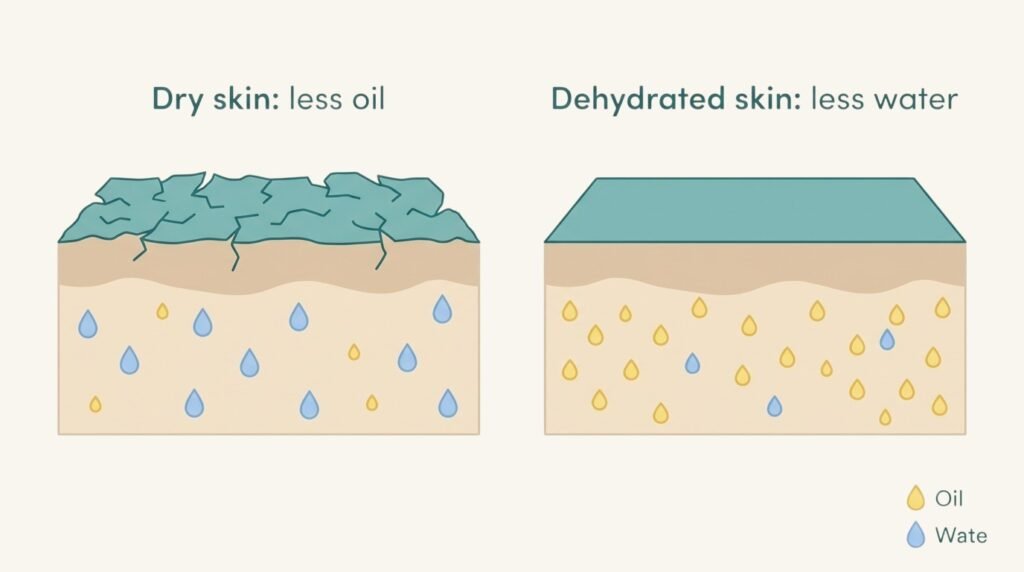
These terms get used interchangeably, but they describe different things. Many men have more than one at the same time.
| Condition | What it means | Common signs | What the cleanser should prioritise |
|---|---|---|---|
| Dry skin | A skin type that produces less oil (sebum) and tends to lose water more easily | Tightness, rough texture, visible flaking, dullness | Mild surfactants, minimal stripping, conditioning ingredients |
| Dehydrated skin | A temporary condition of low water content, which can occur in any skin type, including oily skin | Tightness, dull look, fine lines more visible, sometimes oily and tight together | Gentle cleansing and humectant support; avoid over-washing |
| Sensitive skin | A tendency to react (stinging, burning, itching, redness) to things that shouldn’t normally cause that [10] | Reactions to new products, fragrance, weather or shaving | Simple, low-irritant formulas; fewer potential triggers |
| Irritated / compromised barrier | The skin’s outer layer isn’t doing its protective job well, often after over-washing, harsh actives or weather exposure | Stinging with water or products, redness, persistent flaking, rough patches | Very mild cleansing, fewer washes, pausing exfoliants and actives |
Some context on these terms. “Dry” versus “dehydrated” is a distinction widely used in cosmetic and skincare education, but clinical dermatology more often talks about xerosis (dry skin) and barrier function [3]. Treat the categories as practical guides, not diagnoses.
This guide can’t diagnose you. If you’re unsure where you fall, our guide on How to Find Your Skin Type is a useful starting point, and a dermatologist can assess persistent problems properly.
What the Best Facewash for Dry Skin Should Actually Do
No single product is “the best” for every man with dry skin, so the useful question is what a cleanser should accomplish. A facewash should:
- Remove sweat and everyday dirt, including Indian city pollution and commute grime
- Remove sunscreen and product residue appropriately
- Remove excess sebum
- Do all of that without disrupting skin comfort
The difference between clean and stripped matters here.
Clean skin feels smooth and comfortable within a minute or two of drying. Stripped skin feels tight, “squeaky” or slightly rough, and may look dull or flaky. That squeaky feeling comes from surfactants removing more than dirt. They also remove surface lipids and can interact with proteins in the outer skin layer [4]. For a person with oily skin, some of this may be tolerable. For dry skin, there’s less margin for it.
If your skin feels tight right after washing, that’s a reason to reconsider the product, how often you use it, or both.
Ingredients to Look For in a Facewash for Dry Skin
Ingredients are easier to evaluate by function. One caution applies to all of them: a cleanser stays on your skin for roughly 30–60 seconds before you rinse it off. Ingredients that work well in a leave-on moisturizer don’t necessarily deliver the same effect in a wash-off product. Their presence is encouraging, but it’s rarely a dramatic moisturizing mechanism by itself.
A. Humectants
Humectants attract and hold water in the outer skin layer.
- Glycerin: The best-studied humectant in skincare, with a well-documented role in skin hydration and barrier function [7]. It’s extremely common in cleansers, so its presence alone doesn’t separate a good cleanser from a mediocre one.
- Betaine: A gentle humectant that is often also used to make surfactant systems less irritating.
- Sodium PCA: Part of the skin’s own natural moisturizing factor (NMF), the group of water-binding compounds in the outer skin layer [8].
- Panthenol (provitamin B5): A humectant that is also used for its soothing, skin-conditioning role.
- Sodium hyaluronate / hyaluronic acid: Binds a lot of water, but in a rinse-off product it has limited contact time. It’s a reasonable addition, not a reason to pick a cleanser.
Limitation: Humectants support hydration most effectively in leave-on products, and when used in a humid environment or alongside an occlusive layer. In a cleanser they’re a supporting feature.
B. Skin-Conditioning and Emollient Ingredients
These help soften the skin and reduce the feeling of dryness after rinsing.
- Glyceryl oleate, glyceryl stearate and similar esters: Emollient ingredients that may add some “cushion” to a cleanser.
- Fatty alcohols (cetyl alcohol, stearyl alcohol): Despite the word “alcohol,” these are not drying like ethanol. They act as emollients and texture builders, and are very common in cream cleansers.
- Ceramides: Lipids naturally found in the skin barrier. Their inclusion in a wash-off product is plausible and not harmful, but evidence for meaningful barrier repair from a cleanser is limited. They have a stronger case in leave-on moisturizers.
Formulation context matters: emollients can’t compensate for a harsh surfactant base. A cleanser built on aggressive cleansing agents with a pinch of ceramide on top is still an aggressive cleanser.
C. Soothing Ingredients
- Oat (colloidal oatmeal or oat extracts): Used for decades in skincare for dry, itchy skin, with the stronger evidence coming from leave-on and bath products rather than rinse-off cleansers.
- Allantoin: A common skin-conditioning ingredient used for its soothing, softening effect. Evidence is modest, but it’s low-risk.
- Panthenol: Also appears here for its soothing role.
Don’t expect any soothing ingredient to “treat” irritated skin in a 45-second wash. They’re best viewed as sensible supporting ingredients.
Cleansing Agents: The Most Important Part People Ignore
The first few ingredients after water usually make up the cleansing system, and this is where a cleanser is mostly made or broken.
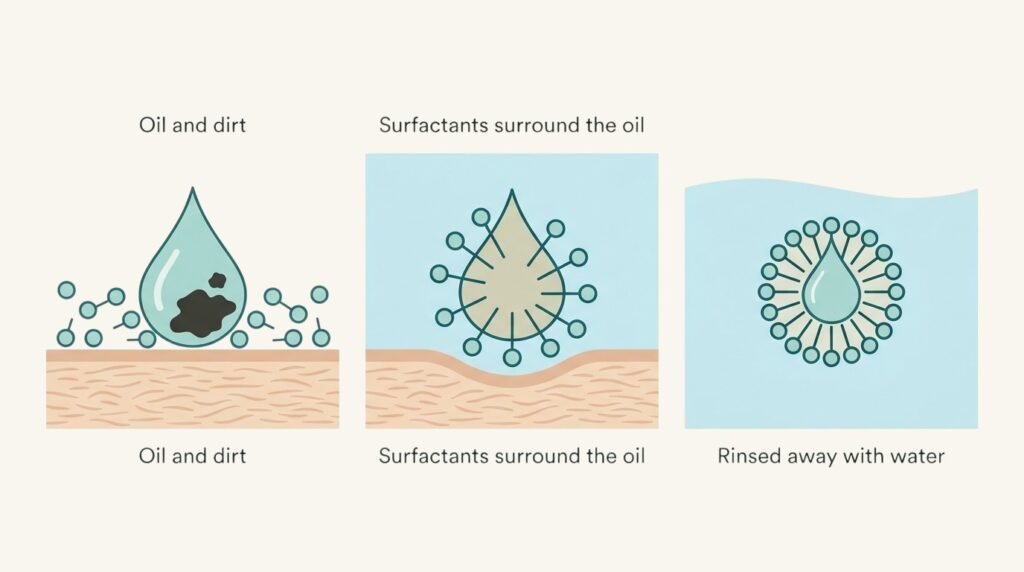
What surfactants do
Surfactants are molecules with a water-loving end and an oil-loving end. They attach to oil, sweat residue and dirt and let water wash them away. You can’t have a cleanser without them. Even a “gentle” product relies on them.
Why “mildness” is complicated
Surfactants differ in how much they interact with the skin’s own proteins and lipids. Some are small and penetrate more readily, which is associated with more irritation. Others form larger structures that are less likely to do so. The cosmetic-science literature generally describes certain classes (such as isethionates, glucosides, amino-acid-based surfactants like glutamates and sarcosinates, and amphoteric surfactants like betaines) as milder options than traditional harsh anionic surfactants, particularly when blended [4][5]. Blending surfactants can also reduce irritation compared with a single one used alone.
Why simple rules fail
- “Sulfate-free” doesn’t automatically mean gentle. Sodium lauryl sulfate (SLS) is a well-known irritant in research settings. But a sulfate-free product can still contain other strong surfactants, and a sulfate-containing product can be tolerable if the system is buffered with milder co-surfactants. The claim tells you what isn’t there, not what is.
- “Natural” doesn’t mean mild. Plant-derived cleansing agents and essential oils can irritate. Natural origin is not a safety or mildness category.
- Concentration matters, but you can’t see it. An ingredient list shows order, not percentage. Surfactant concentration, the surfactant blend and the product’s overall design all influence mildness.
- Use matters too. Even a mild cleanser can cause dryness if used too often, with very hot water, or scrubbed in aggressively.
- pH is one factor. Skin’s surface is mildly acidic, typically around pH 4–6 [6]. Traditional soap is alkaline and can shift skin pH, which is one reason “soap-free” syndet-style cleansers became popular. But pH alone doesn’t determine mildness.
The takeaway: evaluate the cleansing system as a whole, not any one ingredient in isolation.
Cleansers also come in different formats. Foaming gels, cream or lotion cleansers, micellar waters and balms each have a different feel. Cream and lotion formats are often preferred for dry skin because they tend to foam less, but format alone doesn’t determine suitability. The surfactant system still matters.
What to Be Cautious About
This isn’t a blacklist. These are characteristics that may be worth approaching cautiously if dryness or sensitivity is your main concern.
- Very aggressive cleansing. Products built for heavy oil removal (“oil control,” “deep clean,” “matte finish”) are designed for a different problem.
- Strong fragrance. Fragrance is among the more common triggers of contact reactions, and “fragrance-free” is a sensible filter if you’re irritation-prone.
- Essential oils (peppermint, tea tree, citrus oils, lavender and others). They’re often marketed as natural, but they contain fragrance-active compounds that can irritate some skin.
- Strong exfoliating acids such as glycolic or higher-strength salicylic acid, if dryness is the primary issue and you’re using them daily.
- Frequent “deep cleansing” products, including cleansing brushes and scrubs used every day.
- Heavy menthol or cooling agents, which can sting on already irritated skin.
None of these is universally bad, and plenty of people tolerate them. The point is that if your skin is dry, reactive or both, they’re reasonable first suspects when something feels off.
Dry Skin Plus Other Concerns
Dry skin often comes with another concern, such as sensitivity, dehydration, acne, or rough texture. That changes what you should look for in a cleanser. Here’s how.
Dry + Sensitive Skin
Prioritise simplicity. Look for a mild cleansing system, few additives and no strong fragrance or essential oils. Avoid stacking multiple actives. If you add a new product, add one at a time so you can identify what caused a reaction. Persistent burning or stinging, particularly with basic products, is worth discussing with a dermatologist.
Dry + Dehydrated Skin
Dehydrated skin tends to benefit from reducing water loss and supporting hydration. Look for a mild cleanser with humectants, and don’t over-wash. Remember that the real hydration work happens after cleansing, with a moisturizer applied while skin is still slightly damp.
Dry + Acne-Prone Skin
This is where many men go wrong. Standard acne cleansers are often designed for oily skin, with strong surfactants and exfoliating actives. Used on dry skin, they can worsen dryness and irritation. Irritated skin is also less likely to tolerate acne treatments, which can derail the whole routine.
Salicylic acid is not automatically bad. It’s a recognised acne ingredient in dermatology guidelines [9], and it can help with blocked pores. But a wash-off cleanser has limited contact time, so its benefit is typically modest compared with leave-on forms. If you’re dry and acne-prone, a gentle cleanser plus targeted, leave-on treatment is often better tolerated than a strong medicated wash used twice daily. If you’re using salicylic acid cleansers and your skin feels tight or flaky, consider reducing frequency or switching to a gentler base. Moderate-to-severe acne should be assessed by a dermatologist rather than managed through facewash selection alone.
Dry + Dull or Rough Skin
Dull, rough skin tempts people to scrub or use strong exfoliants. But rough texture on dry skin is often caused by buildup of dry cells and a weakened barrier. Aggressive exfoliation can make that worse. Start with a milder cleanser, consistent moisturizing, and gentler exfoliation only if needed.
If your skin is dry on the cheeks but oily in the T-zone, our Combination Skincare Routine for Men covers how to handle both.
Marketing Claims: What Do They Actually Mean?
Facewash labels can be vague. Here’s what common claims usually do and don’t tell you.
| Claim | What it may mean | What it does NOT prove |
|---|---|---|
| Hydrating | Contains humectants or has a lighter, comfortable feel | That the product measurably hydrates skin after rinsing |
| Gentle | The brand considers it mild for general use | That it’s suitable for your skin, or free of irritants |
| Moisturizing | Contains emollients or conditioning agents | That it replaces a moisturizer |
| Barrier-friendly | Marketing language suggesting barrier support, sometimes referencing ceramides | That it repairs your barrier; the term isn’t standardised |
| Dermatologist tested | A dermatologist was involved in some testing | That dermatologists recommend it; testing criteria vary by company |
| pH balanced | Formulated close to skin’s pH, or sometimes just “balanced” loosely | That it’s non-irritating; pH is only one factor |
| Sulfate-free | Doesn’t contain sulfate surfactants | That the surfactants used are mild |
| Soap-free | Doesn’t use traditional soap (fatty acid salts) | That it’s mild; many harsh cleansers are soap-free |
| Non-comedogenic | Formulated or tested to be less likely to clog pores | A guarantee against breakouts; there’s no universal standard |
| Fragrance-free | No added fragrance (but check the definition) | That it has no irritants; “unscented” products may contain masking fragrance |
None of this means brands are being dishonest. These are simply loose terms. The ingredient list tells you far more than the front of the bottle.
How to Read a Facewash Ingredient List
Here is a practical seven-step framework.
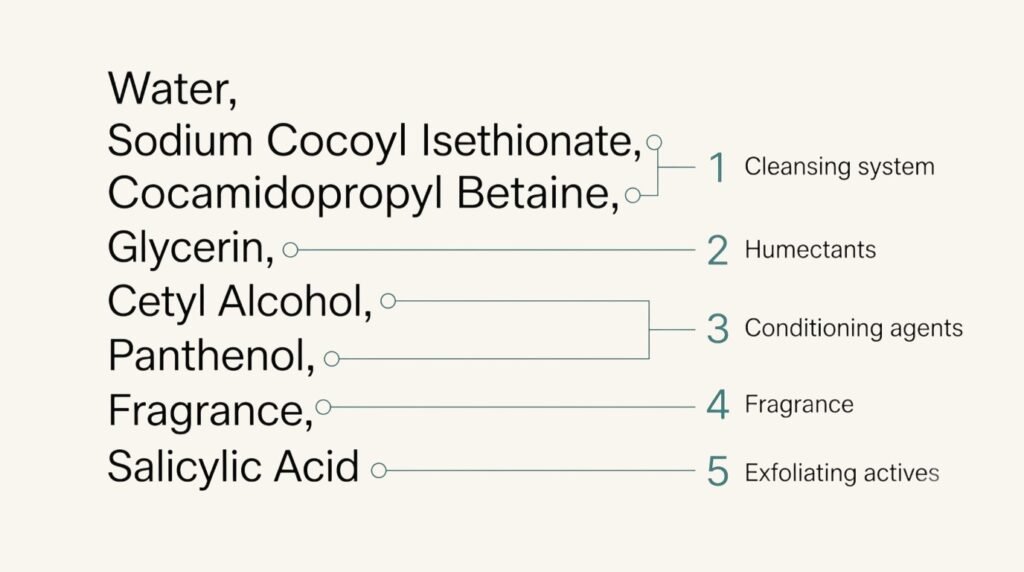
- Find the cleansing system. Look at the first few ingredients after water. Identify the surfactants. Is it a blend? Are there any obviously harsh ones? Remember that the system matters more than any single ingredient.
- Check for supportive ingredients. Look for humectants (glycerin, panthenol, betaine) and conditioning agents (fatty alcohols, glyceryl esters). Their presence is a mild positive signal, not proof of quality.
- Look for fragrance and essential oils. These may appear as “fragrance/parfum” or as named plant oils. If you’re irritation-prone, this is worth noting.
- Identify exfoliating actives. Salicylic acid, glycolic acid, lactic acid, scrubs. Ask whether you actually need exfoliation in a wash.
- Match it to your actual concern. Dry and sensitive? Dry and acne-prone? Dehydrated? Your priorities differ.
- Judge the whole formulation. Ingredients are generally listed in descending order of concentration, but those below roughly 1% can appear in any order. So the position of minor ingredients tells you little.
- Don’t judge from one ingredient. A cleanser with ceramides isn’t automatically good, and one with a known irritant isn’t automatically bad. Look at the overall picture, then let your skin’s response decide.
How Often Should You Wash Dry Skin?
There’s no universal rule, and the evidence here is based on general dermatology practice rather than strong trials. General dermatology guidance recommends washing twice a day and after heavy sweating [1], but individual tolerance varies.
- Evening: Most people benefit from a proper cleanse. It removes sunscreen, sweat, pollution and the day’s buildup, especially in Indian cities where commutes can be long and dusty.
- Morning: If your skin feels dry or tight, rinsing with plain water or using a very mild cleanser may be enough. If you sweat overnight, use heavy night products or have oilier areas, a gentle cleanse may suit you better.
- After sweat or sunscreen: A wash makes sense after workouts, or when you’ve been wearing sunscreen all day.
- Avoid repeated washing. Washing several times a day “to stay fresh” is a common source of dryness.
Experiment gradually. Change one variable at a time (frequency, product, water temperature) and watch how your skin responds over a couple of weeks. If you’re also adjusting the rest of your routine, our Normal Skin Care Routine for Men covers the basics of a cleanse-and-moisturize structure.
Common Facewash Mistakes Men Make
- Using body soap on the face. Many bar soaps are more alkaline and more stripping than facial skin typically tolerates.
- Washing too often. More washes don’t mean cleaner or healthier skin.
- Choosing a cleanser because it foams heavily. Foam is a texture, not a measure of cleaning power or quality.
- Treating “squeaky clean” as healthy. It’s a sign of removal, not of health.
- Using strong acne cleansers on dry skin. See the acne section above.
- Scrubbing flaky skin aggressively. Flakes usually need gentleness and moisture, not friction.
- Changing products too often. Constant switching makes it impossible to know what’s working or causing problems.
- Using very hot water. Hot water can worsen dryness. Lukewarm is usually better, a point reinforced in dermatology advice for dry skin [2].
- Skipping moisturizer after cleansing. Applying moisturizer while skin is still slightly damp helps lock in water.
How to Choose Based on Your Skin’s Response
Rather than relying only on labels, use what your skin tells you after washing. This is a guide, not a diagnosis.
- Tight immediately after washing: Reconsider cleansing strength or frequency. This is often the clearest sign of over-stripping.
- Comfortable but clean: The cleanser is likely well tolerated.
- Burning or stinging: Investigate irritation. Simplify your routine, pause actives and fragrance-heavy products, and see a dermatologist if it persists.
- Flaky after repeated cleansing: Consider whether the cleanser, frequency or exfoliants are contributing.
- Oily later in the day despite dry-feeling skin: This doesn’t automatically mean you need a stronger cleanser. Skin that has been stripped can feel tight and look shiny at the same time. If this sounds like you, our Oily Skin Care Routine for Men explains why over-cleansing oily skin can backfire.
Give a new cleanser at least a couple of weeks unless it causes obvious irritation, in which case stop using it.
Conclusion
Choosing the best facewash for dry skin isn’t about brand names, big foam, a “hydrating” label, one hero ingredient or “sulfate-free” alone. Those are surface signals.
What matters is the cleansing system, the supporting formulation, your particular skin concern (dry, dehydrated, sensitive, acne-prone or a mix), the product’s irritation potential, and above all how your skin feels after you wash.
A good cleanser should leave your face clean and comfortable, not tight. If you remember one rule, make it this: your face should feel better after washing, not just cleaner.
Frequently Asked Questions
What is the best facewash for dry skin?
There’s no single best facewash for dry skin, because suitability depends on the formulation and your individual skin. The most reliable approach is to choose a mild cleansing system with supportive humectants and conditioning ingredients, and to avoid anything that leaves your skin tight.
What should I look for in a facewash for dry skin?
Look for a mild surfactant system, humectants such as glycerin or panthenol, and conditioning ingredients such as fatty alcohols. If your skin is reactive, prefer fewer potential irritants such as fragrance and essential oils. Then judge by how your skin feels afterwards.
Is face wash necessary for dry skin?
Usually yes, at least once a day, typically in the evening. Dry skin still collects sweat, dirt, sunscreen and pollution. Some people with very dry skin manage with water alone in the morning, but evening cleansing is generally sensible.
Should dry skin use a foaming cleanser?
Not necessarily, but it can. Foam doesn’t tell you whether a cleanser is harsh or mild. Some foaming cleansers are well tolerated, while others strip skin. Cream or lotion cleansers are often preferred for dry skin, but the surfactant system matters more than the format.
Is salicylic acid face wash good for dry skin?
It can be, but it often isn’t the best first choice. Salicylic acid is a recognised acne ingredient [9], but in a wash-off product it’s usually combined with stronger cleansing agents and can worsen dryness. If you use it, consider less frequent use and a moisturizer afterwards.
Can dry skin use face wash twice a day?
Often yes, if the cleanser is mild and your skin tolerates it. Twice-daily washing is a common general recommendation [1], but if you notice tightness or flaking, reducing to once a day or using water in the morning may help.
Is fragrance-free face wash better for dry skin?
It can be better if your skin is sensitive or easily irritated, since fragrance is a common trigger. If your skin tolerates fragranced products well, it isn’t essential. Check that “fragrance-free” isn’t confused with “unscented,” which may still include masking fragrance.
What ingredients should I avoid in a face wash for dry skin?
There’s no universal avoid-list, but some things may be worth approaching cautiously: aggressive surfactant systems, strong fragrance, essential oils and frequent use of strong exfoliating acids. Individual tolerance varies, so patterns in your own skin’s reactions matter more than a fixed list.
What is the difference between dry and dehydrated skin?
Dry skin is a skin type that produces less oil, while dehydrated skin is a temporary condition of low water content that can affect any skin type. Dry skin tends to feel rough or flaky, while dehydrated skin often looks dull and tight. They can occur together.
Can men with dry skin use acne face wash?
It’s possible, but it requires care. Many acne cleansers are designed for oily skin and can worsen dryness. If you have both concerns, a gentle cleanser with a separate, targeted acne treatment is often better tolerated. For persistent or moderate-to-severe acne, see a dermatologist.
Authoritative Sources
- Fluhr JW, Darlenski R, Surber C. Glycerol and the skin: holistic approach to its origin and functions. British Journal of Dermatology. 2008;159(1):23–34.
- Rawlings AV, Harding CR. Moisturization and skin barrier function. Dermatologic Therapy. 2004;17(Suppl 1):43–48.
- Reynolds RV, Yeung H, Cheng CE, et al. Guidelines of care for the management of acne vulgaris. Journal of the American Academy of Dermatology. 2024;90(5):1006.e1–1006.e30.
- Misery L, Ständer S, Szepietowski JC, et al. Definition of sensitive skin: an expert position paper from the Special Interest Group on Sensitive Skin of the International Forum for the Study of Itch. Acta Dermato-Venereologica. 2017;97(1):4–6.