
TGJ Note: The Grooming Journal does not recommend products simply for the sake of recommending them. We create buying guides to help you understand your options and make a more informed decision based on your specific grooming concern, needs, and preferences.
The products we feature are not sponsored placements. We select and assess products based on relevant product information, such as ingredients, formulation, materials, specifications, stated purpose, and how well they fit the specific concern or need discussed in the guide.
We do not physically purchase or test the products featured in our guides. Our assessments are based on publicly available product information, manufacturer details, ingredients or materials, specifications, and other relevant evidence.
Some links in our articles may be affiliate links, which means TGJ may earn a commission if you make a purchase through them. This does not influence which products we include or how we assess them.
If we ever feature a sponsored product or sponsored placement, it will be clearly identified as sponsored. Sponsored content will not be presented as an independent, non-sponsored recommendation.
Our goal is simple: we don’t tell you what to buy. We help you understand what you’re buying.
Quick Summary
The right beard trimmer is not necessarily the one with the most attachments or the highest price. Choose one based on your usual beard length, trimming routine, required precision, skin tolerance, and maintenance needs.
- Short beard: Prioritize precise, small-length adjustments.
- Medium or long beard: Look for a wider usable length range.
- Shaping: Precision control and an appropriate blade design matter.
- Sensitive skin: Consider skin-friendly blade features and trimming technique.
- Frequent use: Battery life, charging, motor consistency, and cleaning become more important.
- Blade construction: Understand what stainless steel, titanium coatings, and other blade terms actually mean.
The core rule is simple: choose the trimmer around your grooming routine, not around its feature list.
Choosing a beard trimmer can look simple until you compare the number of length settings, combs, blade materials, charging systems, and styling features available.
A man maintaining 2–3mm stubble every other day has different requirements from someone maintaining a beard above 15–20mm. Someone who mainly shapes a cheek line also needs a different level of control from someone who only trims the entire beard to one length.
Your beard length, density, trimming frequency, styling goals, skin tolerance, and maintenance habits should therefore guide the decision.
This guide explains what to look for in a beard trimmer, how the major features affect everyday use, and which specifications are actually worth paying attention to.
For basic preparation and technique, see our beginner beard grooming routine.
Table Of Contents
How Do You Choose a Beard Trimmer?
Choose a beard trimmer based on your usual beard length, trimming purpose, required precision, skin tolerance, and maintenance routine. Short stubble usually benefits from precise low-length settings, while longer or denser beards need a wider trimming range and consistent cutting performance. The right trimmer should match how you actually maintain your beard rather than simply offering the most features.
Types of Beard Trimmers
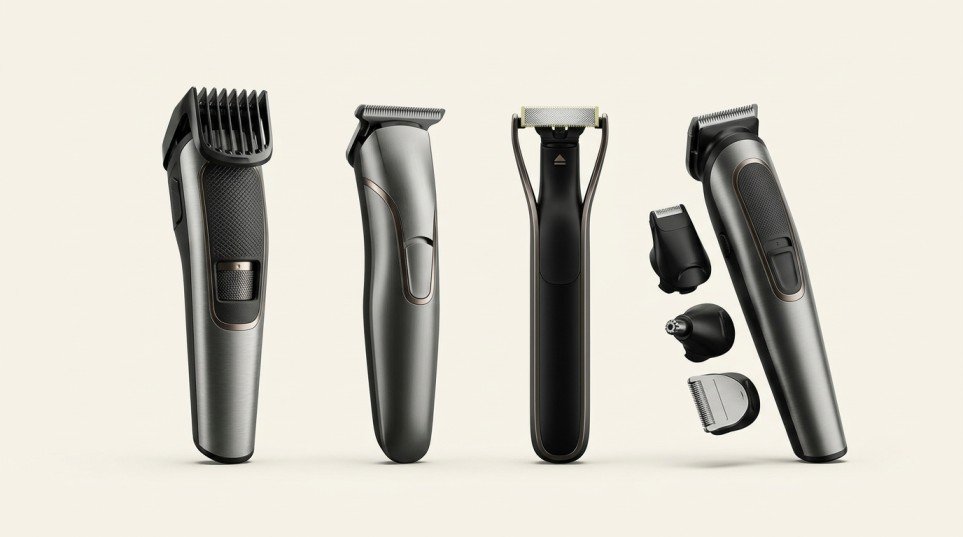
Different trimmers are designed around different grooming routines. The right type depends more on how you maintain your beard than on how many accessories come in the box.
1. Basic Beard Trimmers
These are designed mainly for routine beard and moustache trimming.
They generally suit users who:
- Maintain one or a few beard lengths
- Do not need extensive body-grooming attachments
- Prefer a straightforward setup
- Want fewer accessories to manage
For a simple beard routine, a large number of attachments may add complexity without adding much practical value.
2. Stubble and Precision Trimmers
These focus on shorter lengths and detailed control.
They can be useful for:
- Short stubble
- Defined moustaches
- Cheek-line maintenance
- Neckline shaping
- Small corrections around facial hair
When trimming at very short lengths, even small changes in adjustment can noticeably affect the finished appearance.
3. Multi-Grooming Trimmers
Multi-grooming systems combine beard trimming with additional functions such as head, body, or detail grooming.
They can make sense if you want one device for several grooming tasks.
However, extra attachments are only useful if you will actually use them.
4. Hybrid Trimmer-Shavers
Some devices combine trimming, edging, and shaving functions.
The Philips OneBlade system, for example, is designed around trimming, edging, and shaving rather than functioning like a conventional beard trimmer alone. Exact combs and specifications vary by model, so the specific model should always be checked before purchase.
These systems can be useful when your routine involves switching between beard lengths, edging, and closer shaving.
Match the Trimmer to Your Beard
Short Stubble: Around 1–5mm
For short stubble, precision is usually more important than a very wide maximum length.
Look for:
- Small length increments
- Stable comb positioning
- Good visibility around edges
- Comfortable operation at short settings
A precision-oriented trimmer can be more useful here than a multi-grooming kit with dozens of accessories.
Medium Beard: Around 6–15mm
A medium beard benefits from a wider range of practical length settings.
Look for:
- Reliable length control
- Secure combs
- Consistent cutting performance
- Easy cleaning
If you regularly change between different lengths, an integrated adjustment system can also be convenient.
Long Beard: 15mm+
Longer beards require more length range.
A trimmer that stops at 10mm may be perfectly adequate for short and medium beards but unsuitable if you regularly maintain a beard above 15mm.
Longer-beard users should pay particular attention to:
- Maximum usable length
- Comb stability
- Motor consistency
- Number of passes required
- Cleaning and maintenance
For Shaping
If your main goal is defining cheek lines, moustache edges, or the neckline, look beyond maximum length.
Useful features can include:
- A precision attachment
- Good visibility around the blade
- A narrow trimming head
- Stable control at short lengths
For Sensitive Skin
No trimmer can guarantee irritation-free trimming.
If your skin is easily irritated, pay attention to:
- Rounded blade tips
- Skin-protection features
- Smooth comb movement
- Wet/dry compatibility where relevant
- Cleaning requirements
You may be able to reduce unnecessary friction by combining an appropriate trimmer with controlled pressure, clean equipment, and a suitable trimming technique.
If you frequently experience persistent irritation, bumps, or ingrown hairs, grooming technique and skin care may need attention beyond the trimmer itself.
For Frequent Trimming
If you trim several times a week, convenience becomes more important.
Consider:
- Battery runtime
- Charging time
- Charging connector
- Cleaning method
- Replacement parts
- Blade maintenance
- Ergonomics
A feature that seems minor during occasional use can become much more noticeable when you use the device repeatedly.
For Beard + Hair + Body Grooming
If one device is intended to cover several grooming tasks, a multi-grooming system may make more sense.
But compare the actual attachments you need rather than choosing based on the number printed on the box.
For Travel
For travel, consider:
- Battery runtime
- Charging compatibility
- Size
- Weight
- Lock function
- Ease of cleaning
- Number of accessories required
A compact setup can be more practical than carrying a large collection of attachments.
For a Limited Budget
Budget should not be the only selection criterion.
Instead, identify the features you actually need first.
For example, paying more for ten additional attachments does not necessarily make sense if you only maintain one beard length.
Beard Density Matters
Beard density can affect how a trimmer feels in actual use.
A dense beard can place more demand on the cutting system, especially when trimming longer hair or making repeated passes.
For dense or coarse facial hair, look for a device designed to maintain consistent cutting performance rather than focusing only on the number of length settings.
Patchy or Uneven Beard
A trimmer cannot change beard density or make patchy growth biologically uniform.
However, consistent length and controlled shaping can change how uneven growth looks.
If patchiness is your main concern, see our guide on how to style a patchy beard.
What to Check Before Choosing a Beard Trimmer
1. Length Range
Check the actual usable trimming range rather than only the number of settings.
A trimmer with 40 settings is not automatically more useful than one with 20 if both cover the lengths you actually use.
2. Precision of Adjustment
Some trimmers use an adjustable dial, while others rely on separate combs.
An integrated adjustment system can make frequent length changes easier, while separate combs may be simpler for fixed-length routines.
3. Guards and Combs
Look at:
- Number of combs
- Minimum length
- Maximum length
- Increment size
- How securely each comb attaches
A large number of combs is only useful if they cover the lengths you need.
4. Blade Design
Blade terminology can be confusing.
Manufacturers may describe blades using terms such as:
- Stainless steel
- Titanium
- Self-sharpening
- Skin-friendly
- Precision blades
- Dual-cut
These terms describe different aspects of the cutting system and should not be treated as interchangeable.
5. Motor Performance
Motor behaviour matters more when cutting dense or coarse hair.
A trimmer that can maintain consistent cutting performance through thicker areas may require fewer repeated passes than one that struggles under load.
However, motor power alone does not determine trimming quality. Blade design, comb geometry, hair characteristics, and technique also matter.
6. Battery and Charging
Check:
- Runtime
- Charging time
- Charging connector
- Corded/cordless operation
- Whether the device can be used while charging
For regular use, battery convenience can matter as much as the headline runtime.
7. Wet or Dry Use
Wet/dry compatibility can make cleaning easier and may suit users who prefer trimming with water.
But waterproofing should never be assumed simply because a trimmer is washable.
Always check the manufacturer’s instructions for the specific model.
8. Cleaning
Look for a cleaning process you will realistically follow.
A trimmer that requires complicated maintenance may become harder to keep in good condition.
9. Replacement Parts
Check whether the manufacturer provides replacement:
- Blades
- Foils
- Combs
- Charging accessories
This becomes particularly important for systems with replaceable cutting components.
10. Warranty and Support
A longer warranty is useful only when service and replacement support are actually accessible.
Check the manufacturer’s warranty terms rather than relying solely on seller descriptions.
Titanium vs Stainless Steel Beard Trimmer Blades
“Titanium” and “stainless steel” are often presented as if they represent two completely different categories of blades.
In practice, the construction can be more complicated.
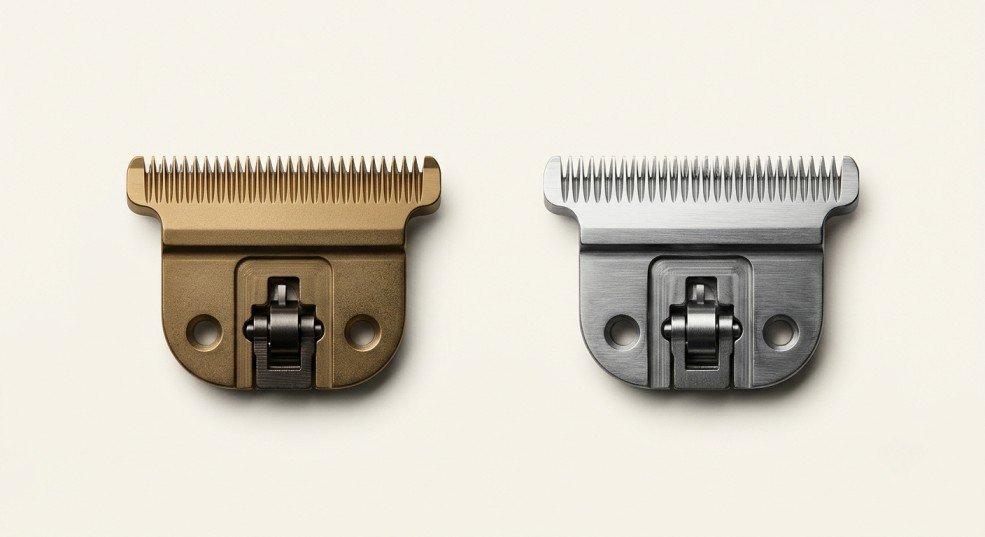
Some consumer trimmers use steel cutting components with a titanium-based coating or surface treatment. In such cases, “titanium” does not necessarily mean the entire cutting element is made from solid titanium.
Titanium-based coatings such as titanium nitride are used in cutting and wear-resistant applications because of their hardness and surface properties.
Comparison
| Feature | Stainless Steel | Titanium / Titanium-Coated |
|---|---|---|
| Base material | Often used for cutting components | May refer to coating or surface treatment |
| Corrosion resistance | Generally good | Depends on the underlying material and coating |
| Wear resistance | Depends on alloy and treatment | Can be improved with suitable coatings |
| Cutting performance | Depends on blade geometry and sharpness | Depends on the complete cutting system |
| What matters most | Material + design + maintenance | Coating + base material + design + maintenance |
The important point is that blade material alone does not determine trimming quality.
Blade geometry, sharpness, motor behaviour, comb design, and maintenance can all influence the result.
T-Blade vs Standard or Contoured Beard Trimmer
T-blades have a wider, often exposed cutting profile and are commonly associated with outlining and detailed work.
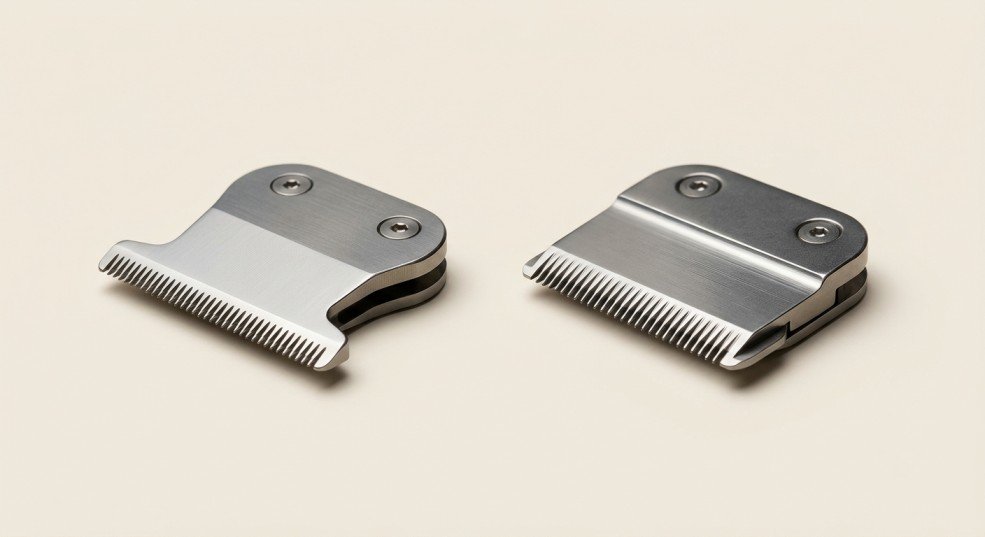
They can be useful for:
- Sharp outlines
- Edge detailing
- Moustache shaping
- Neckline work
Standard or contoured trimmer heads are generally designed around routine beard-length reduction and easier movement across larger areas.
The terminology is not completely standardized across grooming brands, so compare the actual head design rather than relying only on the name.
Does a Higher-Priced Trimmer Mean Better Trimming?
Not necessarily.
A higher price may reflect:
- More attachments
- Better battery technology
- Premium materials
- More precise adjustment
- Improved ergonomics
- Brand positioning
- Additional grooming functions
But none of these automatically makes a trimmer more suitable for your routine.
If you only maintain 3mm stubble, a device designed around extensive long-beard styling may offer features you never use.
Let your requirements determine the features, rather than letting the feature list determine your requirements.
Here Are Some Options You Can Choose From
The products below represent different combinations of beard-length range, precision, grooming functions, and charging options. They are included to help you compare different types of trimmers, not as a ranking or personal recommendation.
1. Philips OneBlade Face QP2724/10
| Suitable For ➞ | Men who mainly need a trimmer for stubble, edging and short facial-hair styles |
| Pros ➞ | Trim, edge and shave functionality; 1, 3 and 5 mm stubble combs; dual-sided blade; rounded tips and dual-protection system; wet and dry use |
| Cons ➞ | The included combs are focused on shorter beard lengths, so it is less suitable for maintaining a long beard |
| Full Specifications ➞ | Official Philips Specifications → |
The Philips OneBlade QP2724/10 is designed differently from a conventional beard trimmer. Its main strength is controlling shorter facial hair while also allowing edging and shaving. The included 1, 3 and 5 mm combs make it particularly relevant for stubble and short-beard routines, while the dual-sided blade helps with outlining.
Check price and latest deals ➞
2. Xiaomi Beard Trimmer 2C
| Suitable For ➞ | Men who want precise beard-length control from stubble through longer beard styles |
| Pros ➞ | 40 length settings; 0.5 mm precision; 0.5–10 mm and 10.5–20 mm comb ranges; stainless-steel blades; up to 90-minute runtime; USB Type-C charging; washable attachments |
| Cons ➞ | Cordless use only; the trimmer body itself is not washable |
| Full Specifications ➞ | Official Xiaomi Specifications → |
The Xiaomi Beard Trimmer 2C is more focused on beard-length control than multi-grooming. Its two combs cover 0.5 to 20 mm in 40 settings, making it relevant for users who regularly move between stubble, short beard and longer beard lengths.
Check price and latest deals ➞
3. Philips All-in-One Trimmer 3000 Series MG3927/15
| Suitable For ➞ | Men who want one grooming device for beard, hair and selected body-grooming tasks |
| Pros ➞ | 9-in-1 design; self-sharpening steel blades; rounded blade tips; 0.5 mm precision trimming comb; beard, hair and body grooming attachments |
| Cons ➞ | More attachment-focused than a dedicated beard trimmer; users looking only for beard trimming may not need the additional tools |
| Full Specifications ➞ | Official Philips Specifications → |
The MG3927/15 takes a multi-grooming approach rather than focusing only on beard length. Its nine tools and 0.5 mm precision trimming comb make it relevant for users who want to handle beard, hair and other grooming tasks with one device.
Check price and latest deals ➞
4. Philips All-in-One Trimmer 7000 Series MG7922/15
| Suitable For ➞ | Men who want a more comprehensive face, head and body grooming system |
| Pros ➞ | 13-in-1 design; self-sharpening steel blades; BeardSense technology; premium precision comb; face, head and body grooming tools |
| Cons ➞ | More equipment than necessary for someone who only maintains a beard |
| Full Specifications ➞ | Official Philips Specifications → |
The MG7922/15 is positioned as a broader grooming system rather than a beard-only trimmer. Its 13 tools cover face, head and body grooming, while BeardSense technology and the precision comb are designed to support more controlled trimming.
Check price and latest deals ➞
5. NOVA NHT 1053
| Suitable For ➞ | Men who want a wide trimming range and long battery runtime for beard, moustache and general grooming |
| Pros ➞ | 40 length settings; 0.5–20 mm trimming range; stainless-steel blades; up to 160-minute claimed runtime; corded and cordless operation; washable head; 2-year brand warranty |
| Cons ➞ | Not water-resistant; specifications and accessories should be checked against the current seller listing before purchase |
| Full Specifications ➞ | Official NOVA Product Specifications → |
The NOVA NHT 1053 stands out mainly for its combination of a broad 0.5–20 mm range, 40 length adjustments and long claimed runtime. That makes it a useful example in a buying guide for users who want flexibility across different beard lengths without moving into a more expensive multi-grooming system.
Check price and latest deals ➞
Disclaimer: specifications, features, included attachments, pricing, and availability can change or be updated by the manufacturer or retailer over time. Our product assessments are based on the product information and specifications available to us at the time of writing or updating this guide.
Always check the current specifications, included accessories, warranty information, and other product details on the manufacturer’s official website or the product listing before purchasing. Do not assume that an older specification or product listing is identical to the current version.
If a product’s specifications or availability change and the change comes to our attention, we will make reasonable efforts to review and update our assessment and product list where appropriate. However, we cannot guarantee that every change will come to our attention immediately—or at all.
Our assessment therefore reflects the information available to us at the time of the latest update.
How to Maintain a Beard Trimmer
Good maintenance helps keep a trimmer clean and usable over time.
1. Clean the Cutting Area
Remove trapped hair after use according to the manufacturer’s cleaning instructions.
2. Clean the Combs
Hair can accumulate inside combs and affect how smoothly they move through the beard.
3. Keep the Device Dry When Required
Do not assume that every washable trimmer can be submerged or used in the shower.
Follow the specific manufacturer’s instructions.
4. Store It Properly
Avoid leaving grooming equipment exposed to unnecessary moisture for long periods, particularly when the device contains exposed metal components or is not designed for wet storage.
5. Check the Blades
Dull or damaged cutting elements can make trimming less efficient and may increase the need for repeated passes.
6. Replace Consumable Parts
If the manufacturer provides replacement blades or other cutting components, monitor their condition and replace them according to the manufacturer’s guidance.
If you use your trimmer several times a week, a little maintenance goes a long way. Clear out trapped hair, keep the attachments clean, and handle the blades carefully. These simple habits can help the trimmer stay consistent and make your regular grooming routine easier over time.
Conclusion
Choosing a beard trimmer is mainly about matching the tool to your grooming routine.
Start with your usual beard length and trimming frequency. Then consider precision, length range, blade design, motor performance, battery, charging, wet/dry capability, cleaning, and replacement support.
You do not need the trimmer with the longest list of features. You need one whose useful features match the way you actually maintain your beard.
That is the difference between buying a feature list and choosing a grooming tool.
Frequently Asked Questions
What should I look for in a beard trimmer?
Focus on the length range, adjustment precision, blade design, comb stability, battery, cleaning requirements, and whether the trimmer suits your beard length and trimming routine.
What beard trimmer length is best for short stubble?
Short stubble generally benefits from low-length settings with small adjustment increments. The exact setting depends on the appearance you want to maintain.
Is a beard trimmer suitable for a long beard?
Yes, but check the usable maximum length. If you maintain a beard above 15–20mm, a trimmer that stops at 10mm may not cover your needs.
Is titanium better than stainless steel for beard trimmers?
Not automatically. “Titanium” may refer to a coating or surface treatment rather than a solid titanium cutting element. Overall blade construction and design matter more than the material name alone.
Are more beard trimmer settings better?
Not necessarily. A smaller number of useful settings can be more practical than dozens of settings that you never use.
Is a cordless beard trimmer better than a corded one?
Neither is universally better. Cordless models provide greater freedom of movement, while corded operation can be useful when uninterrupted power is important.?
Can a beard trimmer reduce irritation?
A suitable trimmer and controlled technique may help reduce unnecessary friction, but no trimmer can guarantee irritation-free grooming.
Can a beard trimmer fix a patchy beard?
No. A trimmer cannot change the underlying pattern of beard growth. It can, however, help maintain an even length and controlled shape.
For more guidance, see how to fix a patchy beard.
How often should I clean my beard trimmer?
Clean it according to the manufacturer’s instructions and remove trapped hair regularly. Frequent users may need to clean it after every few sessions.
Authoritative Sources
- American Academy of Dermatology — A Dermatologist’s Top Tips for a Healthy Beard
- American Academy of Dermatology — DIY Treatment for Common Beard Problems
- American Academy of Dermatology — How to Shave
- American Academy of Dermatology — Razor Bump Prevention
- Cleveland Clinic — What May Be Causing Your Itchy Beard?
- Philips — OneBlade QP2724/10 Official Specifications
- Xiaomi — Beard Trimmer 2C Official Specifications