Quick Summary
This guide explains how to build a combination skincare routine for men — one that manages an oily T-zone and drier cheeks without overtreating either. You’ll learn the morning and evening steps, how to layer products by zone, which weekly extras help, common mistakes to avoid, and how to keep the routine simple enough to actually stick with.
If your forehead and nose are shiny by lunchtime while your cheeks feel tight after washing, you don’t have “bad” skin — you have two skin types on one face, and most routines aren’t built for that. A proper combination skincare routine for men treats the T-zone and the cheeks differently instead of forcing one product to do two jobs.
Not sure if combination skin is actually what you’re dealing with? It’s worth confirming first—a quick guide on How to Find Your Skin Type takes less than a minute and will save you from buying products that don’t match what your face is actually doing. Written as a beginner skincare routine for men who’ve never had to think about skin type before, this guide walks through the exact morning and evening steps, the mistakes that quietly undo good routines, and how to adjust things as the seasons change.
Table Of Contents
What Is a Combination Skincare Routine for Men?
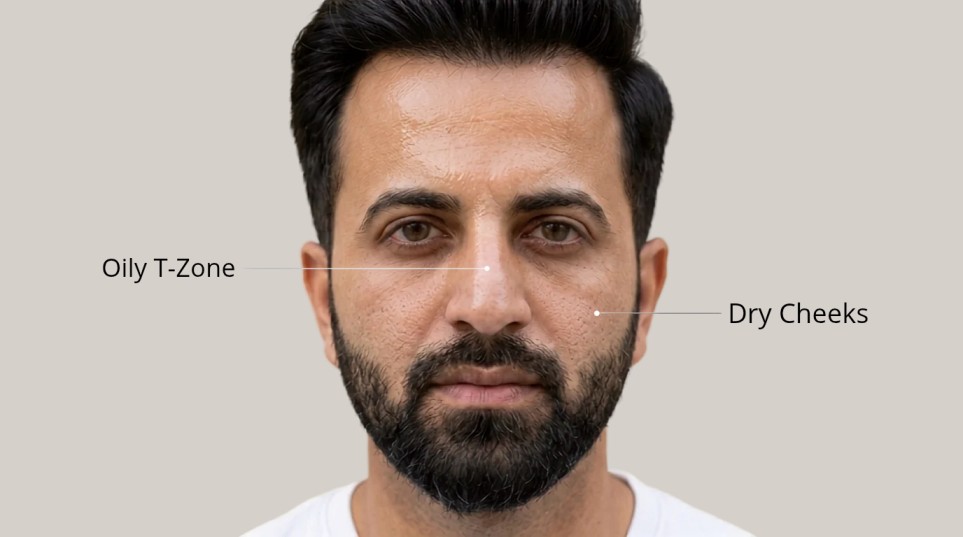
A combination skincare routine for men is a face care approach that treats an oily T-zone (forehead, nose, chin) and a normal-to-dry perimeter (cheeks, jawline) with different product weights instead of one formula for the whole face. It typically includes a gentle cleanser, a lightweight gel or oil-free moisturizer for the T-zone, a richer cream for the cheeks, and daily sunscreen.
Understanding Combination Skin in Men
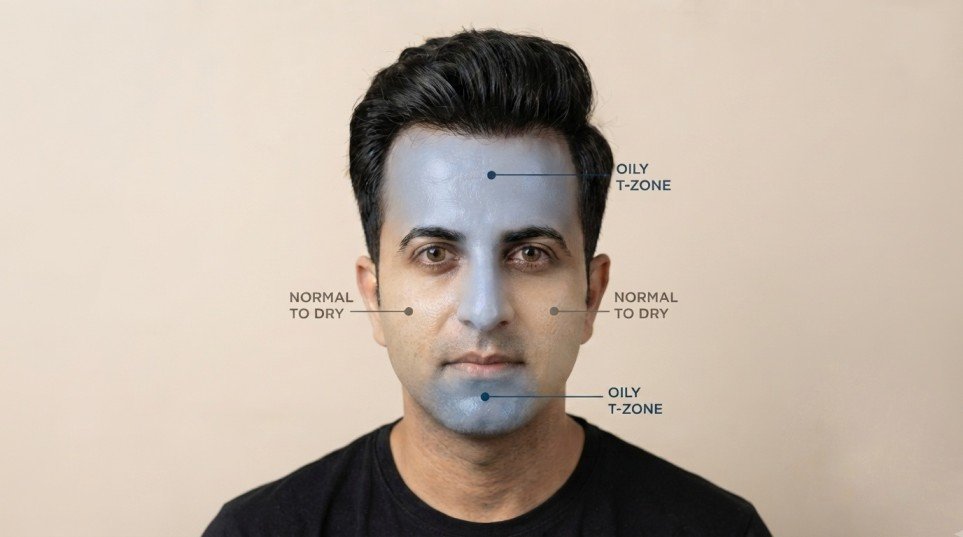
Combination skin is widely regarded as the most common skin type among men, and the reason usually comes down to sebaceous gland density — the T-zone simply has more oil glands per square centimeter than the cheeks or jaw. That’s not something a cleanser or serum “fixes”; it’s baseline anatomy, which is why treating the whole face identically rarely works long-term. A men’s skincare routine for combination skin has to work with that anatomy rather than against it, which is the whole logic behind treating zones differently instead of picking one product and hoping it covers everything.
Shaving adds a second variable most guides ignore. Repeated blade contact along the jaw and cheeks disrupts the skin barrier, which can make those areas feel drier or more sensitive than they’d naturally be — sometimes to the point where men mistake barrier damage for a separate “dry skin problem” rather than a side effect of their shaving habits. If that’s the case, a fragrance-free, alcohol-free moisturizer applied immediately after shaving does more to calm that irritation than any product change elsewhere in the routine.
Skin that’s oily across the entire face, including the cheeks — isn’t combination skin, and following a combination routine in that case will under-treat the oil. In that scenario, a dedicated oily skincare routine will get better results. Likewise, if the T-zone isn’t noticeably oilier than the rest of the face, a dry skincare routine is the more accurate fit.
Building Your Morning Combination Skincare Routine
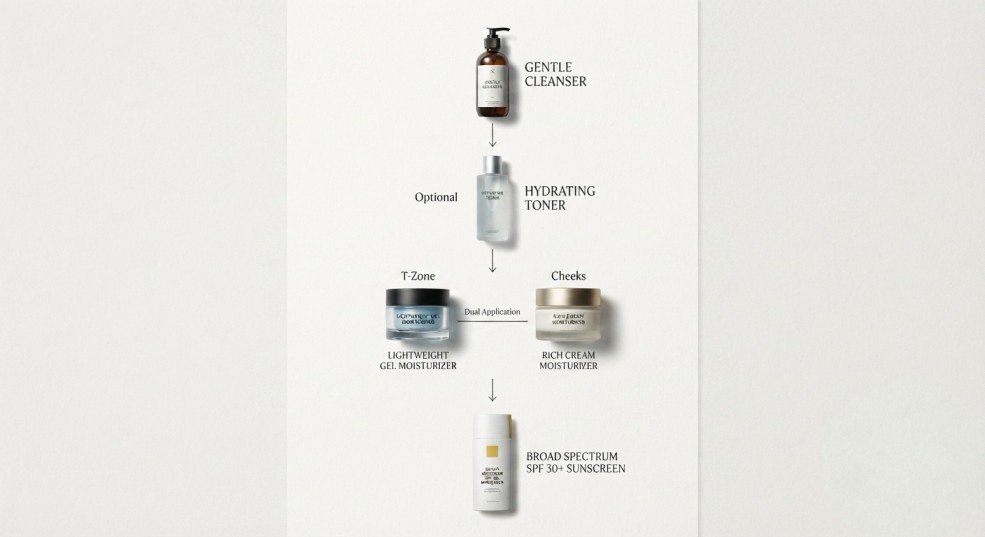
If you’re figuring out how to build a skincare routine for combination skin from scratch, this is where it starts. The morning routine has one job: clean without stripping, hydrate without adding shine, and protect against UV damage before you leave the house.
Step 1: Cleanse With a Gentle, Non-Stripping Formula
Use a gel or foaming cleanser that clears oil and sweat without leaving skin feeling tight afterward. A cleanser that’s too harsh doesn’t just dry out the cheeks — it signals the T-zone to produce more oil to compensate, which is the opposite of what you’re going for.
Step 2: Add a Lightweight Hydrating Layer (Optional)
A water-based toner or essence can prep skin before moisturizer, particularly useful if the cheeks feel undersupported by moisturizer alone. It’s a nice-to-have, not a requirement — skip it if your routine already feels complete without it.
Step 3: Moisturize by Zone
This is the step that separates a working combination routine from one that fights itself. Rather than applying moisturizer evenly:
- Use a lightweight, oil-free or gel-based moisturizer on the T-zone.
- Use a richer, more emollient moisturizer on the cheeks and jawline.
Two separate products work well, but so does one moisturizer applied thin on the T-zone and thicker on the cheeks — the zone-based logic matters more than the product count.
Step 4: Apply Sunscreen Daily
Broad-spectrum SPF 30 or higher isn’t optional, regardless of skin type — it’s the single step with the strongest evidence behind it for preventing premature aging and reducing skin cancer risk. Choose a lightweight, non-comedogenic formula so it doesn’t undo the balance you just built. Most men also apply far less than the amount sunscreens are actually tested at — roughly a nickel-sized amount for the face is the real benchmark, not the thin layer most routines get away with.
Building Your Evening Combination Skincare Routine
Evenings remove the day’s buildup and set skin up to repair overnight, which is when most visible improvement actually happens.
Step 1: Double Cleanse If You Wore Sunscreen or Sweated Heavily
An oil-based or micellar first cleanse, followed by your regular cleanser, removes sunscreen and oil buildup more thoroughly than one wash alone — especially relevant for the T-zone, where residue is most likely to sit in pores overnight.
Step 2: Exfoliate 2–3 Times a Week, Not Daily
A chemical exfoliant — typically a salicylic acid formula (around 0.5–2%) for the T-zone or a milder lactic acid for the cheeks — clears buildup without over-drying skin. Combination skin generally needs a slower cadence than straightforward oily skin: exfoliating the whole face on an oily-skin schedule is one of the fastest ways to leave the cheeks irritated within a couple of weeks.
Step 3: Apply Targeted Treatments
If you’re using a treatment serum — for oil control, texture, or hydration — apply it only to the area it’s meant for. Spreading a T-zone-formulated serum across the cheeks usually does more harm than good.
Step 4: Finish With Night Moisturizer
The same principle from the morning carries over here — go lighter where skin runs oily, heavier where it runs dry. Skipping this step because skin feels oily at night is one of the more common reasons combination routines stall out.
Weekly Add-Ons for Combination Skin
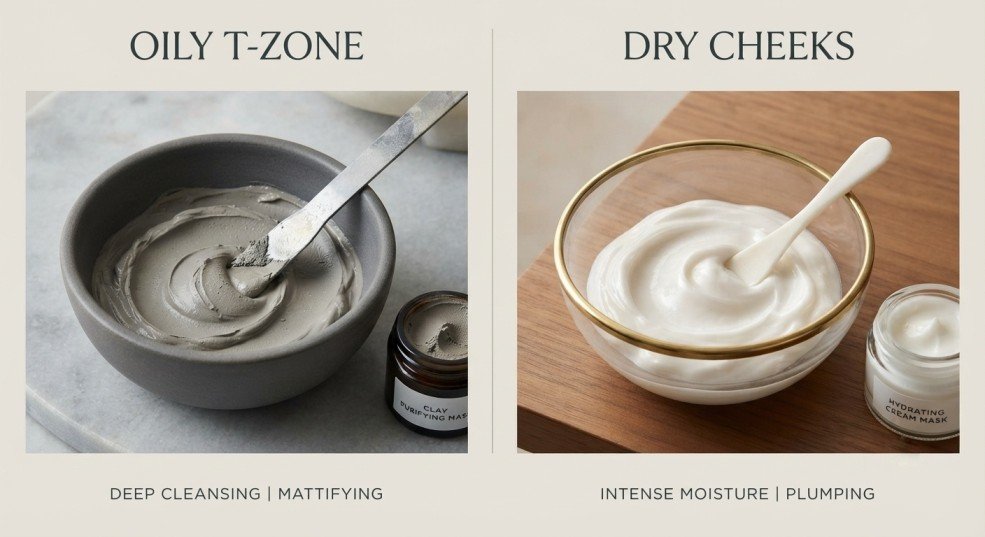
Two optional weekly additions can help manage the different needs of each zone without adding daily complexity:
- A clay or charcoal mask on the T-zone only, once a week, to absorb excess oil and reduce the appearance of enlarged pores.
- A hydrating mask on the cheeks, once a week, to replenish moisture without affecting the T-zone.
Both can be applied in the same session — one product per zone, ten to fifteen minutes, rinse.
Best Practices for Long-Term Balance
Beyond the daily steps, a few combination skin care tips for men are what actually separate a routine that works for a week from one that still works a year from now.
Adjust the Routine Seasonally
Combination skin shifts with humidity. Most men need a slightly richer moisturizer in winter and a lighter one in summer, using the same core routine but adjusting product weight rather than swapping the whole system.
Introduce New Products One at a Time
Add any new cleanser, serum, or moisturizer alone for one to two weeks before introducing another. If irritation or breakouts show up, you’ll know exactly what caused it instead of guessing across three new products at once.
Patch Test Active Ingredients First
Apply a small amount of any new active — retinoids, acids, strong actives — to the jawline for a few days before using it on the whole face. The T-zone and cheeks tolerate actives differently, and the jawline is a reasonable middle ground to test on.
Keep the Product List Lean
A combination routine doesn’t need more products than a standard one — it needs more intentional use of the same core products: cleanser, one or two moisturizer weights, sunscreen, and an occasional exfoliant or mask.
Rinse After Workouts, Don’t Just Wipe
Sweat mixes with T-zone oil and whatever product is still sitting on the skin, and wiping it off with a towel just spreads that mix around rather than removing it. A quick rinse with your regular cleanser — or oil-absorbing sheets when a full rinse isn’t practical — right after training is a small habit that keeps post-workout breakouts along the hairline and forehead from becoming a recurring pattern.
The Role of Nutrition and Hydration in Skin Balance
Skin health is shaped by more than what you apply topically. A handful of nutrients have a documented role in barrier repair and oil regulation:
- Zinc plays a role in normal skin function and wound healing, although its direct effect on T-zone oil production is less clear.
- Omega-3 fatty acids support the lipid layer responsible for holding moisture in — most relevant for drier zones like the cheeks.
- Vitamin C functions as an antioxidant and supports collagen synthesis, contributing to overall skin resilience.
- Vitamin E works alongside other antioxidants to help protect skin cells from oxidative stress.
- Adequate water intake supports overall hydration status, though topical moisturizer has a more direct and immediate effect on surface hydration than water intake alone.
These nutrients support skin function as part of general health, but they work alongside a topical routine, not instead of one — no amount of hydration or diet adjustment will correct product misuse on its own.
Common Mistakes
Most combination-skin routines don’t fail because of a missing product — they fail because of one of these five habits, each of which quietly undoes the zone-based logic covered above.
1. Using One Moisturizer Uniformly Across the Whole Face
The most common error in combination skincare. A moisturizer rich enough for the cheeks tends to clog the T-zone, while one light enough for the T-zone under-hydrates the cheeks.
Fix: apply different weights or amounts by zone, as outlined above.
2. Over-Cleansing to Control Oil
stripping cleansers can irritate and dry the skin, which may make oiliness feel worse and disrupt the skin barrier.
Fix: two gentle cleanses a day — morning and night — is enough.
3. Skipping Moisturizer Because Skin Feels Oily
Oily skin still needs hydration. Skipping moisturizer on the T-zone often increases oil production rather than reducing it.
Fix: always moisturize; just choose a lighter formula for oilier areas.
4. Over-Exfoliating the T-Zone
Because the T-zone feels oilier, it’s tempting to exfoliate it more often or more aggressively than the rest of the face. This damages the barrier and often increases sensitivity across the entire face, not just the T-zone.
Fix: limit chemical exfoliation to 2–3 times weekly, applied evenly rather than concentrated repeatedly in one area.
5. Ignoring Sunscreen Due to Shine Concerns
Many men skip sunscreen assuming it’ll worsen T-zone shine.
Fix: a lightweight, matte-finish, non-comedogenic sunscreen formulated for oily or combination skin solves this without the greasy trade-off.
Myth vs Fact
| Myth | Fact |
|---|---|
| Combination skin needs a completely different, more complicated routine. | The core steps — cleanse, moisturize, and protect — stay the same. What changes is how and where products are applied. |
| Oily skin doesn’t need moisturizer. | Oily areas still need hydration. A lightweight moisturizer can support the skin barrier without adding unnecessary heaviness. |
| Washing more often controls a shiny T-zone. | Over-washing can irritate and dry the skin barrier. A gentle cleanser used according to your skin’s needs is usually a better approach. |
| Combination skin is a temporary phase that will eventually even out. | Skin can shift with age, weather, hormones, and other factors, but combination skin does not necessarily disappear on its own. |
| Combination skin requires two completely separate skincare routines. | You can use the same core routine across your face while adjusting product amounts or textures by zone. Two different moisturizers are optional, not mandatory. |
| More moisturizer will make the T-zone healthier. | Using a heavier moisturizer than needed can feel greasy or contribute to congestion. The better approach is to use a lighter formula or smaller amount on oilier areas. |
| Clay masks should be used over the entire face. | Clay can be more useful on oilier areas such as the T-zone. Applying it to drier cheeks can leave them feeling tight or irritated. |
| Sunscreen is unnecessary if your skin is oily. | Oily or combination skin still needs daily broad-spectrum sun protection. Choose a lightweight, non-comedogenic sunscreen if shine is a concern. |
Quick Action Checklist
- Cleanse twice daily with a gentle, non-stripping formula
- Apply a lighter moisturizer to the T-zone, a richer one to the cheeks
- Use broad-spectrum SPF 30+ every morning, even indoors
- Exfoliate 1–2 times weekly, adjusting the frequency and area based on how your skin responds.
- Add a clay mask (T-zone) and hydrating mask (cheeks) once a week
- Introduce new products one at a time to track reactions
- Adjust product richness seasonally as humidity changes
Conclusion
A combination skincare routine for men doesn’t require a crowded shelf of products—it requires applying the right amount of the right formula to the right part of the face. Cleanse gently, moisturize by zone, protect with sunscreen daily, and exfoliate in moderation rather than aggressively. Give the routine several weeks of consistent use before judging the results. Switching products too quickly makes it difficult to tell what is actually working, and switching things too early is the fastest way to end up back at zero.
Frequently Asked Questions
Do I need two separate moisturizers for combination skin?
Not necessarily. Many men manage combination skin with one moisturizer applied in different amounts — thinner on the T-zone, thicker on the cheeks. Two formulas help if skin is significantly imbalanced, but they’re not required to start.
How often should I exfoliate combination skin?
Two to three times per week is generally sufficient. Daily exfoliation is more likely to damage the barrier than to improve balance, particularly on the cheeks.
Can combination skin change over time?
Yes. Weather, stress, hormonal changes, and age can all shift how oily or dry different zones become, which is why periodic routine adjustments are normal rather than a sign something’s wrong.
Is a toner necessary for combination skin?
No. A toner or essence adds a light hydration step, but it’s optional. Cleanser, moisturizer, and sunscreen are the non-negotiable core of the routine.
What’s the biggest difference between an oily skin routine and a combination skin routine?
An oily-skin routine generally uses oil-control approaches across the face, while a combination-skin routine adjusts products by zone. The T-zone may need lighter, oil-controlling products, while the cheeks and jawline may need more hydration.
Authoritative Sources
- American Academy of Dermatology (AAD) — Skin Care Basics
https://www.aad.org/public/everyday-care/skin-care-secrets/routine/healthier-looking-skin - American Academy of Dermatology (AAD) — How to Apply Sunscreen
https://www.aad.org/public/everyday-care/sun-protection/shade-clothing-sunscreen/how-to-apply-sunscreen - American Academy of Dermatology (AAD) — How to Safely Exfoliate at Home
https://www.aad.org/public/everyday-care/skin-care-secrets/routine/safely-exfoliate-at-home - American Academy of Dermatology (AAD) — Acne: Tips for Managing
https://www.aad.org/public/diseases/acne/skin-care/tips - American Academy of Dermatology (AAD) — Moisturizer: Why You May Need It if You Have Acne
https://www.aad.org/public/diseases/acne/skin-care/moisturizer