Quick Summary
This guide explains the difference between dark spots and acne scars, why they happen, how to identify them, evidence-based treatment options, and when professional dermatological care may be needed.
Understanding dark spots vs acne scars starts with one simple question: has the texture of the skin changed, or only its color?
An acne breakout can heal and leave behind a brown, dark, red, or purple mark while the skin remains completely smooth. That is usually a post-inflammatory color change rather than a true acne scar.
In other cases, inflammation can damage deeper skin tissue and leave a depression or raised area. That is a structural acne scar.
You can also have both at the same time. One breakout may leave a flat dark mark while also creating a small indentation.
This distinction matters because the wrong treatment can waste time. A brightening product may improve discoloration around a scar, but it cannot simply rebuild a depressed area of skin.
This guide explains what dark spots are, why they happen, what acne scars are, how different scar types are treated, and what skincare can realistically accomplish.
Table Of Contents
What Is the Difference Between Dark Spots and Acne Scars?
Dark spots are usually flat areas of skin discoloration left after acne, often caused by post-inflammatory hyperpigmentation (PIH). Acne scars involve a lasting change in the skin’s structure or texture, such as a depression or raised area. If the skin is smooth and only the color has changed, it is more likely a dark spot; a persistent indentation, raised area, or uneven texture is more consistent with an acne scar.
What Are Dark Spots?
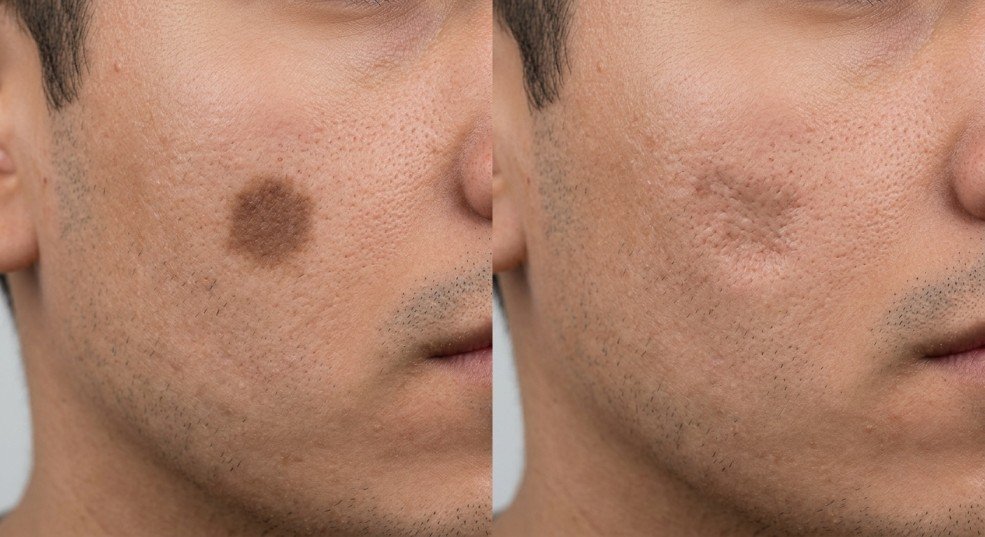
Dark spots left after acne are commonly a form of post-inflammatory hyperpigmentation (PIH).
When acne causes inflammation, the healing process can lead to increased or uneven pigmentation in the affected skin. The pimple may disappear, but the resulting pigmentation can remain visible for months.
The key feature is color rather than texture.
A PIH mark is generally flat, so the affected area should feel similar to the surrounding skin when you gently run a fingertip over it.
The color can vary with skin tone and the individual lesion. It may appear brown, dark brown, purple, or another darker shade.
PIH is also more common and often more noticeable in darker skin tones.
Why Do Dark Spots Happen?
Acne inflammation is the main trigger.
When a pimple becomes inflamed, the skin’s healing response can alter pigmentation. More significant or prolonged inflammation can leave a more noticeable mark.
Picking, squeezing, or repeatedly irritating a pimple can add further inflammation and increase the risk of post-acne pigmentation and scarring.
This is why preventing new acne is part of preventing new dark spots.
If you frequently deal with breakouts, see our Why Men Get Acne guide for a deeper look at common acne triggers and management.
Evidence-Based Solutions for Dark Spots
Treating post-acne pigmentation is not about using as many brightening ingredients as possible.
The more useful approach is to protect the skin, control active acne, and use an appropriate topical treatment consistently.
1. Use Sunscreen Every Morning
Broad-spectrum sunscreen is an important part of a routine for post-inflammatory hyperpigmentation.
An SPF 30 or higher sunscreen is a sensible baseline. Sun protection can help reduce further darkening and protect the skin while pigmentation is being treated.
For people prone to hyperpigmentation, tinted sunscreens containing iron oxides may provide additional protection against visible light, which can contribute to pigmentation, particularly in darker skin tones.
Sunscreen does not directly erase an existing dark spot. Its role is to reduce further pigmentary change and prevent continued exposure from working against your treatment.
2. Control Active Acne
If new acne keeps appearing, new marks can keep forming.
That makes acne treatment an important part of managing post-acne pigmentation. Depending on the acne, evidence-based topical options can include retinoids, benzoyl peroxide, salicylic acid, and azelaic acid.
3. Choose a Suitable Pigment-Focused Active
You do not need several brightening ingredients at once.
Depending on your skin and existing routine, options include:
- Azelaic acid: useful for acne and can also help improve post-inflammatory hyperpigmentation.
- Retinoids: can help manage acne and may improve pigmentation over time.
- Niacinamide: can help improve uneven pigmentation and is generally well tolerated.
- Vitamin C: may help improve the appearance of uneven pigmentation, although results depend heavily on the formulation.
- AHAs such as glycolic acid: can improve pigmentation and skin texture but may cause irritation if overused.
Evidence for topical PIH treatments supports several of these approaches, but results vary between ingredients, formulations, and individuals.
The strongest ingredient is not automatically the best choice. A treatment that your skin tolerates and that you can use consistently is more useful than an aggressive routine that repeatedly causes irritation.
4. Introduce Actives Gradually
Using several strong actives at once can irritate the skin.
Retinoids, exfoliating acids, scrubs, and multiple brightening products do not need to be introduced together.
More irritation does not automatically mean better results, and irritation can make pigmentation harder to manage.
Introduce one new active at a time and give your skin time to adjust.
5. See a Dermatologist When Basic Treatment Is Not Enough
If pigmentation is persistent, extensive, or not improving despite consistent skincare and sun protection, a dermatologist can assess the cause and recommend appropriate treatment.
This is particularly relevant for darker skin, where post-inflammatory pigmentation is more common and some procedures can themselves trigger pigmentary changes.
How Long Do Dark Spots Take to Fade?
There is no single timeline.
Some post-acne dark spots gradually become lighter over several months. Others can remain visible for a year or longer.
The American Academy of Dermatology notes that some flat dark spots left after acne can last a year or longer, although treatment and appropriate skincare can help improve their appearance.
That does not mean every mark will take that long.
Consistent sun protection and appropriate treatment can help improve their appearance, but constantly changing products is unlikely to make the process faster.
What Are Acne Scars?
An acne scar forms when inflammation damages the skin deeply enough to alter its structure during healing.
Unlike PIH, the problem is not simply a change in pigmentation. There is a physical change in the skin.
Most acne scars can be broadly divided into:
- Depressed or atrophic scars: the skin sits below the surrounding surface.
- Raised scars: excess scar tissue creates an elevated area.
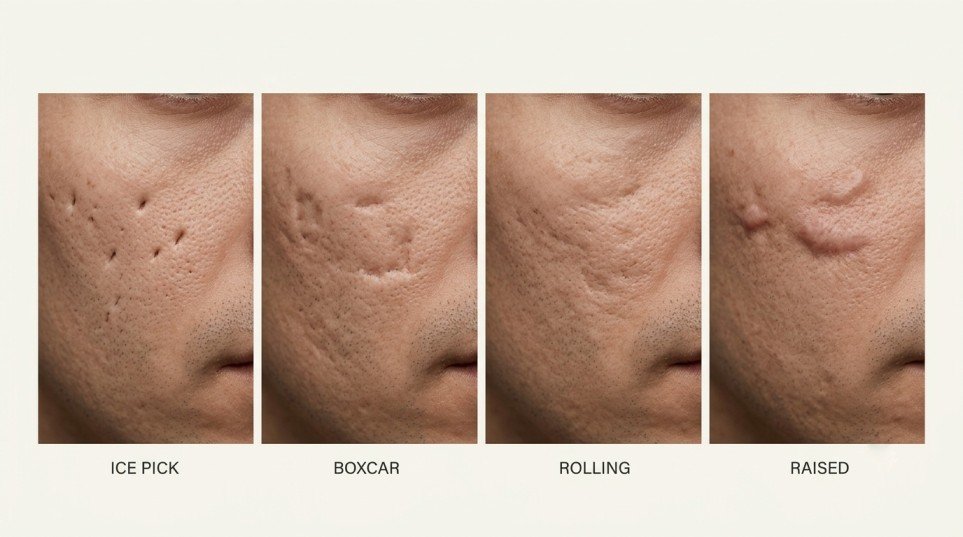
The three main types of depressed acne scars are ice pick, boxcar, and rolling scars. Raised acne scarring includes hypertrophic scars and keloids.
A scar can also have pigmentation or redness around it, meaning a person can have both a structural scar and post-inflammatory color change.
Why Do Acne Scars Happen?
Acne scarring is more strongly associated with deep and inflammatory acne.
The deeper the inflammation extends into the skin, the greater the potential for scarring. Picking, popping, squeezing, or scratching acne can also increase inflammation and raise the risk of scarring.
Individual susceptibility matters as well. Some people develop scars more easily than others, including people with a close family history of acne scarring.
This is why treating inflammatory acne early is important—not only for clearing current breakouts but also for reducing the chance of long-lasting marks and scars.
Types of Acne Scars
Ice Pick Scars
Ice pick scars are narrow and deep depressions that extend downward into the skin.
They often look like small punctures and can be difficult to improve with surface-level skincare alone.
Boxcar Scars
Boxcar scars are wider depressions with relatively defined edges.
They may be shallow or deep, and treatment options can differ depending on their depth and characteristics.
Rolling Scars
Rolling scars are broad depressions with sloping edges that create a wavy or uneven appearance.
Some rolling scars can involve tethering beneath the skin, which helps explain why surface-level skincare cannot fully correct certain rolling depressions.
Raised Scars
Raised acne scars develop when excess collagen is produced during healing.
Hypertrophic scars remain within the general boundaries of the original injury, while keloids can extend beyond them. Raised acne scars are more common in people with darker skin tones.
Evidence-Based Solutions for Acne Scars
There is no single treatment that works equally well for every acne scar.
Treatment depends on the scar type, depth, location, skin characteristics, and whether active acne is still present. The American Academy of Dermatology emphasizes individualized treatment because different scar types often require different approaches.
| Scar Type | What It Looks Like | Treatment Direction |
|---|---|---|
| Ice pick | Narrow, deep depression | Targeted scar procedures |
| Boxcar | Wider depression with defined edges | Resurfacing, microneedling, fillers, or scar-specific procedures |
| Rolling | Broad, wavy or tethered depression | Subcision or combination treatment |
| Raised | Elevated scar tissue | Treatments directed at excess scar tissue |
Ice Pick Scars
Because ice pick scars are narrow and deep, treatment often needs to target the individual scar rather than simply treating the entire skin surface.
Depending on the scar, a dermatologist may consider targeted procedures such as TCA CROSS or selected surgical techniques.
These are professional procedures and should not be treated as DIY skincare.
Boxcar Scars
Treatment depends heavily on whether the scar is shallow or deep.
Depending on the individual scar, dermatologists may consider microneedling, laser resurfacing, chemical peels, fillers, or other scar-specific procedures.
Rolling Scars
Rolling scars can involve tethering beneath the skin.
Subcision is a procedure designed to release fibrous strands pulling the depressed skin downward. It may be used alone or combined with another treatment depending on the scar.
Raised Scars
Raised scars require a different treatment strategy because the problem is excess scar tissue rather than loss of tissue.
Depending on whether the scar is hypertrophic or keloidal, a dermatologist may consider treatments such as corticosteroid injections, laser treatment, prescription medication, or other scar-directed approaches.
What Can Skincare Actually Do?
This is where expectations matter.
Skincare can help when active acne, pigmentation, or mild textural changes are part of the problem.
Topical retinoids can help control acne and may make mild acne scarring less noticeable. The AAD specifically lists topical retinoids and salicylic acid as options that can make mild acne scarring less noticeable.
But skincare has clear limits.
A brightening serum may improve discoloration around a scar. A retinoid may improve acne and contribute to gradual changes in skin appearance.
Neither should be confused with rebuilding a deep structural depression.
If you can clearly see or feel a persistent indentation or raised scar, especially after active acne has settled, professional assessment is usually more useful than continually trying new scar creams.
Microneedling is one professional option with evidence for improving atrophic acne scars, although treatment results vary and multiple sessions may be needed.
How Long Does Acne Scar Treatment Take?
Acne scar treatment usually takes time.
Some procedures require multiple sessions, and improvement depends on the scar type, depth, treatment used, and individual response.
The goal is generally meaningful improvement rather than guaranteed complete removal. Acne-scar treatments can make scars less noticeable, but no treatment can promise perfect skin.
Dark Spots vs Acne Scars: How to Tell the Difference
The most useful comparison is color versus texture.
| What You Notice | More Likely |
|---|---|
| Completely flat skin with only a color change | Dark spot / PIH |
| Brown or dark flat mark | Post-acne pigmentation |
| Persistent narrow, deep depression | Ice-pick scar |
| Wider depression with defined edges | Boxcar scar |
| Broad, wavy depression | Rolling scar |
| Raised area above surrounding skin | Raised scar |
| Discoloration plus a lasting indentation or bump | Both |
If the area feels smooth and only looks darker, pigmentation is more likely.
If you can feel a persistent indentation or raised area, structural scarring is more likely.
However, you cannot always identify the exact scar type reliably at home. If you are unsure, especially before considering a procedure, a dermatologist can assess the skin directly.
What If You Have Both?
Having both pigmentation and acne scars is common.
One acne lesion can leave behind a flat dark mark while also causing a change in skin texture.
Instead of searching for one product to fix everything, deal with the problems in a sensible order:
Control active acne → protect the skin → treat pigmentation → assess structural scars.
If you need help building a routine for oily or acne-prone skin, see our Best Oily Skin Care Routine for Men guide.
For cleansing, see Best Face Washes for Oily Skin Men.
And if your routine needs lightweight barrier support, see Best Moisturizer for Oily Skin for Men.
The important point is that the same product does not have to solve every problem.
Mistakes That Can Make Dark Spots and Acne Scars Worse
1. Picking and Squeezing Acne
Picking, popping, squeezing, or scratching can increase inflammation and raise the risk of acne scarring and discoloration.
2. Using Too Many Actives
Combining several acids, retinoids, scrubs, and brightening products can irritate the skin.
More irritation does not automatically mean better results.
3. Skipping Sunscreen
If pigmentation is one of your main concerns, sun protection is an important part of the treatment approach.
4. Treating a Scar Like a Dark Spot
A pigment-fading product may improve discoloration around a scar, but it cannot simply rebuild a structural depression.
5. Expecting a Fast Fix
Dark spots can take months to fade, while established acne scars may require multiple professional treatments.
Changing products constantly is unlikely to speed up either process.
Myth vs Fact
| Myth | Fact |
|---|---|
| Every mark left after acne is an acne scar. | Many post-acne marks are completely flat pigmentation rather than structural scars. |
| A dark spot can turn into an acne scar. | Pigmentation itself does not normally transform into a structural scar. New inflammation or injury can create a separate scar. |
| A brightening serum can remove an indented scar. | Brightening products can improve discoloration but cannot simply rebuild a deep structural depression. |
| All acne scars need the same treatment. | Treatment depends on scar type, depth, location, and individual skin characteristics. |
| More exfoliation will fade dark spots faster. | Excessive irritation can make pigmentation harder to manage. |
| Acne scars can always be completely removed. | Treatment can improve the appearance of scars, but complete removal is not guaranteed. |
When to See a Dermatologist
Consider seeing a dermatologist if:
- You are unsure whether a mark is pigmentation or a true scar.
- You have deep, widespread, or persistent acne scars.
- A raised scar is growing, painful, or persistently itchy.
- Dark spots remain despite consistent skincare and sun protection.
- You continue developing acne that leaves new marks.
- You are considering microneedling, laser treatment, chemical peels, fillers, TCA CROSS, subcision, or scar surgery.
- You have darker skin and are considering a procedure that could trigger additional pigmentation.
Professional assessment is particularly useful when the problem is structural. A dermatologist can identify the scar type and determine whether one procedure or a combination approach makes sense.
Quick Action Checklist
- Check whether the mark is flat or has a lasting change in texture.
- Treat a flat color change as pigmentation rather than automatically calling it a scar.
- Use broad-spectrum SPF 30 or higher every morning.
- Control active acne to reduce new marks and scars.
- Choose one targeted active rather than layering several strong products.
- Do not expect brightening products to remove deep structural scars.
- Identify the scar type before considering professional treatment.
- See a dermatologist if scars are deep, raised, persistent, or difficult to identify.
Conclusion
Dark spots and acne scars may come from the same breakout, but they are different problems.
A dark spot is mainly a change in skin color, often related to post-inflammatory hyperpigmentation. An acne scar is a structural change that alters the skin’s texture or contour.
That distinction should guide what you do next.
For pigmentation, the foundation is controlling active acne, protecting the skin from sun exposure, and using a suitable topical treatment consistently.
For established scars, especially clear depressions or raised areas, the best approach depends on the scar type and may require professional treatment.
The goal is not to find the strongest product or the fastest procedure. It is to identify what you are actually dealing with and choose a treatment that matches the problem.
Frequently Asked Questions
Can a dark spot turn into an acne scar?
A dark spot itself does not normally turn into an acne scar. PIH is a change in pigmentation, while a scar involves a structural change during healing. However, new inflammation, picking, or repeated irritation can cause additional skin damage and potentially create a separate scar.
How can I tell if an acne mark is a scar or a dark spot?
Look at both color and texture. A completely flat mark that differs only in color is more likely pigmentation. A persistent depression or raised area suggests a structural scar. If you see both discoloration and a lasting texture change, you may have both.
How long do dark spots take to fade?
Some fade within several months, while darker or more persistent pigmentation can last a year or longer. Consistent sun protection and appropriate treatment can help improve their appearance, but there is no universal timeline.
Do dark spot creams work on acne scars?
They can improve discoloration around a scar, but they generally cannot correct the structural change responsible for a depressed or raised acne scar. If the texture is clearly altered, scar-specific treatment may be more appropriate.
Can retinoids help acne scars?
Topical retinoids can help control acne and may make mild acne scarring less noticeable. They can also help with post-inflammatory pigmentation. They are not a universal solution for deep ice-pick, boxcar, or rolling scars.
Is it too late to treat old acne scars?
No. Established acne scars can still be treated, although the appropriate option depends on their type and depth. Older scars may require procedures rather than topical skincare alone, and improvement often takes time.
Authoritative Sources
- American Academy of Dermatology Association — Acne: Signs and Symptoms
- American Academy of Dermatology Association — Acne Scars: Signs and Symptoms
- American Academy of Dermatology Association — Acne Scars: Causes
- American Academy of Dermatology Association — Acne Scars: Consultation and Treatment
- DermNet NZ — Acne Scarring
- DermNet NZ — Post-inflammatory Hyperpigmentation
- PubMed — Microneedling Monotherapy for Acne Scar: Systematic Review and Meta-Analysis of Randomized Controlled Trials