
Quick Summary
A receding hairline can often be slowed, and sometimes partially regrown, but the outcome depends heavily on the cause and how early you act. Most cases trace back to androgenetic alopecia, driven by DHT sensitivity in the frontal follicles. This guide breaks down what’s actually reversible, which treatments have real clinical evidence behind them, and what a realistic timeline looks like — so you can make an informed decision instead of chasing products that don’t work.
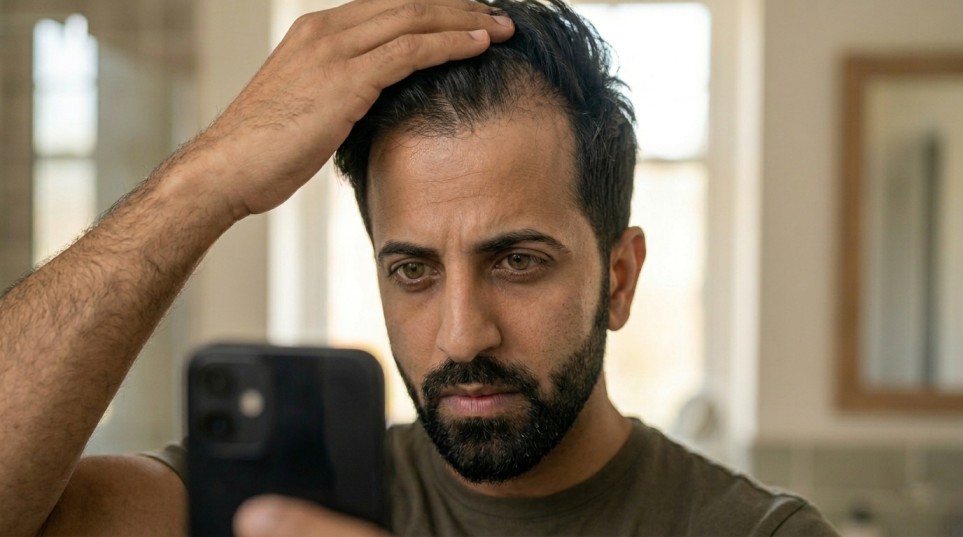
Notice more forehead showing in photos than you remember? A receding hairline is usually one of the first signs of hair loss a man spots in himself, often years before anyone else mentions it. The question that actually matters isn’t whether it’s happening — it’s whether anything can be done about it now that you’ve noticed.
The honest answer: it depends on the cause, the stage, and how quickly you act. For most men, a receding hairline is androgenetic alopecia — a genetic, hormone-driven condition with real, evidence-backed treatment options.
This guide walks through what causes it, how to fix a receding hairline using methods that are actually supported by research, and what results look like when treatment works as intended.
Table Of Contents
What Is a Receding Hairline?
A receding hairline is the gradual backward movement of hair along the forehead and temples, most often caused by androgenetic alopecia — a genetic condition in which DHT causes hair follicles to shrink over time. Unlike a stable, one-time mature hairline, a true receding hairline keeps progressing and is often accompanied by thinning further back on the scalp.
What Actually Causes a Receding Hairline?
Androgenetic Alopecia: The Most Common Cause
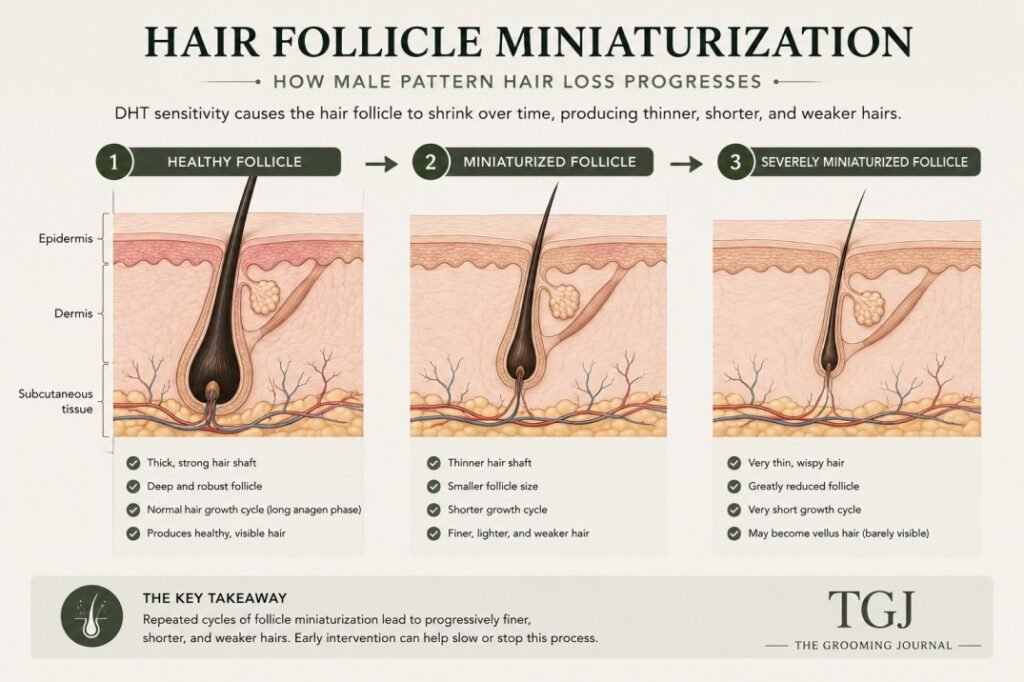
For many men, a receding hairline is caused by androgenetic alopecia, also known as male pattern hair loss. It’s driven by dihydrotestosterone (DHT), a byproduct of testosterone that binds to androgen receptors in genetically sensitive follicles, mainly at the temples, frontal hairline, and crown.
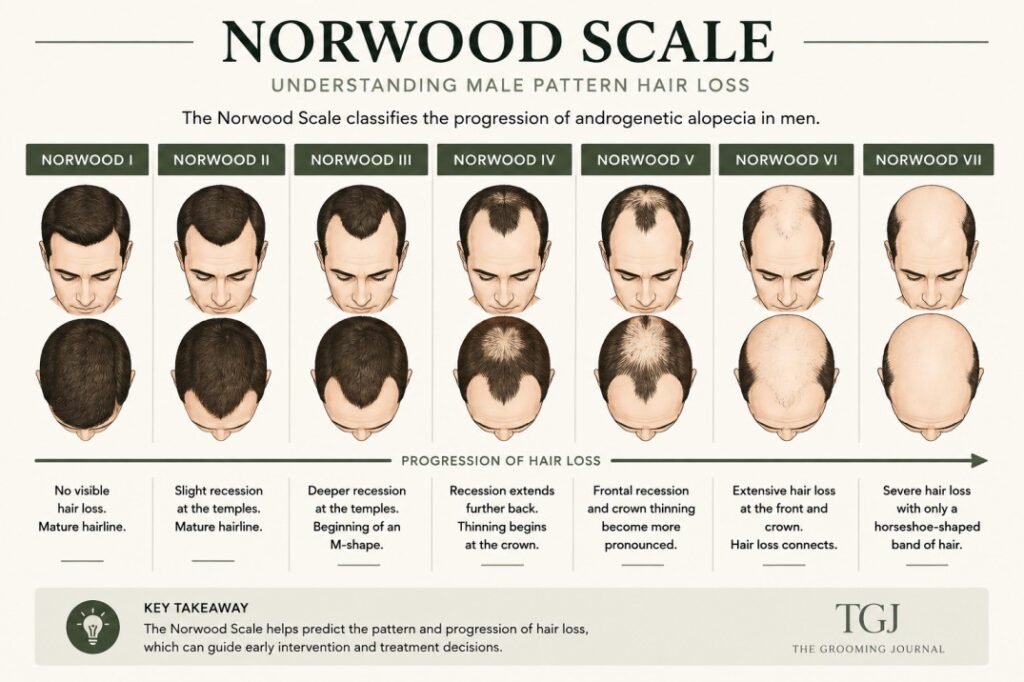
Each time an affected follicle cycles through growth and shedding, it produces a slightly finer, shorter hair than before. Over years, this miniaturization can shrink a follicle to the point where it only grows a fine, barely visible hair — or stops producing hair altogether. This pattern is mapped by the Norwood scale, which dermatologists use to describe how far the recession has progressed.
One persistent myth worth clearing up early: this isn’t inherited only from your mother’s side. The genes involved are polygenic, meaning they come from both parents, so a full family history — not just your maternal grandfather’s hairline — is the more useful thing to look at.
Other Causes Worth Ruling Out
Not every hairline change is androgenetic alopecia, which is exactly why a proper diagnosis matters before starting treatment.
- Traction alopecia comes from constant tension on the hairline — tight buns, slicked-back styles, or man buns pulled the same direction daily. Caught early, it’s often reversible simply by changing how you style your hair.
- Frontal fibrosing alopecia is a scarring, inflammatory condition that affects the frontal hairline. It’s more commonly diagnosed in postmenopausal women but does occur in men, and it needs a dermatologist’s evaluation rather than over-the-counter treatment.
- Telogen effluvium causes diffuse shedding across the whole scalp, usually triggered by stress, illness, or a nutrient deficiency. It’s typically temporary but rarely shapes itself into a hairline-specific pattern. If your shedding feels more general than hairline-specific, our guide on how to stop hair fall covers that broader picture in more depth.
Mature Hairline or Early Balding? How to Tell the Difference
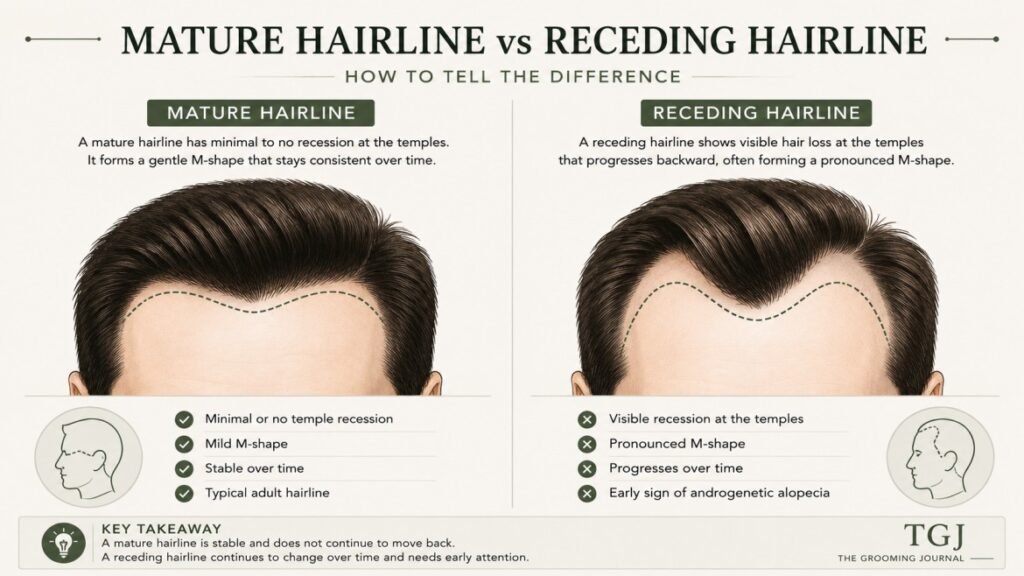
A mature hairline vs receding hairline comparison trips up a lot of men in their twenties, and understandably so — both start with the same thing: a hairline that looks different from your teenage years.
A mature hairline is a normal, one-time adjustment that typically settles between the late teens and late twenties. It forms a soft, symmetrical M-shape at the temples, and — this is the key part — density behind the hairline stays strong and the shape stabilizes once it’s done shifting.
A true receding hairline behaves differently over time:
- It keeps moving instead of settling into a stable shape.
- The recession is often uneven between the two temples.
- Fine, miniaturized hairs become visible along the frontal band under bright light.
- Thinning frequently shows up elsewhere too, especially at the crown.
Hair loss is common in men, and early changes can appear well before significant thinning becomes obvious. The most reliable way to tell your own pattern apart is time: compare photos taken in the same lighting every few months.
A mature hairline stops moving. A mature hairline tends to settle, while a receding hairline keeps changing over time.
Can a Receding Hairline Actually Be Reversed?
What “Reversal” Really Means
This is worth separating into three different outcomes, because they get lumped together constantly:
- Stopping further loss — the most achievable goal for most men who start treatment.
- Regrowing thinned, miniaturized hair — realistic for follicles that are still active but producing finer, shorter hairs.
- Restoring your exact teenage hairline — rarely realistic, especially in areas where follicles have been fully dormant for years.
Once a follicle becomes severely miniaturized or permanently damaged, regrowth becomes much harder. That’s why starting treatment early matters.
Why Timing Changes Everything
The hairline is also, historically, a harder area to regrow than the crown. Topical minoxidil in particular has stronger clinical evidence at the vertex than at the frontal hairline, though it can still help slow recession there.
This is one reason combination therapy — finasteride and minoxidil together — is generally considered more effective than either used alone: they act on different parts of the same process, one blocking the DHT that drives miniaturization, the other directly stimulating the follicle.
How to Fix a Receding Hairline: Treatments With Real Evidence Behind Them
1. Topical Minoxidil
Minoxidil is available over the counter in 2% and 5% strengths and remains one of only two treatments FDA-approved specifically for pattern hair loss. It works by prolonging the growth (anagen) phase of the hair cycle and increasing blood flow to the follicle.
When used consistently as directed, minoxidil typically needs several months before its effectiveness can be properly assessed, with fuller results often taking longer to appear. An initial shedding phase in the first few weeks is common and isn’t a sign the product is failing — it’s usually old hairs being pushed out to make way for new growth. Benefits fade gradually within months of stopping, since minoxidil manages the condition rather than curing it.
2. Oral Finasteride
Finasteride is a prescription-only medication that works differently: it blocks the enzyme that converts testosterone into DHT, addressing the hormonal trigger rather than just stimulating the follicle. Finasteride can slow hair loss and promote regrowth, though results vary. Because it’s a systemic medication, it requires a doctor’s evaluation and an honest conversation about potential side effects, including rare but real effects on sexual function that should be discussed before starting rather than after.
3. Low-Dose Oral Minoxidil
An increasingly common off-label option, low-dose oral minoxidil is prescribed by some dermatologists as an alternative or add-on to the topical version. Early evidence looks promising, but it isn’t currently FDA-approved specifically for hair loss, requires prescription oversight, and typically involves monitoring for effects on blood pressure. This is a conversation for a dermatologist, not a starting point for self-treatment.
4. Low-Level Laser Therapy (LLLT)
Devices like laser combs and caps deliver red or near-infrared light to the scalp and are FDA-cleared for hair growth support. Evidence is more modest than for minoxidil or finasteride, but it’s a low-risk option that some men use alongside primary treatment rather than in place of it.
5. Platelet-Rich Plasma (PRP)
PRP uses growth factors from your own blood, injected into the scalp to stimulate follicle activity. Evidence is growing, particularly when PRP is combined with other treatments, but results vary between patients and it typically requires multiple sessions at meaningful cost. It’s reasonable as an add-on for some men, less reliable as a stand-alone fix.
6. Hair Transplant Surgery
A transplant surgically relocates DHT-resistant donor follicles (usually from the back or sides of the scalp) to the hairline. Transplanted hair is permanent, but your remaining native hair is still vulnerable to DHT — which is why surgeons generally recommend continuing medical therapy after surgery, not stopping it. This option makes sense for men with an established, relatively stable pattern and realistic goals, and results typically take eight to twelve months to fully mature.
One clarification worth making here: JAK inhibitors, a newer class of medication approved for alopecia areata (an autoimmune, patchy form of hair loss), are not approved or evidence-supported for androgenetic alopecia. If your hairline recession follows the gradual, predictable pattern described above rather than sudden patchy loss, that’s a different condition with different treatment.
Important: Before starting any treatment for hair loss—including prescription medicines or procedures—consult a qualified dermatologist or healthcare professional. The right treatment depends on the underlying cause, stage of hair loss, medical history, and individual risk factors.
What’s Not Proven to Regrow a Receding Hairline
- Biotin supplements only help if you have an actual biotin deficiency, which is uncommon. Taking extra biotin without a diagnosed deficiency has no meaningful evidence behind it for regrowing a receding hairline.
- “Hair growth” shampoos and oils may improve how your scalp and hair feel, but there’s no strong clinical evidence they reverse androgenetic alopecia on their own.
- Caffeine-based products show some effect on follicle cells in lab settings, but real-world evidence for regrowing a human hairline remains limited and mixed.
If your main concern is general hair fall rather than hairline-specific recession, our hair fall solutions guide covers the broader picture, including where these products genuinely help and where they fall short.
Building a Routine That Supports Your Hairline
Treatment does the heavy lifting, but daily habits can either support it or work against it. With androgenetic alopecia, the hairline is already vulnerable, so added stress from tight hairstyles, aggressive brushing, or frequent bleaching can put unnecessary strain on the hair.
A few habits are worth building in: keep pulled-back styles loose around the temples, protect your scalp from excessive sun exposure, and be gentle with wet hair, which is more fragile than dry hair. These habits won’t reverse a receding hairline, but they can help reduce avoidable stress on hair that’s already vulnerable.
When to See a Dermatologist
Book an appointment rather than self-treating if you notice any of the following:
- Recession that feels sudden, patchy, or uneven rather than gradual.
- Itching, redness, scaling, or visible scarring near the hairline.
- A strong family history combined with clear progression over months, not years.
- You’re considering finasteride, which requires a prescription and medical guidance.
An early consult also means more treatment options, since a dermatologist can confirm the cause with a scalp exam before you spend months on the wrong approach.
Myth vs Fact
| Myth | Fact |
|---|---|
| Hair loss is inherited only from your mother’s side | Genes for pattern hair loss come from both parents — it’s polygenic, not tied to one side of the family. |
| Wearing hats causes a receding hairline | No good evidence supports this; pattern hair loss is driven by genetics and DHT, not headwear. |
| A mature hairline means you’re going bald | A mature hairline is a normal, one-time shift that stabilizes — it doesn’t automatically predict ongoing pattern loss. |
| Frequent washing speeds up hairline recession | Washing removes hairs already in their shedding phase; it doesn’t cause additional follicles to miniaturize. |
| Once you see regrowth, you can stop treatment | Minoxidil and finasteride manage an ongoing process — stopping typically leads to gradually losing the hair you gained. |
Common Mistakes
Waiting years to act
Early-stage, still-active follicles respond to treatment far more reliably than ones that have been dormant for years — delay is the costliest mistake in this whole process.
Quitting after a few weeks
Both minoxidil and finasteride need a minimum three-to-four-month trial before results are visible. Stopping early means never finding out if it would have worked.
Skipping a proper diagnosis
Treating traction alopecia, a nutrient deficiency, or a scarring condition as if it were androgenetic alopecia wastes months on the wrong plan.
Overprocessing the hairline while chasing regrowth
Frequent bleaching or tight styling right at the hairline adds mechanical stress that works against the treatment you’re paying for.
Expecting your exact teenage hairline back
The realistic goal is stabilization and meaningful density improvement — not necessarily a full cosmetic reset.
Quick Action Checklist
- Compare hairline photos every few months in the same lighting to track real change.
- Book a dermatologist visit if recession is fast, patchy, itchy, or runs strongly in your family.
- Start with an evidence-backed option — topical minoxidil, or finasteride with a prescription — over unproven products.
- Commit to a minimum four-month trial before judging results.
- Loosen up styles that pull tightly at the temples and hairline.
- Ask about combination therapy if a single treatment plateaus.
- Revisit the conversation with your doctor before considering surgery.
Conclusion
For most men, a receding hairline is linked to androgenetic alopecia, a genetic form of hair loss that can’t be reversed with shampoo, oils, or willpower. But it can often be managed, especially when treatment starts early.
The goal isn’t always to recreate your teenage hairline. In many cases, it’s about slowing further loss, protecting existing follicles, and regaining some of the density that has already been lost.
The sooner you understand what’s causing the recession and discuss your options with a dermatologist, the more room you have to act. If you’re also dealing with general shedding, our guide on how to stop hair fall covers the broader causes and treatment options.
Frequently Asked Questions
Can a receding hairline grow back naturally without treatment?
Rarely, if it’s true androgenetic alopecia — it’s a progressive genetic condition, not something that typically self-corrects. If what you’re seeing is actually a mature hairline settling in your teens or twenties, no treatment is needed because nothing progressive is happening.
Can minoxidil regrow a receding hairline?
Minoxidil may help thicken weakened hair and slow further loss, but results at the hairline can be less predictable than at the crown. It works best when follicles are still active, and continued use is needed to maintain the benefits.
How long does it take to see results from minoxidil or finasteride?
Most dermatologists recommend a minimum three-to-four-month trial, with fuller results assessed around the twelve-month mark. Early shedding in the first few weeks of minoxidil is common and isn’t a sign of failure.
Is a receding hairline still reversible at a more advanced stage?
It becomes harder. Long-established recession with dormant follicles responds less predictably to medical therapy alone, which is why hair transplant surgery is often discussed at this stage — usually alongside, not instead of, continued medical treatment.
Does finasteride work better than minoxidil for the hairline specifically?
Evidence suggests finasteride can be particularly effective at the hairline and temples for many men, though individual response varies. It requires a prescription and a conversation with a doctor about potential side effects before starting.
Can women get a receding hairline too?
Yes, though female pattern hair loss more commonly causes diffuse thinning at the crown while the hairline stays intact. A genuinely receding frontal hairline in women can also point to frontal fibrosing alopecia, which needs a dermatologist’s evaluation rather than standard pattern-hair-loss treatment.
Authoritative Sources
- American Academy of Dermatology (AAD) — Male pattern hair loss: diagnosis and treatment
- U.S. Food and Drug Administration (FDA) — Finasteride safety information and approved use
- NHS — Hair loss: causes and treatment
- DermNet — Androgenetic alopecia
- Mayo Clinic — Hair loss: symptoms and causes