
Quick Summary
Castor oil is one of the most recommended oils for beard growth, but the evidence doesn’t back the reputation.
The sources reviewed for this article include no clinical trial of castor oil on beard hair, and a 2022 systematic review found no strong evidence that it improves hair growth on the scalp.
Its better-supported benefit is cosmetic: it may add shine and manageability, which can make a beard look healthier.
Laboratory and computer-based work on ricinoleic acid is interesting but unproven in people, and none of it is specific to beard follicles. Skin reactions are uncommon but documented, so patch test first.
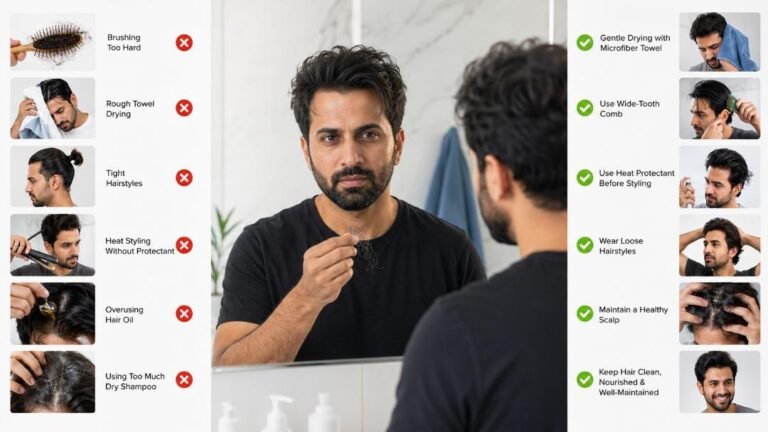
Genetics, age and androgen sensitivity set the limits of beard density; nutrition and sleep matter mainly when something is lacking.
Castor oil has a reputation that runs well ahead of its research. It turns up in forum threads, before-and-after photos and the ingredient lists of “growth” oils. The claim is usually stated as fact: apply it daily, wait about three months, and the beard thickens.
A claim repeated often is not an effect demonstrated. This article separates what has been tested in people from what is only proposed in the lab, what comes from tradition, and what rests on personal experience. It also audits how castor oil is used in beard oil marketing, so you can judge castor oil for beard growth on its merits.
Table Of Contents
Does castor oil help beard growth?
Not reliably. We found no clinical trial testing castor oil on beard hair, and a 2022 systematic review found no strong evidence that it promotes scalp hair growth either. It may improve shine and manageability, which can make a beard look fuller, but that is different from growing new hair.
Why Is Castor Oil Popular for Beard and Hair Growth?
Castor oil is pressed from the seeds of Ricinus communis, a plant native to northeastern Africa and India. For generations it has been a staple of hair care in African, Caribbean and Indian communities, mostly for shine, moisture and manageability rather than growth (Girdler et al., 2026). Beard brands inherited that reputation and added a growth promise.
What’s in it. Roughly 90% of castor oil’s fatty acids is ricinoleic acid, with smaller amounts of oleic, linoleic, stearic and palmitic acids (Girdler et al., 2026; Kumar et al., 2023). Purified castor oil contains no ricin, the toxin in the seed. Hydrogenated and PEG-castor oils are different, chemically modified ingredients that usually work as thickeners or emulsifiers. That distinction matters when you read a label.
Why conditioning gets mistaken for growth. A thick oil coats the hair, adds shine and reduces friction. Hair that breaks less and reflects more light looks fuller within days or weeks, while real growth is slow and hard to judge by eye. So an early improvement is easily credited to growth.
Popularity is not efficacy. The authors of the 2022 systematic review noted that many dermatologists let patients keep using hair oils because harm is unlikely, not because efficacy is proven (Phong et al., 2022). Long use shows an oil is pleasant and low-risk for many people. It doesn’t show that it grows hair.
What Does Science Say About Castor Oil for Beard Growth?
Beard-specific research. As of October 2026, the sources reviewed for this article included no clinical trial of castor oil on beard hair. Anything said about beards is extrapolated from scalp research, lab work or personal experience.

The 2022 systematic review. Phong and colleagues at UC Irvine analysed 22 articles on coconut, castor and argan oil for hair, mostly in patients with skin of color. For castor oil they found weaker evidence for improving hair quality by increasing luster, and no strong evidence for hair growth (Phong et al., 2022). Read it as “good tests are missing,” not “castor oil does nothing.”
A newer review. A 2026 narrative review in Cureus describes evidence for improved luster and raises a possible benefit in androgenetic alopecia, while noting that clinical translation is uncertain (Girdler et al., 2026). Narrative reviews are less rigorous than systematic ones, and this one mixed lab work and case reports with clinical studies. It describes no beard trial.
The ricinoleic acid mechanism. A signalling molecule called prostaglandin D2 (PGD2) is elevated in the bald scalp of men with androgenetic alopecia. It inhibits hair growth in lab-grown human follicles and in mice (Garza et al., 2012). A later computational study predicted that ricinoleic acid could inhibit the enzyme that makes PGD2 (Fong et al., 2015). That prediction is the root of the “castor oil supports growth” idea, and it has limits:
- It’s a prediction. The authors framed these compounds as candidates for further testing, not proven treatments.
- It concerns balding scalp. Androgens stimulate beard growth but suppress growth in androgenetic alopecia (Inui and Itami, 2013). A pathway that matters in balding follicles can’t be assumed to limit beard follicles.
- The pathway hasn’t guaranteed results. A phase 2a trial of setipiprant, a PGD2 receptor blocker, showed no clinical efficacy in men with androgenetic alopecia, as summarised in the Cureus review.
- Delivery is untested. No study shows that castor oil applied to skin delivers enough ricinoleic acid to a follicle to matter.
| Type of evidence | What exists for castor oil | What it tells you about beards |
|---|---|---|
| Clinical trials on beard hair | None found | Nothing direct |
| Clinical research on scalp hair | No strong evidence for growth; weaker evidence for luster | Indirect and limited |
| Laboratory and computational work | Predicted PGD2 synthase inhibition by ricinoleic acid | A hypothesis, not a result |
| Traditional use | Long use as a hair oil in several cultures | Not evidence of efficacy |
| Personal experience | Widespread reports | Real observations, but cause can’t be isolated |
Lack of evidence isn’t proof of impossibility. A small effect in some men can’t be ruled out. But a plausible hypothesis is not a result.
What Does Indian Ayurveda Say About Castor Oil?
In Ayurveda, castor is Eranda and the oil is Eranda taila. The classical emphasis is on internal and medicinal use, not hair.

- Classical texts. A 2023 literary review reports that Sushruta described Eranda taila as the best of the laxative oils, and that Charaka listed the root as vrishya (associated with vitality) and vatahara (pacifying vata) (Kumar et al., 2023). It also lists tvachya (skin-friendly) and kantivardhaka (enhancing complexion or luster) among the oil’s properties.
- Modern guidelines. Ayurvedic standard treatment guidelines list Eranda taila mainly as an internal medicine, for purgation (virechana) and conditions such as sciatica (gridhrasi) (CAPS, NCBS).
- Hair care. Indian hair care centres on scalp oiling, with the belief that it prevents hair loss and adds shine (Mysore and Arghya, 2022). Classical keshya (hair-beneficial) oils such as Neeli Bhringadi taila are multi-herb formulas, and the one reviewed uses a sesame oil base (Ayushdhara review, 2022).
None of the sources consulted links Eranda taila to beard growth. That reports what was found, not that no reference exists. These are modern reviews of classical texts, not the Sanskrit originals, so a qualified Ayurvedic scholar should check primary texts further. “Ayurvedic” retail blends are marketing, not classical sources.
Traditional use is a valuable record of what people have relied on, and it often points researchers to good questions. It isn’t clinical evidence. It tells us castor oil is familiar and generally tolerated, not that it increases beard density.
What Castor Oil Can and Cannot Do for Your Beard
Used sensibly, castor oil is a thick conditioning oil. It can smooth hair, reduce dryness and add shine. Those are the realistic castor oil beard oil benefits, and they are cosmetic.
Growth, density, retention and shine are different outcomes
Before-and-after claims blur these together. They are separate things:
| Outcome | What it means | Castor oil evidence |
|---|---|---|
| New hair growth | Follicles producing new hairs, or hairs growing faster | Not shown for beard hair |
| Density | Number and thickness of hairs, set largely by follicles and androgen response | Not shown; appearance can change without it |
| Retention and breakage | Fewer hairs snapping or being lost | Plausible from lubrication, not tested on beards |
| Shine, smoothness, manageability | How existing hair looks and feels | Weaker evidence for luster on scalp hair |
| Overall appearance | The combined impression | Can improve without any new hair |
A beard can look fuller because fewer ends snap, light reflects more evenly or the hairs lie differently. None of that adds a single hair.
What about 90 days?
Ninety days is a practical observation period, not an established clinical timeline. No study defines what castor oil should achieve in that time.
You might notice softer hair, less dryness, easier combing and more shine. Those cosmetic changes can appear quickly, because the oil coats hair that is already there.
But visible change doesn’t prove the oil caused it. Over three months a beard also gets longer, and length changes how dense it looks. Many men start oiling a beard that is still filling in, and change their washing, trimming and moisturising at the same time. Lighting, camera angle and styling shift photos too.
Personal observations still count. They are accurate records of what happened to you, and useful for judging feel, skin tolerance and appearance. Their limit is causation: with no comparison group, they can’t show the oil was responsible.
If you track your results, photograph the beard dry and unstyled, at the same length, light and distance. No scientifically established guarantee exists that castor oil produces beard growth after 90 days.
Common claims, briefly
- “It activates dormant follicles.” No study shows this. Follicle changes in beard development are driven by androgens over several hair cycles, not a topical oil.
- “It fills patchy areas.” Genes largely determine sparse areas. The American Academy of Dermatology suggests a style that works with them, letting nearby hairs grow longer, and talking to a dermatologist before trying minoxidil (AAD). See how to shape and trim a patchy-looking beard. Trimming changes how a beard looks, not how it grows.
- “Jamaican black castor oil is superior.” One manufacturer describes it as made from roasted beans, giving a darker oil with a smoky smell (Lush). We found no peer-reviewed comparison showing better growth. A processing difference isn’t an outcome difference, so patch test it too.
- “It raises testosterone or DHT.” No study reviewed suggests a topical conditioning oil changes hormone levels. Beard growth depends on your hormones and follicle sensitivity, not what sits on the skin.
None of this means castor oil can’t have any biological effect. It means the evidence for a growth effect on beards doesn’t exist yet.
How to Apply Castor Oil to Your Beard
If you’re wondering how to use castor oil for beard growth, the honest framing is that these steps are for cosmetic conditioning. They are not a clinically validated beard-growth protocol, and no schedule has been shown to produce results.
- Patch test first. Dab a little on a small area of skin and wait a day or two, since allergic reactions can be delayed.
- Start clean. Towel-dry the beard so it’s slightly damp.
- Use very little. It’s thick, so a few drops go far. Warm them between your palms.
- Work it through the hair. If your skin tolerates it, a little can reach the skin beneath. Keep it away from your eyes.
- Avoid excess. Too much leaves a heavy, greasy beard and can bother the skin.
- Stop at the first sign of irritation. Persistent redness, itching, stinging or new breakouts mean stop.
Frequency is a matter of tolerance, not a validated schedule. If your beard feels dry and your skin is comfortable, a small amount when needed is reasonable.
Possible side effects on facial skin
Reactions are uncommon but documented. Case reports describe allergic contact dermatitis to castor oil and ricinoleic acid in cosmetic products, and one rare case of sudden hair matting (felting) after a first scalp application (Girdler et al., 2026). It’s another reason to start small.
Acne-prone and sensitive skin need extra care. For beard acne, the AAD advises a small amount of non-comedogenic beard conditioner and no beard oil (AAD). Tolerance varies widely from man to man.
For where oil fits alongside cleansing, moisturising and trimming, see a simple beard grooming routine.
Beard Growth Is Not Just About What You Apply
Genetics, age and androgens. After puberty, androgens gradually convert small vellus follicles into larger terminal ones, and each follicle responds differently (Inui and Itami, 2013). That’s why two men with similar hormone levels can grow very different beards. Your genes largely decide where beard hair grows densely and where it stays sparse. For the broader picture, see factors that influence natural beard growth.
Calories and protein. Hair is made of protein, so your body needs enough energy and protein to build it. Severe or prolonged restriction, including crash dieting, is a recognised trigger for diffuse shedding on the scalp. Most men on a normal, varied diet aren’t limited by this, and eating more won’t thicken a beard.
Nutritional deficiencies. A 2019 review found that micronutrients play an important but not fully understood role in the hair cycle, and that deficiencies may contribute to hair loss. It called for larger trials on supplementation (Almohanna et al., 2019). Correcting a confirmed deficiency, ideally after testing, makes sense. But this research concerns hair loss, mostly on the scalp, not beard density in healthy men.
Sleep, activity and general health. These support normal body function, including hair growth. None has been shown to override a genetic beard pattern.
Medical factors. Medical conditions, some medications and skin infections can affect hair growth. Alopecia areata, an autoimmune condition, can also affect the beard.
A balanced diet and healthy lifestyle help you grow the beard your genes allow, without deficiencies holding it back. They can’t create density your follicles don’t support. If you notice sudden, patchy or unexplained beard hair loss, see a dermatologist rather than adding products.
The Truth About Castor Oil in Beard Oil Marketing
Castor oil is familiar, widely available and carries a growth reputation, which probably explains why it features so often in beard oils. It works both as a conditioning ingredient and a talking point. That doesn’t make every brand misleading, since many make accurate cosmetic claims. The risk is how easily “conditions your beard” slides into “grows your beard.” For the broader picture, see whether beard growth oils actually work.
Ingredient presence is not product efficacy. An ingredient with a mechanism behind it doesn’t make the finished product effective. The formula, the amount and how you use it all matter, and evidence for one ingredient doesn’t transfer automatically to a blend.
How to read an ingredient list. In the US, cosmetic ingredients must be listed in descending order of predominance, but those at 1% or less may be listed in any order (FDA). Rules differ by country, so check yours.
Take this simplified, hypothetical list: Simmondsia Chinensis (Jojoba) Seed Oil, Prunus Amygdalus Dulcis (Sweet Almond) Oil, Ricinus Communis Seed Oil, Tocopherol, Mentha Piperita Oil. The first ingredients are likely the bulk of the formula. Once the 1% line is crossed, position tells you little, and the list doesn’t show where that line falls. The castor oil could be a major component or a trace, and the label won’t say which.
Check the exact name too. Ricinus Communis Seed Oil is castor oil itself. Hydrogenated Castor Oil and PEG-40 Hydrogenated Castor Oil are modified ingredients with different jobs.
Keep five things separate: the ingredient, its concentration, the whole formulation, the product claim and the clinical evidence. A product can contain castor oil and be pleasant to use, yet have no evidence behind a growth claim.
Testimonials, influencers and before-and-after pictures. These don’t independently establish efficacy. Photos vary in lighting, angle, length and styling. Beards also change on their own over months, people who share results aren’t a random sample, and sponsorship can shape what’s shown. They can be sincere without proving cause, and the same limits apply to any castor oil beard growth before and after post.
Cosmetic claims versus growth claims. The wording tells you a lot:
- Cosmetic conditioning: “softens,” “reduces dryness,” “adds shine,” “makes your beard look fuller.”
- Biological growth: “stimulates follicles,” “grows new hair,” “activates dormant follicles,” “increases density.”
The first describes how existing hair looks and feels. The second claims a change in the follicle, and needs human clinical evidence for that specific claim.
Five questions to ask of any beard oil:
- Does it claim to condition existing hair, or stimulate new growth?
- Is there human clinical evidence for that specific claim?
- Does the evidence concern castor oil itself, or the finished formulation?
- Is the claim based mainly on testimonials or promotional images?
- Does the brand distinguish cosmetic benefits from biological growth?
A brand that answers all five clearly is easier to trust than one that leans on the word “growth.”
Conclusion
Castor oil for beard growth remains an unproven idea. The 2022 systematic review found no strong evidence for hair growth, no beard trial turned up in this review, and the ricinoleic acid mechanism comes from scalp-focused and computational work never tested on beard follicles. What castor oil can reasonably offer is conditioning: shine, smoothness and manageability. If you use it, patch test, apply sparingly and stop if your skin objects.
For a thicker beard, the factors that count sit mostly outside the bottle: genetics, age, androgen sensitivity and, where relevant, fixing a nutritional or medical problem. Judge any growth claim by the evidence behind it, not how often it’s repeated.
Frequently Asked Questions
1. Does castor oil help beard growth?
It hasn’t been shown to. No beard-specific clinical trial was found, and the best review of hair oils found no strong evidence for growth. Any benefit is better described as conditioning.
2. How long does castor oil take to grow a beard?
There’s no established timeline, because castor oil hasn’t been shown to grow beard hair. Softness and shine can appear within days to weeks. Change over about 90 days can’t be attributed to the oil without a comparison.
3. Can castor oil fill patchy beard areas?
No evidence says it can. Sparse areas are largely set by genetics and follicle response to androgens. A flattering style, letting nearby hair grow longer and talking to a dermatologist are more realistic.
4. Is Jamaican black castor oil better for beard growth?
No study found shows it is. It’s made from roasted beans and contains ash, but a different process isn’t proof of a better result. Patch test it like any castor oil.
5. Can I apply castor oil to my beard every day?
No validated schedule exists. Some people use a little regularly without trouble, while others get irritation or breakouts. Start small and cut back if your skin reacts. For beard acne, the AAD advises avoiding beard oil.
6. Does castor oil make beard hair thicker?
It can make a beard look thicker by coating hairs and reducing breakage. It hasn’t been shown to thicken individual hairs or add more of them.
7. Can diet and lifestyle improve beard growth?
They can support normal growth, and correcting a deficiency may help. They can’t override your genetic beard pattern, and supplements are unlikely to thicken a beard if you aren’t deficient.
Authoritative Sources
- Phong C, Lee V, Yale K, Sung C, Mesinkovska N. (2022). Coconut, Castor, and Argan Oil for Hair in Skin of Color Patients: A Systematic Review. Journal of Drugs in Dermatology, 21(7), 751–757. Read on PubMed
- Girdler K, Cabatu A, Olds H, Potts GA. (2026). Use of Castor Oil in Dermatology: A Narrative Review. Cureus, 18(2), e103289. Read the full-text article on PubMed Central
- Maduri VR, Vedachalam A, Kiruthika S. (2017). “Castor Oil” – The Culprit of Acute Hair Felting. International Journal of Trichology, 9(3), 116–118. Read the full-text case report on PubMed Central
- Verheyden M, Rombouts S, Lambert J, Aerts O. (2017). Contact Allergy to Castor Oil, but Not to Castor Wax. Cosmetics, 4(1), 5. Read the full-text article
- Sánchez-Herrero A, et al. (2018). Allergic Contact Cheilitis in an Adolescent to Ricinus communis Seed Oil (Castor Oil) in a Lip Balm. Contact Dermatitis, 79(3), 176–178. Read on PubMed
- Pharmacopoeia Commission for Indian Medicine & Homoeopathy. Ayurvedic Pharmacopoeia of India: Eraṇḍa (Ricinus communis Linn.). View the official monograph record
Evidence limitation
These sources discuss hair-related evidence, dermatological uses, traditional medicine and potential adverse reactions. They do not establish that castor oil promotes beard growth in humans. Evidence concerning scalp hair should not be treated as direct clinical evidence for beard growth.