Quick Summary
Normal skin needs maintenance, not correction. This guide covers the three daily steps with strong evidence behind them (cleanse, moisturize, protect), what the research actually says about the two common “extra” steps — and where that evidence is more mixed than most articles let on — plus a realistic week-by-week timeline for results.
A normal skin care routine for men doesn’t need to be complicated. If your skin doesn’t get shiny by mid-afternoon, doesn’t feel tight after washing, and rarely reacts to something new, you likely have what dermatologists classify as normal skin. It’s the lowest-maintenance skin type, which is exactly why it gets neglected. Men with normal skin tend to land in one of two camps: doing nothing and letting a decade of sun exposure accumulate quietly, or overcorrecting with a shelf of products aimed at problems they don’t actually have.
Neither serves you well. Normal skin is a baseline that a short routine protects—and that neglect or overtreatment can both erode. What follows isn’t a list assembled from other skincare sites; it’s built around what randomized trials actually show, including the places where the marketing claims outrun the data. That distinction matters more than it sounds: knowing which step is backed by a 4.5-year controlled trial and which is backed by weaker, more mixed evidence changes how much time and money you should put into each one.
Table Of Contents
What Is a Normal Skin Care Routine for Men?
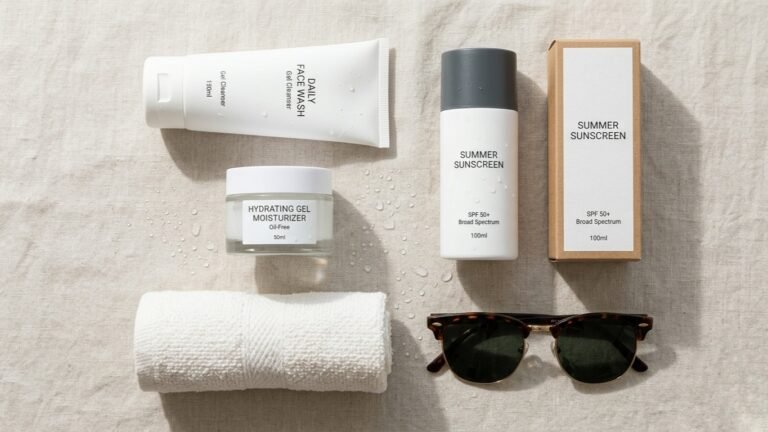
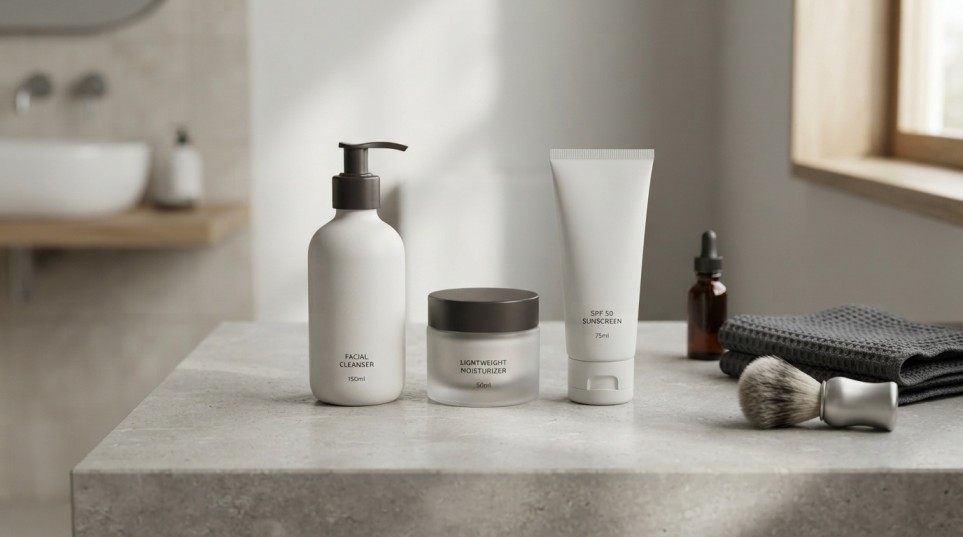
A normal skin care routine for men includes three daily steps: a gentle cleanser, moisturizer, and broad-spectrum sunscreen (SPF 30+). These steps help maintain balanced skin, support the skin barrier, and reduce long-term sun damage.
Understanding Normal Skin First
Before committing to a routine, confirm you’re actually working with normal skin — the term gets applied loosely, and a routine built for it won’t work as well on oily or dry skin.
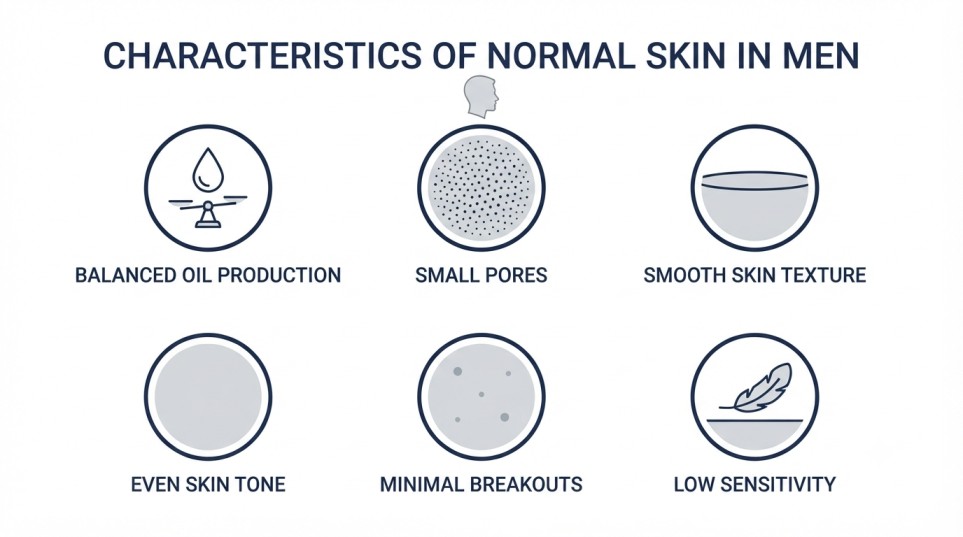
Normal skin generally shows:
- Even oil distribution — not shiny by midday, not tight or flaky
- Small, barely visible pores
- Few blemishes and minimal reaction to new products
- An even tone with good elasticity
If that doesn’t quite describe you, check how to find your skin type first — oily and dry skin respond better to routines built specifically around those needs.
The Core Routine: Steps, Order, and the Evidence Behind Each One
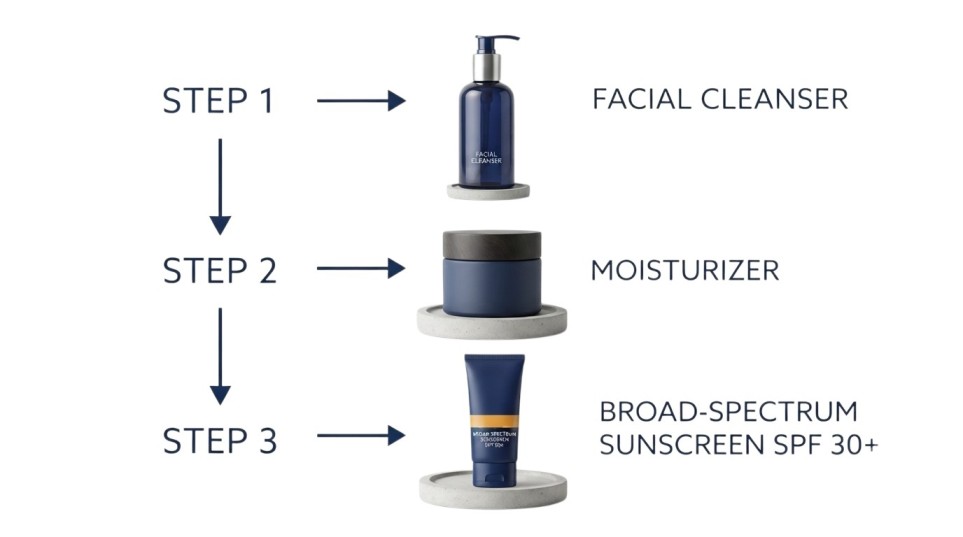
Step 1: Cleanse (Morning and Night)
Washing twice daily clears sweat, oil, and environmental buildup without stripping the barrier. For normal skin, a gentle, low-foam or cream cleanser is enough — nothing formulated for acne control or oil absorption is necessary.
Bar soap made for the body is too alkaline for facial skin and disrupts its natural pH, which is why a dedicated facial cleanser is the standard recommendation over multi-purpose soap.
Step 2: Moisturize (Morning and Night)
This is the step men with normal skin skip most, on the logic that skin that isn’t dry doesn’t need moisturizer. That logic misses what moisturizer is actually doing: helping maintain the skin barrier after cleansing and reducing moisture loss. A compromised barrier is what eventually produces the sensitivity that “balanced” skin is supposed to be immune to.
A lightweight lotion or gel-cream is typically enough; reserve heavier, occlusive creams for genuinely dry climates or winter.
Step 3: Protect (Morning Only) — the step with the strongest evidence
This is worth slowing down on, because it’s the one step in this entire routine backed by a large, multi-year randomized controlled trial rather than short cosmetic studies. In the Nambour trial — a 4.5-year, population-based randomized trial of nearly 1,000 Australian adults — people who applied sunscreen daily showed 24% less skin aging than those who used it only occasionally, and the daily-use group showed no detectable increase in skin aging at all over the study period. That’s not a marketing claim; it’s one of the only long-term controlled trials of its kind in dermatology.
Practically: broad-spectrum SPF 30+, every morning, regardless of season or cloud cover — UV-A penetrates cloud cover and most window glass with little resistance.
Optional Step: Exfoliate (1–2 Times a Week)
Normal skin doesn’t need daily exfoliation, and over-exfoliating is one of the fastest ways to push it into irritated territory. A mild chemical exfoliant — a low-percentage AHA or BHA — once or twice weekly supports cell turnover without the barrier disruption that daily use or physical scrubs can cause. This step is genuinely optional; skip it if your skin looks fine without it.
Optional Step: Retinoid (Nighttime) — the evidence is real but more mixed than most articles admit
Retinoids get presented online as an almost-mandatory step for anyone over 25. The actual research is more nuanced. A 2025 network meta-analysis of 23 randomized controlled trials covering nearly 4,000 participants found that retinol and tretinoin did significantly improve fine wrinkles, though isotretinoin and tazarotene performed better on wrinkles and roughness respectively, with tretinoin showing the most favorable safety profile overall. That’s a real, positive signal for retinoids as a category.
But it’s worth knowing that not every review agrees on how strong that signal is for over-the-counter retinol specifically. A 2021 systematic review in the Journal of Clinical and Aesthetic Dermatology examined nine placebo-controlled trials of OTC retinol products and found that four showed no statistically significant difference from placebo at all, while the remaining five — which did show a mild benefit limited to fine wrinkles — had methodological weaknesses significant enough that the review’s authors argued the results shouldn’t inform treatment decisions. In plain terms: prescription-strength retinoids (tretinoin) have firmer backing than the over-the-counter retinol most drugstore products contain.
None of this means skip retinoids — it means calibrate your expectations. If you use one, start at two to three nights a week, expect possible dryness or flaking in the first few weeks, and don’t be surprised if the visible difference is more modest than the packaging implies.
Daily Skin Care Routine for Normal Skin
The table below summarizes a simple daily skin care routine for men with normal skin, including what to use in the morning and evening.
| Step | AM | PM |
|---|---|---|
| Cleanser | Yes | Yes |
| Moisturizer | Yes | Yes |
| Sunscreen (SPF 30+) | Yes | — |
| Exfoliant (Optional) | — | 1–2×/week |
| Retinoid (Optional) | — | Start 2–3×/week |
Best Practices That Make the Routine Actually Work
Apply products thinnest to thickest. Cleanser, then any treatment serum, then moisturizer, then sunscreen last in the morning. A heavy product applied before a lighter one blocks whatever comes after it from absorbing.
Give products roughly 60 seconds to absorb between steps — especially before layering sunscreen on top.
Patch test anything new on your inner forearm for two to three days before it goes near your face, even for low-reactivity skin.
Don’t wash your face more than twice a day. A post-workout rinse is the one reasonable exception. Beyond that, over-cleansing is one of the more common ways men accidentally push normal skin toward dryness or irritation.
Adjust with the seasons. Skin that reads as normal in spring can lean drier under winter heating or oilier in summer humidity. A lighter moisturizer for a summer skincare routine for men is a reasonable seasonal tweak, not a sign anything’s wrong.
When This Routine May Not Work
- You notice new breakouts, tightness, or redness — your skin may be shifting toward a different skin type. If that happens, switch to our Oily Skin Care Routine for Men, Dry Skin Care Routine for Men, or Combination Skin Care Routine for Men, depending on your skin’s needs.
- You have a diagnosed condition like rosacea, eczema, or persistent acne — these need dermatologist-guided treatment, not a general maintenance routine
- You’re running multiple actives at once (retinoid, exfoliant, vitamin C) and seeing irritation — introduce actives one at a time
- Results plateau after 8–10 weeks of consistency — that’s a reasonable point to see a dermatologist rather than keep guessing
What Results to Realistically Expect
Skin cell turnover takes roughly four to six weeks, so visible changes in tone and texture typically surface around four to eight weeks — not overnight. Sunscreen’s payoff works differently: it’s preventive, protecting against damage that would otherwise show up years later, which is why it’s the hardest step to “feel” day to day despite having the strongest trial evidence behind it.
If you add a retinoid, expect a possible adjustment period of mild dryness or flaking in the first two to four weeks, with any texture improvement — where the research supports one — typically becoming noticeable starting around week eight to twelve.
Common Mistakes Men Make With Normal Skin
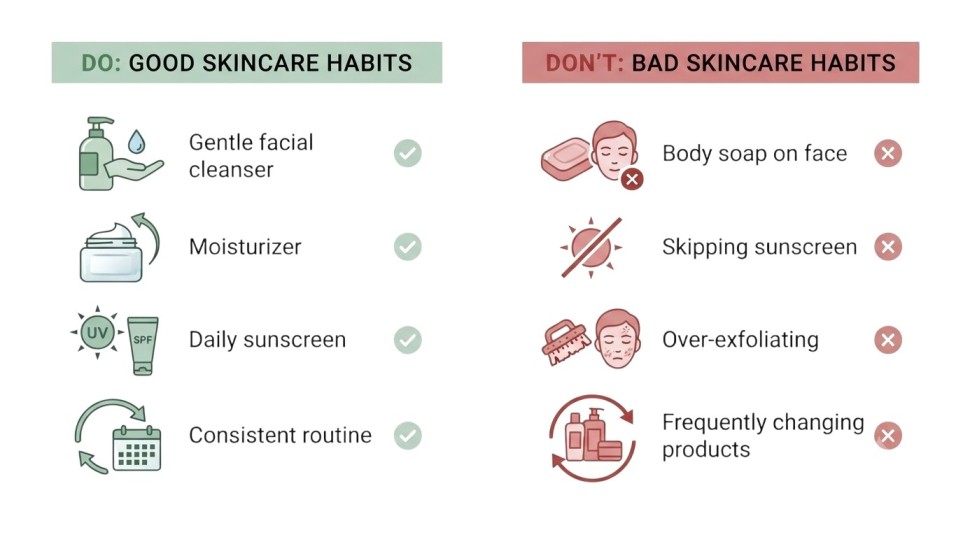
Give your routine at least 4–8 weeks before judging changes in skin tone, texture, or overall comfort. If you use a retinoid, mild dryness or flaking may occur during the first few weeks, while visible improvements can take 8–12 weeks. Sunscreen works mainly by preventing future UV damage, so its benefits are long-term rather than immediately visible.
Myth vs Fact
| Myth | Fact |
|---|---|
| Normal skin doesn’t need a skincare routine. | Normal skin still benefits from cleansing, moisturizing, and daily sun protection. |
| You only need sunscreen on sunny days. | UV exposure can occur even when it is cloudy, so daily broad-spectrum SPF 30+ is recommended. |
| If your skin isn’t dry, you don’t need moisturizer. | Moisturizer helps support the skin barrier even when your skin doesn’t feel dry. |
| Washing your face more often keeps normal skin healthier. | Over-cleansing can strip the skin barrier and cause dryness or irritation. |
| Cold water closes your pores. | Water temperature does not open or close pores. |
| Expensive skincare products work better. | The ingredients and formulation matter more than the price. |
| Exfoliating every day gives smoother skin. | Over-exfoliation can irritate the skin and damage the barrier. |
| Retinol is essential for every man over 25. | Retinoids can help with certain concerns, but they are optional and not necessary for everyone. |
| Natural ingredients are always safer for normal skin. | Natural does not automatically mean gentle or suitable for every skin type. |
| If a product burns, it means it is working. | Burning or persistent irritation can indicate that the product is damaging or irritating the skin. |
Quick Action Checklist
- Cleanse morning and night with a gentle, low-foam facial cleanser
- Moisturize right after cleansing, both morning and night
- Apply broad-spectrum SPF 30+ every morning, year-round
- Exfoliate only 1–2 times a week, if at all
- If adding a retinoid, start at 2–3x/week and calibrate expectations to the modest, mixed evidence for OTC formulations
- Patch test any new product before applying it to your face
- Give a routine 4–8 weeks before judging whether it’s working
Conclusion
A normal skin care routine for men doesn’t need to be complicated, and it doesn’t need every product a shelf display suggests. Cleanse, moisturize, protect—that’s the part with the clearest evidence and the highest return for the least effort. Everything past that is optional, useful in proportion to what the research actually shows, and worth adding only once the basics are boring and automatic.
Starting from scratch? Run the three core steps for a full month before adding anything else. That gives your skin and you enough time to tell what, if anything, it’s actually missing.
Consistency matters far more than using more products.
Frequently Asked Questions
How many steps should a normal skin routine really have?
Three: cleanser, moisturizer, sunscreen. Exfoliant and retinoid are optional additions based on goals, not requirements.
Do I need different products for morning and night?
Sunscreen is morning-only. Any retinoid or exfoliant is generally used at night, since some ingredients break down in sunlight or increase sun sensitivity.
Can I skip moisturizer if my skin never feels dry?
Not recommended—moisturizer supports the barrier that cleansing disrupts, which matters even when skin doesn’t feel visibly dry.
Does retinol actually work, or is it mostly marketing?
Both, depending on the product. Prescription tretinoin has solid trial support for fine wrinkles. Over-the-counter retinol has a real but smaller and more contested evidence base — some placebo-controlled trials found no significant difference at all.
Can normal skin change to oily or dry over time?
Yes—age, climate, hormones, and stress can all shift skin type, which is why it’s worth reassessing periodically rather than assuming it stays fixed.
Do men with normal skin need a toner?
Usually not. A toner isn’t an essential step for normal skin unless it addresses a specific concern. For most men, cleanser, moisturizer, and sunscreen are enough.
Authoritative Sources
- American Academy of Dermatology (AAD) — Skin Care Basics
https://www.aad.org/public/everyday-care/skin-care-basics - Mayo Clinic — Skin Care: 5 Tips for Healthy Skin
https://www.mayoclinic.org/healthy-lifestyle/adult-health/in-depth/skin-care/art-20048237 - NHS — Sunscreen and Sun Safety
https://www.nhs.uk/live-well/seasonal-health/sunscreen-and-sun-safety/ - Annals of Internal Medicine — Sunscreen and Prevention of Skin Aging: A Randomized Trial (2013)
https://www.acpjournals.org/doi/10.7326/0003-4819-158-11-201306040-00002 - Scientific Reports (Nature) — Comparative Efficacy of Topical Interventions for Facial Photoaging: A Network Meta-analysis (2025)
https://www.nature.com/articles/s41598-025-88591-9 - Journal of Clinical and Aesthetic Dermatology — Evidence for the Efficacy of Over-the-counter Vitamin A Cosmetic Products in the Improvement of Facial Skin Aging: A Systematic Review (2021)
https://jcadonline.com/otc-vitamin-a-facial-skin-aging-systematic-review/