Quick Summary:
“Dry skin isn’t just uncomfortable — it makes skin look dull, flaky, and older than it should. This guide walks through a complete dry skin care routine for men, built around one central insight: dry skin is a barrier problem, not a water problem. Every step in this routine either protects the barrier you have or rebuilds the one you’ve lost. If you’ve tried moisturizing and nothing seems to stick, this is why.”
Most men with dry skin are making it worse before they’ve had coffee. A dry skin care routine for men has to fix that starting point, not just compensate for it with better products.
The hot shower, the body wash used on the face, the alcohol-based aftershave; each one strips the skin barrier a little further. By the time the day starts, the skin is already in recovery mode. Adding moisturizer on top of that cycle helps, but it doesn’t solve anything.
This dry skin care routine for men works differently. It addresses what’s causing the problem first, then builds a routine that protects and repairs the barrier rather than chasing it. You’ll learn which steps matter and exactly why each one belongs in your routine; so you’re not just following instructions, you understand what’s actually happening to your skin.
Table Of Contents
What Is Dry Skin in Men?
Dry skin is a barrier problem. The skin’s outer layer loses moisture faster than it can be replaced; not because of insufficient water intake, but because the lipid barrier holding moisture in has been weakened. In men, this worsens with harsh cleansers, daily shaving, and dry indoor air. Signs include tightness after washing, flaking, rough texture, and a dull complexion.
If only certain areas of your face feel dry while your forehead, nose, or chin become oily, you may have combination skin rather than dry skin. In that case, a Combination Skincare Routine for Men will help you care for different areas of your face more effectively.
Common Signs of Dry Skin
Most men with dry skin experience more than one symptom. Common signs include:
- Tightness after washing
- Flaky or peeling skin
- Rough texture
- A dull complexion
- Itching or irritation
- Skin that feels dry again shortly after moisturizing
The more of these signs you notice, the more likely it is that your skin barrier needs consistent support rather than stronger products.
Why Dry Skin in Men Is a Barrier Problem, Not a Water Problem
Men’s skin is structurally thicker than women’s and produces more sebum naturally. Those facts lead many men to assume their skin is self-sufficient. But sebum and barrier lipids are two different things.
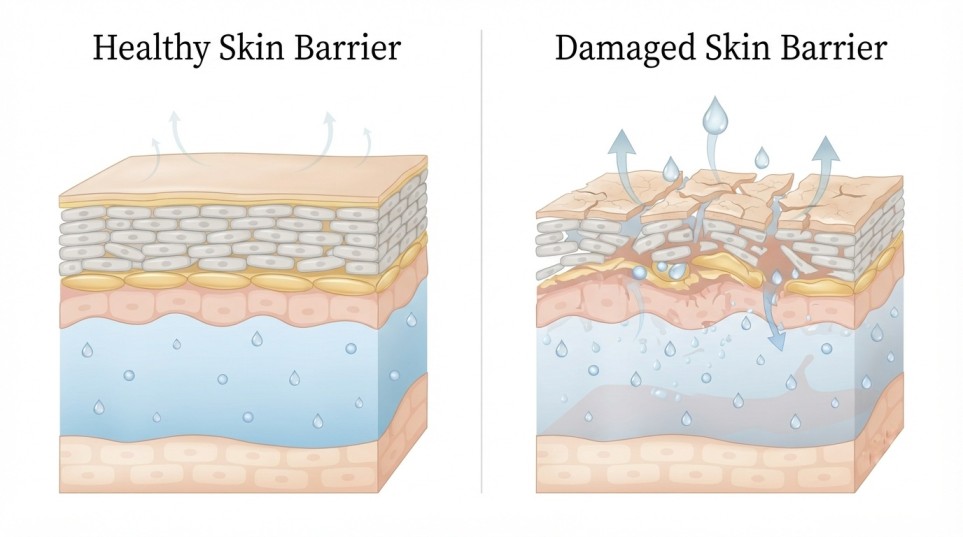
Sebum is the oil produced by sebaceous glands, it sits on the surface. The skin barrier is made up of structural lipids, primarily ceramides, that exist between skin cells and control how much moisture stays locked in. When those lipids are depleted through harsh cleansing, hot water, or chronic neglect, moisture escapes throughout the day regardless of how much water is consumed internally.
This is why simply drinking more water is unlikely to resolve persistent dry skin on its own. Protecting and supporting the skin barrier with appropriate topical care is a more direct approach.
The most common culprits for men are hot showers that dissolve the lipid layer daily, bar soap or body wash used on the face, alcohol-based aftershave applied after every shave, and dry indoor air from heating or air conditioning. Most men don’t connect these habits to their skin, which is exactly why the damage accumulates quietly. Before starting a routine, it’s worth making sure you’re actually working with dry skin and not a combination type; How To Find Your Skin Type: Oily, Dry and Combination Skin Explained Simply walks through the differences clearly so you’re not treating the wrong condition.
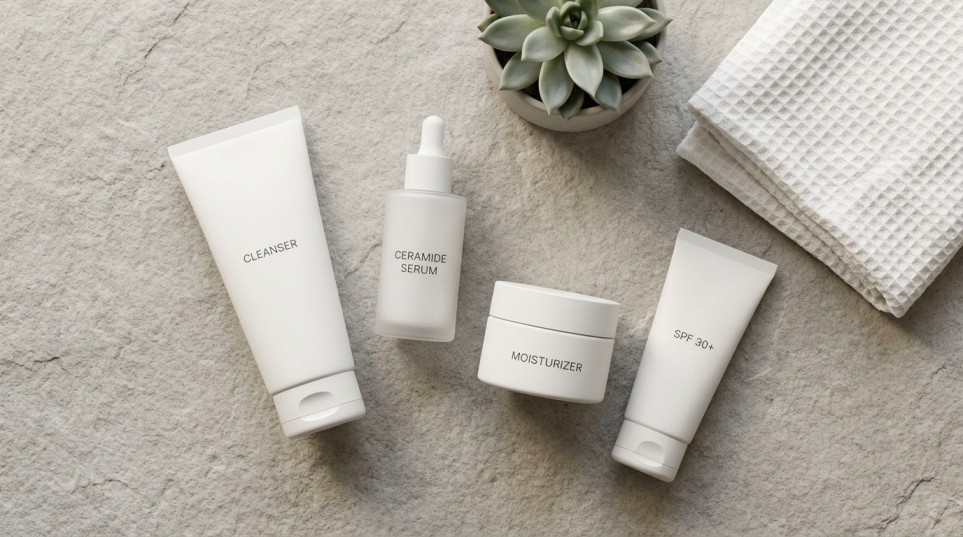
The routine that follows divides into two distinct jobs. The morning protects the barrier you have — cleaning gently, locking in moisture, and guarding against UV damage before the day begins. The evening repairs what the day took from it — removing residue fully, restoring barrier lipids with targeted actives, and sealing everything in while the skin does its overnight work. Every step belongs to one of those two functions.
| STEP | MORNING | EVENING |
| Cleanser | Gentle Cleanser | Pre-cleanse + Gentle Cleanser |
| Hydration | Hydrating Toner | Ceramide Serum |
| Moisturizer | Lightweight/Rich Moisturizer | Rich Night Moisturizer |
| Protection | SPF 30+ | – |
The Morning Routine: Protecting the Barrier You Have
Step 1: Cleanse Without Stripping
The cleanser is where most dry skin routines quietly fail before they start. Phrases like “deep clean” and “pore purifying” signal a product designed to remove oil aggressively. Dry skin doesn’t need that.
Look for cream or milk cleansers labeled gentle, hydrating, or suitable for sensitive skin. The ingredient list should include glycerin or ceramides somewhere near the top. Sodium lauryl sulfate (SLS) can be irritating, particularly for dry or sensitive skin. If your cleanser leaves your skin feeling tight, dry, or uncomfortable after washing, consider switching to a gentler, fragrance-free formula. Fragrances, even in products that claim to be gentle, are among the most consistently documented skin irritants in patch-test literature and are worth avoiding in a cleanser for dry or reactive skin.
Use lukewarm water, never hot. Rinse with lukewarm water and avoid very hot water, which can worsen dryness and irritation.
Step 2: Press In a Hydrating Toner
Most men skip toner because traditional toners were astringents; high-alcohol products designed to strip oil and tighten pores. Those have no place in a dry skin routine. A hydrating toner is an entirely different product.
Sometimes called a hydrating essence or first essence, a good hydrating toner contains ingredients like hyaluronic acid, glycerin, panthenol (Vitamin B5), and niacinamide. These ingredients help increase hydration and can support the skin barrier before moisturizer is applied.. Think of it as the moisture foundation the moisturizer then locks in.
Apply with clean hands by pressing gently into the skin rather than rubbing. Applying a hydrating toner with clean hands can reduce unnecessary product waste and allows you to spread it gently over the skin.
Step 3: Moisturize While Skin Is Still Damp
This is the step where most men lose the most benefit through timing alone.
Moisturizers help increase and maintain skin hydration through a combination of humectants, emollients, and occlusives. Applying them while skin is still slightly damp can help reduce moisture loss. If you wait until your face is completely dry before applying it, there’s very little moisture left to seal in — it has already evaporated. The American Academy of Dermatology recommends what’s often called the “soak and seal” method — applying moisturizer within minutes of washing while skin is still slightly damp. This one timing change, before any product switch, meaningfully improves results.
The most effective moisturizers for dry skin contain three types of ingredients working together. Humectants like hyaluronic acid and glycerin draw moisture into the skin from the environment and from deeper skin layers. Emollients like squalane, jojoba oil, and shea butter fill gaps in the barrier and create a smooth, soft surface. Occlusives like dimethicone create a physical seal on the surface that prevents moisture from leaving. For dry skin, a moisturizer that combines humectants, emollients, and occlusives can provide more complete hydration and barrier support than a formula that relies mainly on humectants. This is why creams and balms are often better suited to dry skin than lightweight gel formulas. Creams and balms are the appropriate format.
Step 4: Apply SPF as the Final Morning Step
UV exposure breaks down collagen and degrades the skin barrier incrementally with each year of unprotected exposure. Men with dry skin who skip SPF are accelerating barrier deterioration in a way that compounds over time, skin becomes progressively drier and more reactive rather than improving.
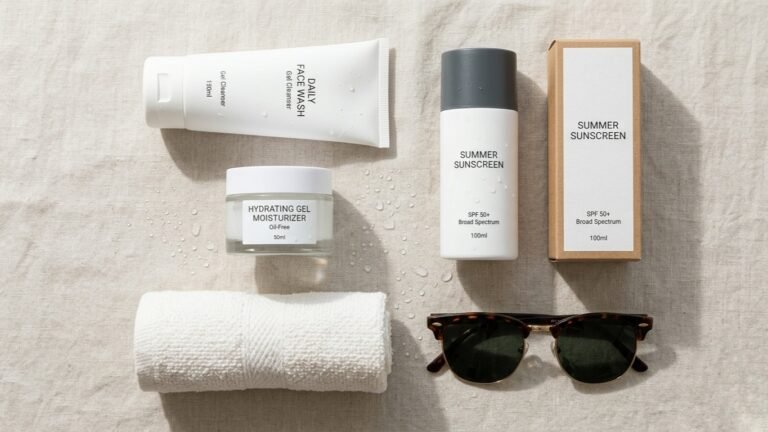
Choose an SPF 30 or higher formula that includes moisturizing properties. The label should include at least one humectant or barrier-supportive ingredient alongside the UV filters. Alcohol-heavy SPF sprays can be drying and are worth avoiding for this skin type. SPF requirements also shift with the season, and heat brings its own adjustments to the routine — A Simple Summer Skincare Routine For Men covers what to change when temperature and humidity become factors.
The Evening Routine: Repairing and Rebuilding Overnight
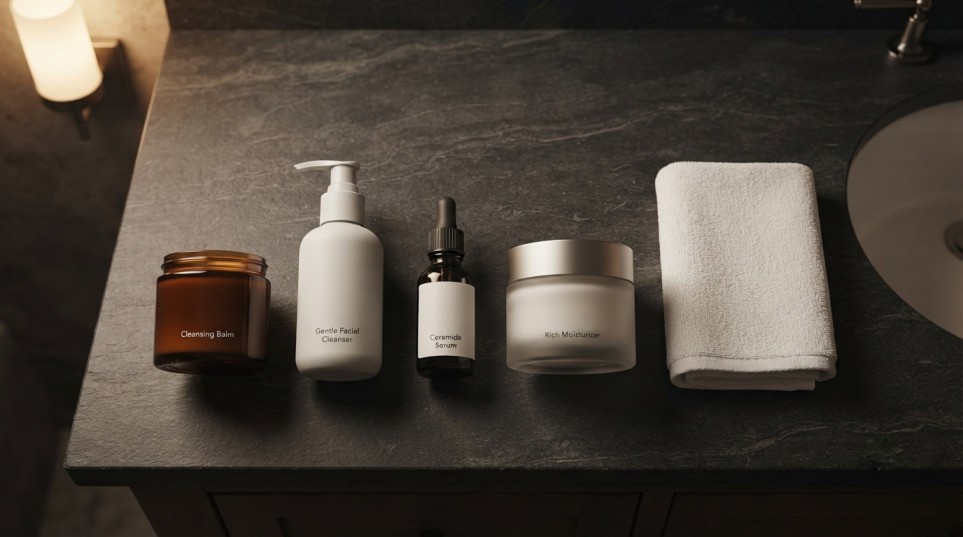
Step 5: Pre-Cleanse to Remove SPF Before Washing
If SPF was worn during the day, and it should have been a single gentle cleanser may not remove it fully. Residual SPF left on skin overnight creates a film that reduces absorption of everything applied after it, undermining the entire evening routine.
A pre-cleanse takes about 30 seconds. Apply a small amount of cleansing balm or micellar water to dry skin, massage briefly, then rinse. Follow with the regular gentle cleanser. Skin is now genuinely clean in a way that lets evening products absorb the way they’re meant to.
Step 6: Apply a Barrier-Repairing Serum
Serums contain higher concentrations of active ingredients than moisturizers, which makes this the most efficient place in the routine to address barrier repair directly. For dry skin, three ingredients earn their place here more than any others.
Ceramides are the most important. The skin barrier is structurally composed of ceramide lipids — molecules that sit between skin cells and regulate how much moisture stays inside. Research published in the Journal of Investigative Dermatology has documented that ceramide concentrations in the outer skin layer decline measurably with age and UV exposure, and that topical ceramide formulations can restore measurable barrier function within weeks of consistent use. Look for ceramides listed explicitly, often labeled ceramide NP, AP, or EOP.
Multi-weight hyaluronic acid is the next most valuable inclusion. Hyaluronic acid molecules exist in different sizes, and products that include more than one molecular weight deliver hydration at multiple skin depths simultaneously rather than only at the surface.
Peptides can be a useful addition to a skincare routine, although their benefits depend on the specific peptide and formulation.
Apply three to five drops to clean, slightly damp skin. Press gently into the skin rather than rubbing vigorously, especially if your skin is already dry or irritated.
Step 7: Seal Everything In with a Rich Night Moisturizer
Evening is the right time for a thicker moisturizer than the one used in the morning. Daytime products sit under SPF and need to be light enough not to interfere with its application. At night, there’s no such constraint.
A rich cream or overnight sleeping mask creates an occlusive layer that seals in the serum and barrier ingredients while the skin repairs itself. For men with very dry or persistently compromised skin, applying a thin layer of petroleum jelly over the moisturizer as the final step can help reduce moisture loss and support barrier repair. Occlusive barriers are among the most consistently effective interventions for reducing transepidermal water loss (TEWL) in clinical literature — petrolatum in particular has demonstrated the highest occlusive efficacy of any commonly available ingredient in comparative dermatological studies.
Two Weekly Practices That Compound Your Results
Exfoliate Once a Week with a Chemical Exfoliant
Dry skin can develop a buildup of flaky, dead skin cells, which can make the skin feel rough and uneven. Gentle exfoliation can help remove this surface buildup without adding unnecessary irritation. Clearing it once a week makes every step of the daily routine work noticeably better.
Chemical exfoliants like lactic acid or a mild alpha-hydroxy acid dissolve the bonds between dead skin cells without abrasion. Lactic acid is particularly suited to dry skin because it also acts as a humectant; it hydrates while it clears, rather than creating additional dryness in the process.
Physical scrubs with coarse particles are worth avoiding entirely. They cause microscopic damage to already-compromised skin, worsen flaking, and give the barrier additional repair work on top of what it’s already managing. One session of gentle chemical exfoliation per week is what dry skin needs. More than that makes things worse.
Run a Humidifier in Your Bedroom
Adding moisture to the air slows the rate at which moisture evaporates from skin throughout the night. For men who sleep in heated or air-conditioned rooms, this is one of the highest-impact additions to a dry skin routine that doesn’t involve a single new product. Skin that spends eight hours in a humidified environment wakes up in a meaningfully different condition than skin that spends eight hours in dry, conditioned air.
Dry Skin Myths vs Facts
| Myth | Fact |
|---|---|
| Drinking more water will fix dry skin. | Staying hydrated supports overall health, but persistent dry skin is often related to a weakened skin barrier. Moisturizers and gentle skincare habits directly help reduce moisture loss from the skin. |
| If your skin looks oily, it cannot be dry. | Oily-looking skin can still feel tight or dehydrated. Dry skin refers to reduced oil and lipids, while dehydration refers to reduced water content. Both can occur at the same time. |
| Hot water is better for cleansing dry skin. | Hot water can strip surface oils and worsen dryness or irritation. Lukewarm water is a better choice for cleansing dry or sensitive skin. |
| You need to exfoliate flaky skin more often. | More exfoliation is not necessarily better. Over-exfoliating can further irritate a weakened barrier. Dry skin usually benefits from gentle, limited exfoliation rather than frequent scrubbing. |
| A thicker layer of moisturizer always gives better results. | More product does not automatically mean better hydration. A well-formulated moisturizer containing humectants, emollients, and occlusives can support the barrier without requiring a heavy layer. |
| Natural oils are always better for dry skin. | Natural does not automatically mean better or safer. Some oils can help reduce moisture loss and soften the skin, but their suitability depends on the individual oil, formulation, and skin type. |
| Moisturizer is only necessary during winter. | Dry indoor air from heating or air conditioning can worsen dryness at any time of year. Consistent moisturizing helps support the skin barrier regardless of the season. |
| Men need different skincare ingredients from women. | Skin responds to effective ingredients regardless of gender. Ingredients such as ceramides, glycerin, hyaluronic acid, and occlusives can benefit dry skin in both men and women. What matters more is the formulation and how well it suits the skin. |
Quick Action Checklist
- Switch to a fragrance-free, sulfate-free gentle cleanser
- Apply moisturizer within a few minutes of washing while skin is still slightly damp.
- Choose a moisturizer that combines humectants, emollients, and occlusives.
- Add a ceramide serum to the evening routine to rebuild the barrier over time.
- Replace alcohol-based aftershave with an alcohol-free aftershave balm
- If your skin tolerates exfoliation, use a gentle lactic acid or mild AHA no more than once a week, and avoid physical scrubs.
- Apply SPF 30 or higher every morning as the final step of the morning routine.
If your skin feels comfortable throughout the day without noticeable tightness, flaking, or excess oil, you may not need a barrier-focused routine like this one. A simpler Normal Skin Care Routine for Men may be enough to keep your skin healthy with fewer products.
Conclusion
Dry skin in men gets progressively worse when it’s ignored and progressively better when the barrier gets consistent support. The improvement isn’t dramatic overnight. With consistent care, dry skin can gradually become more comfortable, smoother, and less prone to flaking.
The dry skin care routine for men laid out here isn’t long because it doesn’t need to be. A gentle cleanser, a moisturizer applied on damp skin within 60 seconds of washing, a ceramide-containing serum in the evening, and SPF every morning are the four steps everything else builds on. The toner, weekly exfoliant, and overnight mask accelerate results, but the foundation is those four.
Start with the cleanser. If it leaves your skin feeling tight or dry after washing, consider switching to a gentler, fragrance-free formula. This simple change may help reduce ongoing dryness and irritation.
If your skin becomes painful, develops deep cracks, starts bleeding, or doesn’t improve after several weeks of consistent care, consult a dermatologist. Persistent dryness can sometimes be caused by conditions such as eczema or psoriasis that require medical treatment.
The skin barrier, given the right conditions, is genuinely capable of rebuilding itself. The routine is just those conditions.
Frequently Asked questions
How often should men with dry skin wash their face?
Twice a day with a gentle, hydrating cleanser is the right frequency. Washing more than twice strips the barrier faster than it can recover. For very dry or reactive skin, a plain lukewarm water rinse in the morning; skipping cleanser entirely is a legitimate approach that many dermatologists recommend. It removes overnight sebum and product residue without the disruption of a surfactant.
Can men with dry skin use face oils?
Yes, and for many men with dry skin, they’re among the most effective tools available. Face oils work best as the final step in an evening routine, applied after moisturizer, not before, to add an additional occlusive layer that seals everything beneath it. Squalane is particularly well-tolerated because it closely mimics the skin’s own natural lipids without feeling heavy or greasy, making it a strong starting point for men who haven’t used face oils before.
Is dry skin in men genetic?
Partially. Some men inherit a naturally lower ceramide production rate or a structurally thinner barrier, which makes them more prone to moisture loss across their lifetime. A genetic tendency doesn’t mean dry skin can’t be managed effectively, it means the routine needs to consistently replace what the skin doesn’t produce on its own. A consistent barrier-focused routine can help manage dryness even when someone is naturally more prone to it.
Why does skin feel tight specifically after washing?
That post-wash tightness is one of the clearest signals that a cleanser is too harsh for the skin type. It means the product removed barrier lipids along with dirt and oil. If a cleanser leaves your skin feeling tight after washing, its surfactants may be contributing to the problem. If SLS is high on the ingredient list, switching to a gentler cleanser may help. Switching to a gentler, hydrating cleanser may help reduce post-wash tightness and dryness.
Can nutritional deficiencies contribute to dry skin in men?
They can. Certain nutritional deficiencies can affect skin health and may contribute to dryness or other skin changes. If persistent dryness does not improve with consistent topical care, it is better to discuss possible underlying causes with a doctor or dermatologist rather than assuming a nutritional deficiency is responsible. If a consistent topical routine hasn’t produced meaningful improvement after six to eight weeks, it’s worth discussing nutritional factors with a doctor or dermatologist rather than assuming more products are the missing piece.
Authoritative Sources
- American Academy of Dermatology (AAD): Dry Skin — Diagnosis & Treatment
- American Academy of Dermatology (AAD): Dermatologists’ Top Tips for Relieving Dry Skin
- DermNet NZ: Dry Skin (Xeroderma/Xerosis)
- American Academy of Dermatology (AAD): Dry Skin — Who Gets and Causes
- PubMed: Ceramides and Barrier Function in Healthy Skin