Quick Summary
Knowing your skin type makes it much easier to choose the right skincare products and build a routine that actually suits your skin. This guide shows you how to identify oily, dry, combination, or normal skin with simple at-home methods, explains the signs to look for, and shows how your skin type should influence your cleanser, moisturizer, and other skincare choices.
If you have ever bought a skincare product because it worked for someone else, only to find that it does very little for your skin, your skin type may be part of the reason.
Oily, dry, combination, and normal skin have different needs. A moisturizer that feels comfortable on dry skin may feel too heavy on oily skin, while a cleanser that works well for oily skin may leave dry skin feeling tight.
The good news is that how to find your skin type is simpler than it sounds. With a gentle cleanse, a short period of observation, and a little attention to how your skin behaves, you can get a good idea of whether you have oily, dry, combination, or normal skin.
Once you know your skin type, choosing products and building a basic routine becomes much easier.
Table Of Contents
What Is Skin Type, Really?
Your skin type describes how your skin naturally behaves, mainly based on how much oil it produces and how well it holds onto moisture.
It is different from a skin condition. Acne, redness, irritation, and dehydration can affect any skin type and may change over time. Your skin type is more about how your skin usually behaves when it is not being affected by a temporary change or a specific condition.
The four commonly recognized skin types are oily, dry, combination, and normal. Understanding which one you have can make it easier to choose skincare products that suit your skin instead of simply following what works for someone else.
Skin type can also change gradually with age, hormones, weather, and other factors. So you do not need to force your skin into one perfect category. The goal is simply to understand your skin’s usual pattern and build your routine around it.
What Is the Easiest Way to Find Your Skin Type?
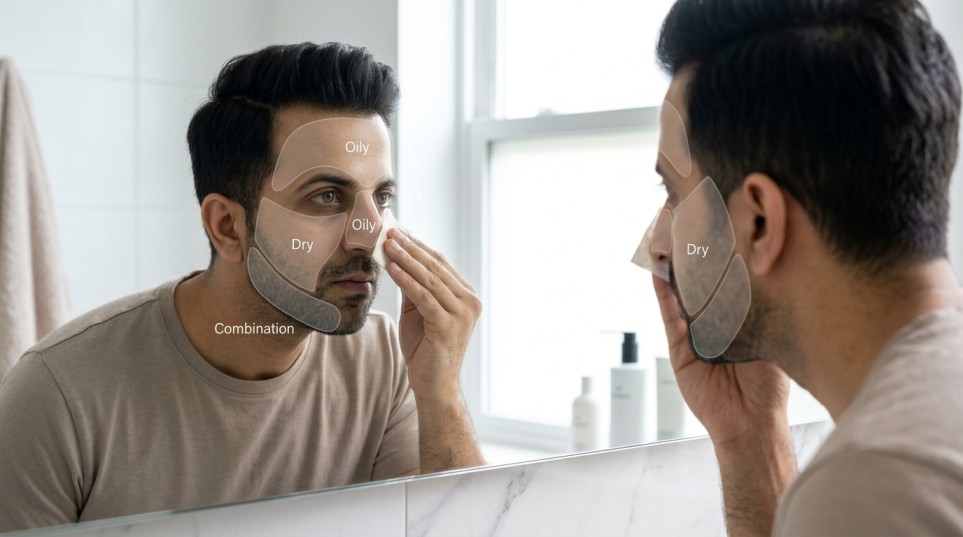
The easiest way to find your skin type at home is to wash your face with a gentle cleanser, leave your skin bare for about an hour, and observe how it looks and feels.
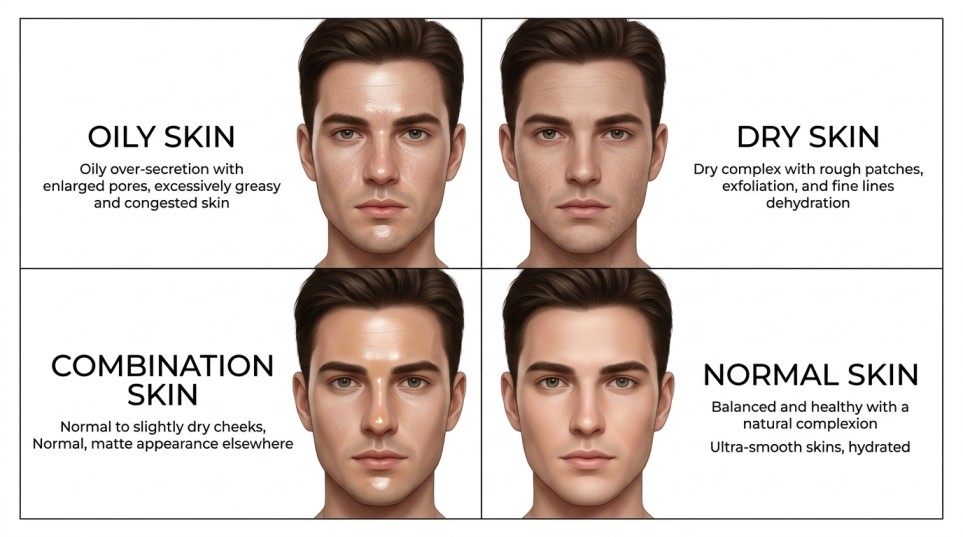
- Oily skin: Your face becomes noticeably shiny or greasy across most areas.
- Dry skin: Your skin feels tight, rough, or uncomfortable.
- Combination skin: Your T-zone becomes oily while your cheeks feel normal or dry.
- Normal skin: Your skin feels comfortable and balanced, without obvious excess oil or dryness.
For a more reliable result, do the test on a normal day and repeat the observation over several days rather than relying on a single reading.
How to Find Your Skin Type: Three Methods That Actually Work
Method 1: The Bare-Face Test

This is the simplest way to get a good idea of your skin type at home.
- Wash your face with a gentle cleanser and pat it dry.
- Do not apply moisturizer, serum, toner, sunscreen, or other skincare products.
- Wait for about an hour and observe how your skin feels and looks.
- Check your forehead, nose, chin, and cheeks in natural light.
Look for these signs:
- Shiny or greasy across most areas: Oily skin
- Tight, rough, or uncomfortable: Dry skin
- Oily T-zone with normal or drier cheeks: Combination skin
- Comfortable and balanced: Normal skin
The exact timing is less important than giving your skin enough time to return to its usual state after cleansing.
Method 2: The Blotting Paper Test
Blotting paper can give you a quick indication of how much oil your skin is producing.
After cleansing, wait about an hour and gently press blotting paper against your forehead, nose, chin, and cheeks. Compare how much oil appears on each area.
- Oil across most areas: More likely oily skin
- Very little oil: More likely dry skin
- Oil mainly from the T-zone: More likely combination skin
- A small, fairly even amount of oil: More likely normal skin
This method is useful as a quick check, but it should not be treated as a precise test on its own.
Method 3: Observe Your Skin Over Time
A single test only shows how your skin behaves on one particular day. Pay attention to your skin over the next couple of weeks as well.
Notice whether your skin consistently becomes oily, feels dry or tight, or behaves differently in different areas of your face. Also consider whether weather, new products, or changes in your routine are affecting it.
A repeated pattern is more useful than one unusual day. If your skin consistently behaves the same way, you can be more confident about your skin type.
Signs of Each Skin Type
Oily Skin
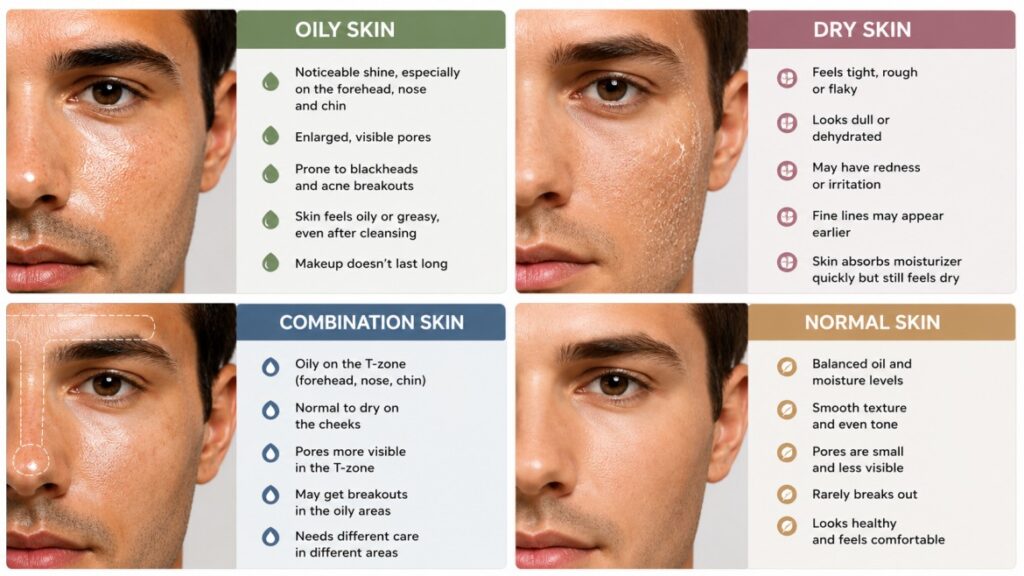
Oily skin produces more sebum, which can make the face look shiny or greasy, especially a few hours after cleansing. Pores may also appear more noticeable, and excess oil can contribute to clogged pores and breakouts.
Common signs:
- Noticeable shine or greasiness across much of the face
- More visible pores, particularly around the nose and forehead
- Frequent blackheads or breakouts
- Blotting paper picks up oil from several areas
If these signs sound familiar, an oily-skin routine should focus on controlling excess oil without leaving the skin dry or irritated. Our Oily Skincare Routine for Men guide covers the basics, including cleanser, moisturizer, sunscreen, and useful ingredients.
Dry Skin
Dry skin produces less oil and often feels tight or uncomfortable, particularly after cleansing. It may also look dull or develop rough or flaky areas.
Common signs:
- Tightness after washing
- Rough or flaky patches
- Dull-looking skin
- Skin that feels uncomfortable without moisturizer
- Fine lines that appear more noticeable when the skin is dry
Dry skin is different from dehydrated skin. Dry skin is a skin type, while dehydration is a temporary lack of water that can affect any skin type.
If your skin consistently feels dry, our Dry Skincare Routine for Men guide explains how to build a routine focused on hydration and skin-barrier support.
Combination Skin
Combination skin has different oil levels in different areas of the face. The T-zone — forehead, nose, and chin — is usually oilier, while the cheeks may feel normal or dry.
Common signs:
- Oily or shiny T-zone
- More visible pores around the nose and forehead
- Cheeks that feel comfortable, normal, or slightly dry
- Products that feel too heavy in some areas but not enough in others
The main mistake with combination skin is treating the entire face as though it has the same needs. A balanced routine can use lighter products on oilier areas and more moisturizing products where the skin feels dry.
Our Combination Skincare Routine for Men guide explains how to manage both areas without overcomplicating your routine.
Normal Skin
Normal skin is relatively balanced. It does not consistently feel excessively oily or dry, and it usually tolerates basic skincare products without much trouble.
Common signs:
- Comfortable, balanced skin
- Little persistent shine or tightness
- Few recurring blemishes
- Relatively small or less noticeable pores
- Skin that generally responds well to a simple routine
Normal skin does not need a complicated routine. Gentle cleansing, moisturizer, and daily sunscreen are usually enough to maintain healthy skin.
Our Normal Skincare Routine for Men guide covers a simple routine for maintaining balanced skin.
What Your Skin Type Actually Means for Your Routine
Knowing your skin type is useful because it gives you a starting point for choosing products. You do not need a completely different routine for every skin type, but some formulas and ingredients may suit you better than others.
Oily Skin
Choose lightweight products that help manage excess oil without leaving your skin feeling stripped.
A gentle cleanser, lightweight non-comedogenic moisturizer, and daily sunscreen are good basics. Ingredients such as niacinamide and salicylic acid can also be useful depending on your skin concerns, particularly excess oil and clogged pores.
The goal is not to remove every trace of oil. Overly aggressive cleansing can leave your skin dry and irritated.
Dry Skin
Focus on keeping the skin comfortable and supporting the skin barrier.
A gentle, non-stripping cleanser and a richer moisturizer can help. Look for ingredients such as ceramides, glycerin, and squalane, which can help support hydration and the skin barrier.
If you also want to treat dark spots or uneven texture, introduce active ingredients carefully. Using too many strong treatments at once can increase dryness and irritation.
Combination Skin
Combination skin usually benefits from a flexible approach rather than treating the whole face exactly the same way.
Use a gentle cleanser across the face, then adjust your moisturizer depending on the area. You may prefer a lighter layer on the oily T-zone and a little more moisturizer on drier areas.
Target treatments such as salicylic acid can also be used mainly where clogged pores or excess oil are a problem rather than automatically applying them everywhere.
Normal Skin
Normal skin generally does not need a complicated routine.
A gentle cleanser, moisturizer, and broad-spectrum sunscreen are enough for a basic routine. Additional products can be added when you have a specific concern, but there is no need to keep adding steps simply because they are popular.
The main goal is consistency and protecting the skin rather than constantly trying to change it.
Mistakes People Make When Identifying Their Skin Type
Getting your skin type right is easier when you avoid a few common mistakes.
Testing immediately after washing: Your skin may feel temporarily tight after cleansing. Give it some time before deciding that you have dry skin.
Confusing a skin condition with your skin type: Acne, redness, irritation, and dehydration can affect any skin type. Do not use one temporary problem to label your entire skin type.
Testing when your skin is unusually affected: A new skincare product, illness, travel, or a change in weather can temporarily alter how your skin feels. Try to assess it when your routine and circumstances are fairly normal.
Judging your skin from one day: Skin can behave differently depending on the weather, stress, and your routine. Look for a consistent pattern over several days rather than relying on one observation.
Assuming your skin type never changes: Skin can become more or less oily or dry over time due to age, hormones, climate, and other factors. Reassess it when your skin’s usual behavior changes.
Common Myths vs Facts About Skin Type
| Myth | Fact |
|---|---|
| Oily skin does not need moisturizer. | Oily skin still needs hydration. A lightweight, non-comedogenic moisturizer can help maintain the skin barrier without adding unnecessary heaviness. |
| If your skin feels tight after washing, you have dry skin. | Not necessarily. A harsh cleanser can temporarily leave any skin type feeling tight. Look at how your skin normally behaves after cleansing and throughout the day. |
| Acne-prone skin is a separate skin type. | Acne is a skin condition, not one of the four basic skin types. Oily, dry, combination, or normal skin can all experience acne. |
| Your skin type stays the same for life. | Skin can become more or less oily or dry with age, hormones, weather, and other changes. |
| If your T-zone is oily, your whole face is oily. | Not always. If your T-zone is oily while your cheeks are normal or dry, you may have combination skin. |
| Dry skin and dehydrated skin are the same thing. | No. Dry skin is a skin type associated with lower oil production, while dehydration means the skin is lacking water and can affect any skin type. |
Quick Action Checklist
- Wash your face with a gentle cleanser and leave your skin bare for about an hour.
- Check how your forehead, nose, chin, and cheeks feel and look.
- Look for a consistent pattern rather than relying on one unusual day.
- Identify whether your skin is oily, dry, combination, or normal.
- Remember that acne, redness, irritation, and dehydration are conditions—not skin types.
- Choose a cleanser and moisturizer that match how your skin behaves.
- Use sunscreen every morning, regardless of your skin type.
- Avoid changing several skincare products at once while trying to understand your skin.
- Reassess your skin type if its usual behavior changes significantly with age, weather, or other factors.
Conclusion
Finding your skin type does not need to be complicated. A simple bare-face test, followed by a few days of observation, can usually give you a good idea of whether your skin is oily, dry, combination, or normal.
Once you know how your skin normally behaves, choosing skincare products becomes easier. You can look for formulas that support your skin rather than buying products simply because they work for someone else.
Remember that skin type is not a permanent label. Age, hormones, weather, and skincare habits can change how your skin behaves over time.
Start with the basics, pay attention to how your skin responds, and adjust your routine when your skin’s needs change.
frequently Asked Questions
Can your skin type change as you get older?
Yes. Skin can become more or less oily or dry over time due to factors such as age, hormonal changes, and changes in the skin barrier. These changes usually happen gradually rather than overnight.
My skin seems like two different types at the same time. What does that mean?
You may have combination skin. If your T-zone becomes oily while your cheeks feel normal or dry, your skin has characteristics of both oily and dry skin.
I have oily skin but sometimes my face feels tight. Is that possible?
Yes. Oily skin can still become dehydrated or irritated, particularly after over-cleansing or using products that are too harsh. In that situation, reducing irritation and using a suitable lightweight moisturizer can help.
Does skin type affect which sunscreen I should use?
Your skin type can influence which sunscreen formula feels most comfortable, but the most important thing is choosing a broad-spectrum sunscreen with adequate SPF and using it consistently. Oily skin may prefer a lighter or less greasy formula, while dry skin may be more comfortable with a moisturizing one.
What is the best moisturizer for my skin type?
For dry skin, look for moisturizing and barrier-supporting ingredients such as glycerin, ceramides, or squalane. Oily skin often does well with a lightweight, non-comedogenic moisturizer. Combination skin may benefit from using different amounts in different areas, while normal skin can usually use a simple balanced moisturizer.
Can stress change my skin type?
Stress can affect how your skin behaves, but it does not necessarily change your underlying skin type. It may temporarily increase oiliness, dryness, irritation, or breakouts, making your skin appear different from its usual baseline.
My skin behaves differently in summer and winter. Which skin type should I trust?
Both observations can be useful. Weather and humidity can temporarily affect oil production and hydration, so look for the pattern that remains consistent over time rather than judging your skin from one season or one day.
Authoritative Sources
- American Academy of Dermatology Association (AAD). Skin Care Basics
- Mayo Clinic. Dry Skin: Symptoms and Causes
- Cleveland Clinic. Sebaceous Glands: Function, Disorders & Treatment
- National Institute of Arthritis and Musculoskeletal and Skin Diseases (NIAMS). Skin Diseases